This post contains affiliate links. As an Amazon Associate I earn from qualifying purchases.
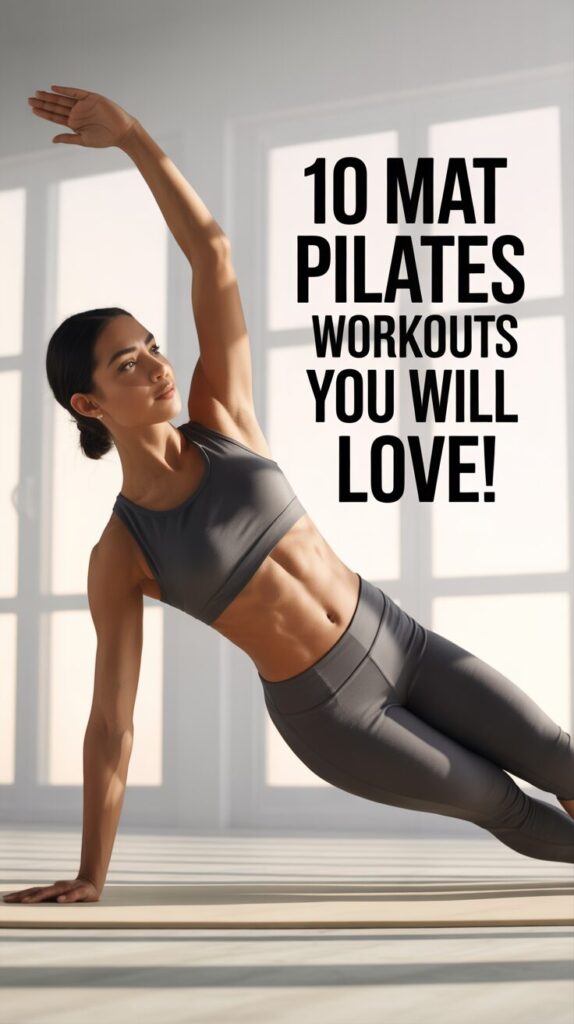
You’ll transform your body with these ten mat Pilates exercises that require no equipment. Start with The Hundred to energize your core, then massage your spine with Rolling Like a Ball. Strengthen your abs through Single Leg Stretch and sculpt your waist with Criss-Cross. Build endurance with Swimming, target your hips in the Side Leg Series, and enhance flexibility with Spine Stretch Forward. Bridge activates your glutes while Mermaid Stretch improves lateral movement. Each exercise below breaks down exactly how to master these foundational movements.
Key Takeaways
- The Hundred builds core strength and circulation through 100 arm pumps while holding a curl-up position with breath control.
- Rolling Like a Ball massages the spine and challenges balance through controlled rolling movements that promote spinal health.
- Single Leg Stretch strengthens the core and improves hip mobility through slow, deliberate movements with rhythmic breathing patterns.
- Criss-Cross sculpts obliques and builds rotational power by twisting the torso toward opposite knees with extended legs.
- Bridge activates glutes and articulates the spine segment by segment, reducing tension while building core stability and flexibility.
The Hundred: Classic Core Energizer
When Joseph Pilates designed The Hundred nearly a century ago, he created what would become the signature warm-up for mat Pilates sessions worldwide. You’ll perform 100 arm pumps while holding a demanding curl-up position, coordinating five pumps per inhale and five per exhale across ten complete cycles.
This exercise builds exceptional core stability by engaging your transverse abdominis, obliques, and rectus abdominis simultaneously. Your legs extend at varying heights depending on your level—feet planted for beginners, tabletop for intermediates, or 45 degrees for advanced practitioners. The movement also activates your arms and shoulders along with your inner thighs, glutes, and hip flexors for comprehensive muscle engagement.
The Hundred develops breath control through structured breathing patterns while increasing circulation and cardiovascular stimulation. Keep your lower back rooted, pump your arms vigorously at hip height, and maintain a neutral neck position. Quality trumps range—modify immediately if your abdominal engagement weakens. This accessible mat-based routine is one of many effective home workouts that can be done with minimal or no equipment.
Rolling Like a Ball: Spinal Massage and Balance Builder
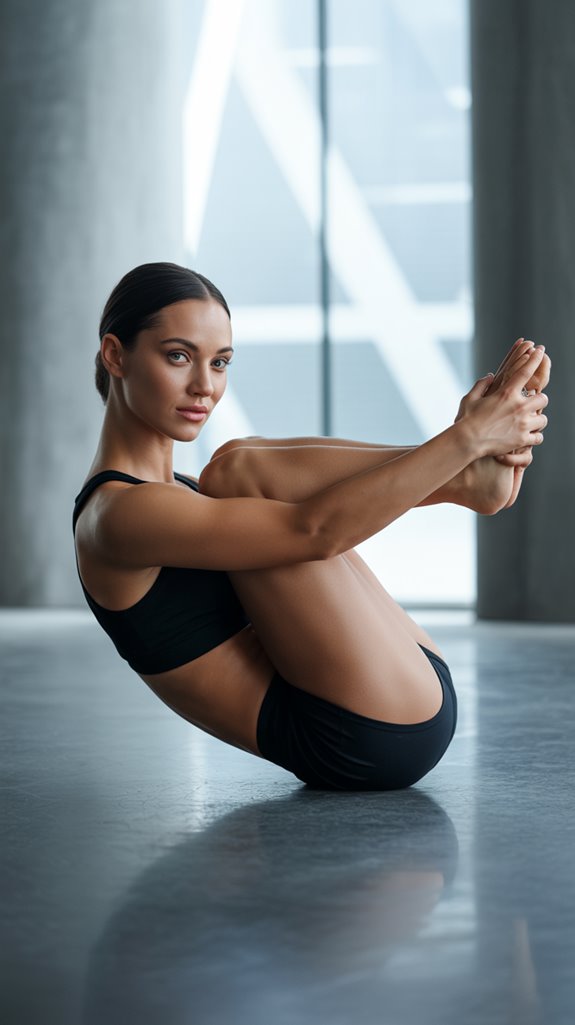
Among Pilates’ most playful yet purposeful exercises, Rolling Like a Ball transforms your body into a self-massage tool while challenging your balance and core engagement. You’ll begin seated, knees drawn tight to chest, maintaining a rounded C-curve from tailbone through shoulder blades. As you roll back on an inhale, each vertebra articulates sequentially, massaging spinal muscles and discs while promoting circulation. The exhale initiates your return to balance on your sacrum—never rolling onto your neck.
This movement demands precise core engagement throughout, activating your rectus abdominis, obliques, and transverse abdominis to control momentum. You’re not simply rocking; you’re deliberately mobilizing each spinal segment while building abdominal endurance. Your arms actively hold your legs, creating a compact shape that facilitates smooth rolling while maintaining space between heels and gluteals. Proper execution enhances spinal health through controlled flexion and extension, making it an effective warm-up that prepares your body for more complex patterns. Many practitioners find it a great introduction to mat Pilates and a way to explore both traditional and modern techniques.
Single Leg Stretch: Lower Abdominal Strengthener
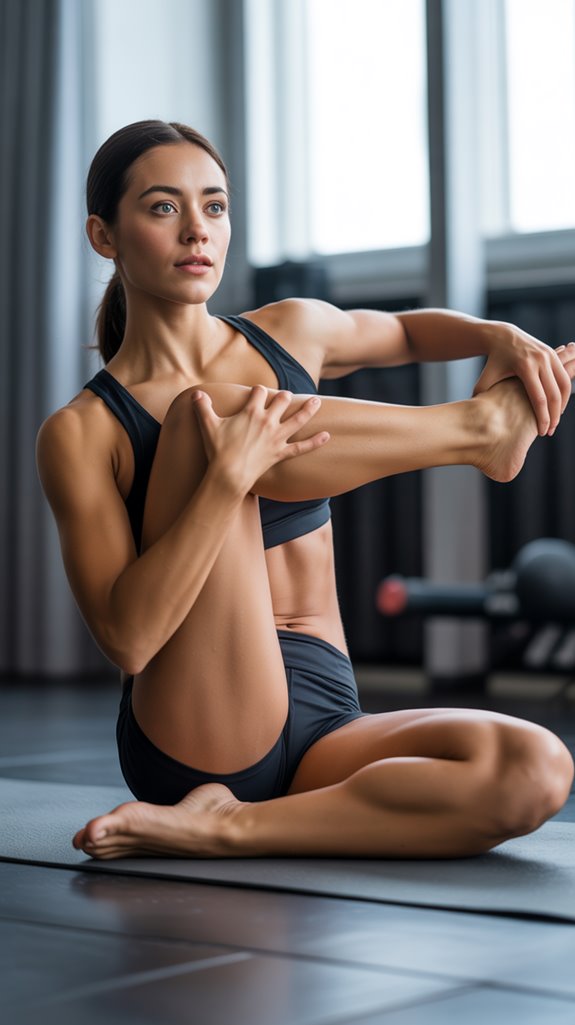
Execute each repetition slowly and deliberately, breathing rhythmically to maximize abdominal recruitment. This methodical approach strengthens your Powerhouse, improves hip mobility, and protects your lumbar spine through consistent practice. The exercise simultaneously engages hip flexors, inner thighs, and lower back muscles to build comprehensive core stability. Many people enjoy combining mat Pilates with bodyweight exercises to make home workouts varied and effective.
Criss-Cross: Oblique Sculptor for a Stronger Waist
The Criss-Cross stands as one of Pilates’ most effective exercises for sculpting defined obliques and building rotational power through your midsection. This advanced movement demands precise coordination as you rotate your torso, tapping your top elbow to the opposite bent knee while extending the other leg. Your internal obliques drive same-side rotation while external obliques control opposite-side movement, creating thorough waist sculpting that few oblique workouts can match.
Execute from supine position with legs in tabletop, hands behind your head. Exhale as you lift and rotate, maintaining your torso curl throughout alternating sides. Keep your pelvis stable and avoid neck strain by pressing your head into your hands. Visualize your rib cage spiraling as you twist to deepen the rotational movement and enhance muscle engagement. This classical sequence challenges your rotational stability and endurance while enhancing thoracic mobility and functional strength for everyday twisting movements.
Swimming: Full-Body Extension for Posture and Endurance
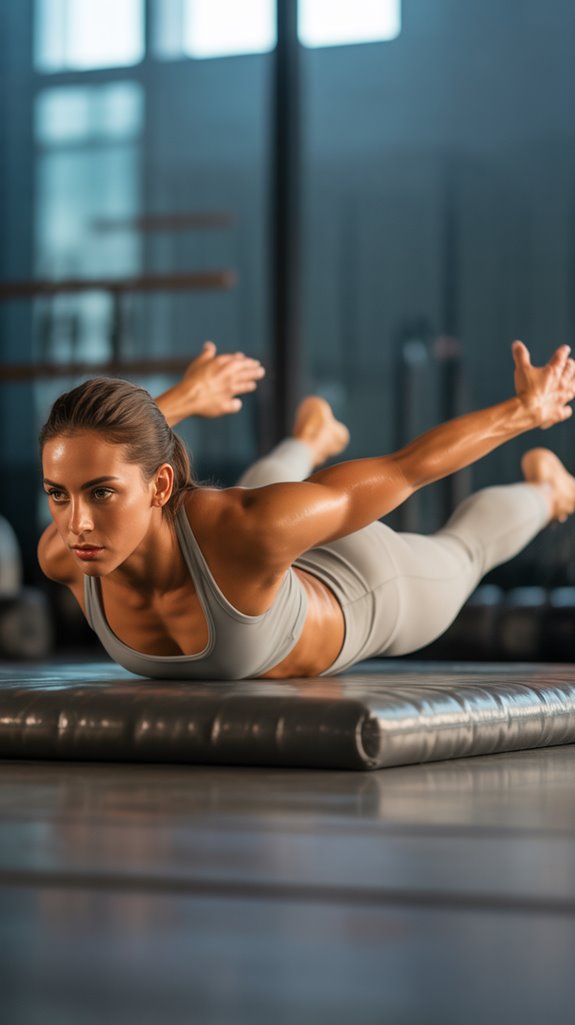
Lying prone with your arms extended forward and legs reaching back, Swimming transforms your body into a dynamic line of opposition that simultaneously builds postural strength and muscular endurance. You’ll alternate lifting opposite limbs in controlled, rhythmic movements that activate your entire posterior chain—from shoulders through glutes. This exercise delivers authentic swimming benefits by strengthening spinal extensors and scapular stabilizers while promoting neutral alignment. The coordinated arm-leg pattern enhances muscle coordination across multiple planes, training your nervous system to maintain stability during complex movements. As you sustain these alternating extensions, you’re developing cardiovascular endurance alongside postural integrity. Your core remains engaged throughout, preventing lumbar compression while your limbs reach into maximum extension. This low-impact exercise offers high-volume training potential, building stamina without joint stress. Research on middle-aged women who engaged in regular swimming three times weekly for 12 weeks demonstrated significant improvements in flexibility and cardiovascular endurance compared to non-exercising control groups.
Plank to Pike: Dynamic Stability Challenge
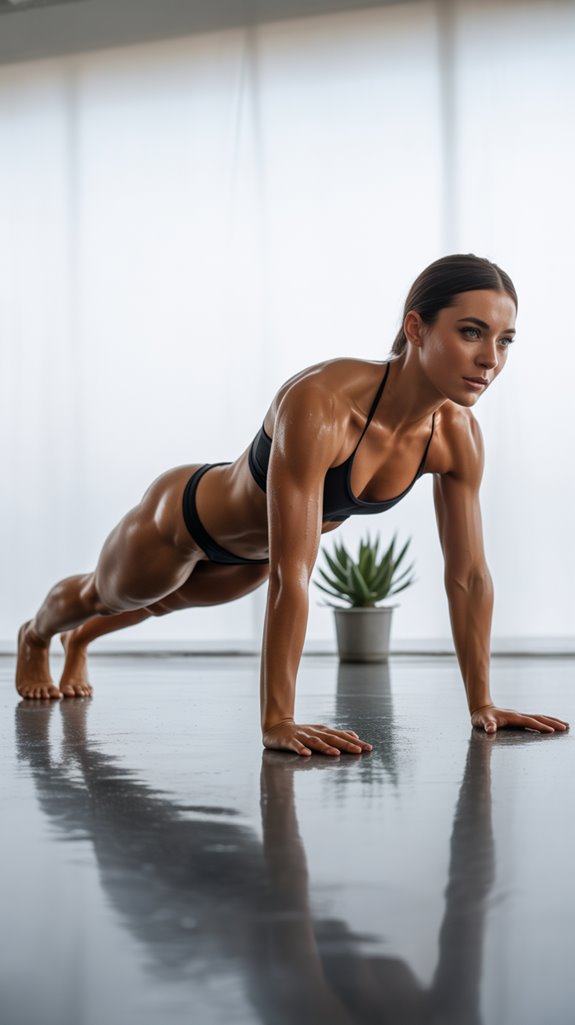
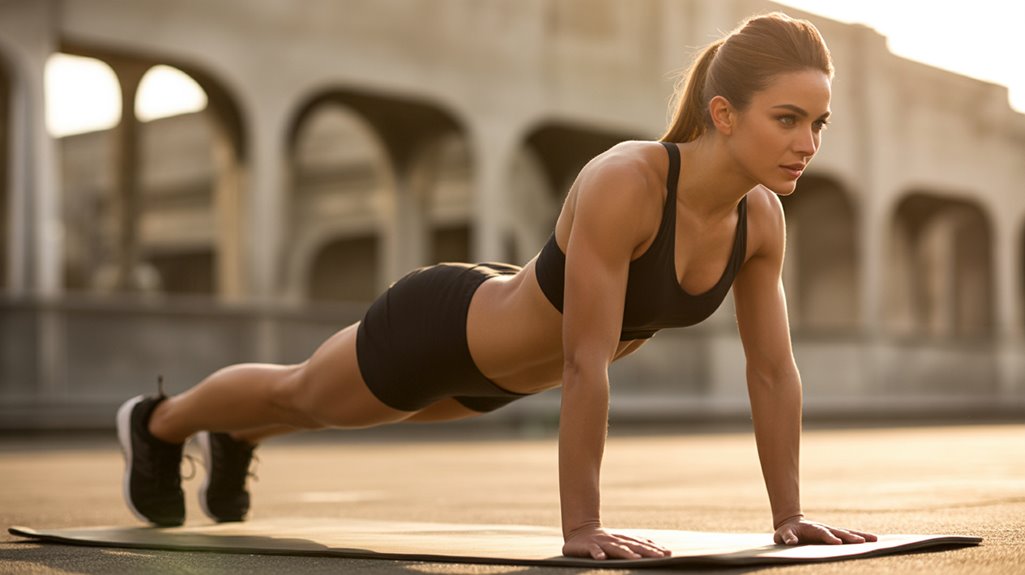
When you shift from a stable plank into an inverted pike position, you’re creating one of Pilates’ most effective dynamic stability challenges. This movement demands deep transversus abdominis activation while your shoulders maintain precise alignment above your wrists. You’ll experience superior abdominal recruitment compared to static holds as your trunk flexes and your hips elevate.
Optimal execution requires:
- Dynamic core tension throughout—pull your navel toward your spine to initiate controlled motion
- Shoulder stability via scapular protraction—engage serratus anterior to prevent joint strain
- Tempo control over speed—slow, deliberate changes maximize muscle engagement
Aim for 8-10 rounds per session. You’ll simultaneously strengthen your anterior deltoids, stretch your posterior chain, and build functional stability that transfers directly to complex movement patterns and injury prevention. For optimal results, practice this 3-4 times weekly to develop noticeable core and abdominal strength improvements.
Side Leg Series: Hip Strength and Lateral Balance
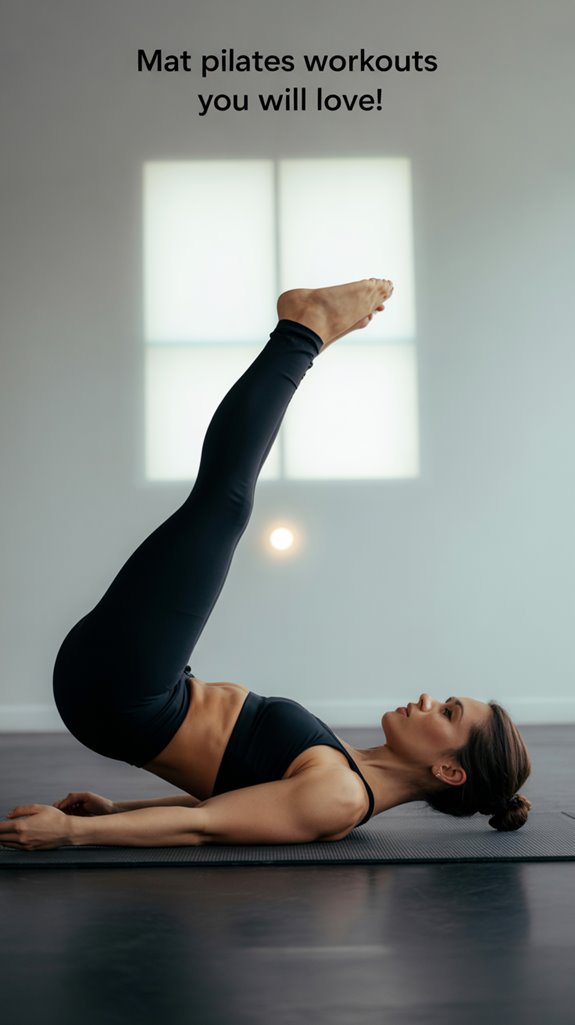
Five distinct movements comprise the Side Leg Series, each targeting specific hip stabilizers while challenging your lateral balance in ways traditional standing exercises can’t replicate. You’ll activate your gluteus medius, adductors, and deep hip stabilizers through controlled lifts, circles, and front-to-back kicks while maintaining a small arch under your waist.
Optimal hip activation demands precise alignment: stack your pelvis vertically and lengthen your spine to prevent compensatory shoulder involvement. The Clam progression exemplifies this principle—elevating your feet intensifies glute engagement while testing lateral stability. Repeated leg extension from the hip joint activates deep-lying hip muscles that are essential for long-term joint stability and functional strength.
Execute 3–4 repetitions minimum per variation, breathing deliberately as you move. You’ll strengthen both inner and outer thigh muscles, reduce muscular imbalances, and enhance functional movement patterns that translate directly to gait efficiency and injury prevention during athletic activities.
Spine Stretch Forward: Flexibility for the Back and Hamstrings
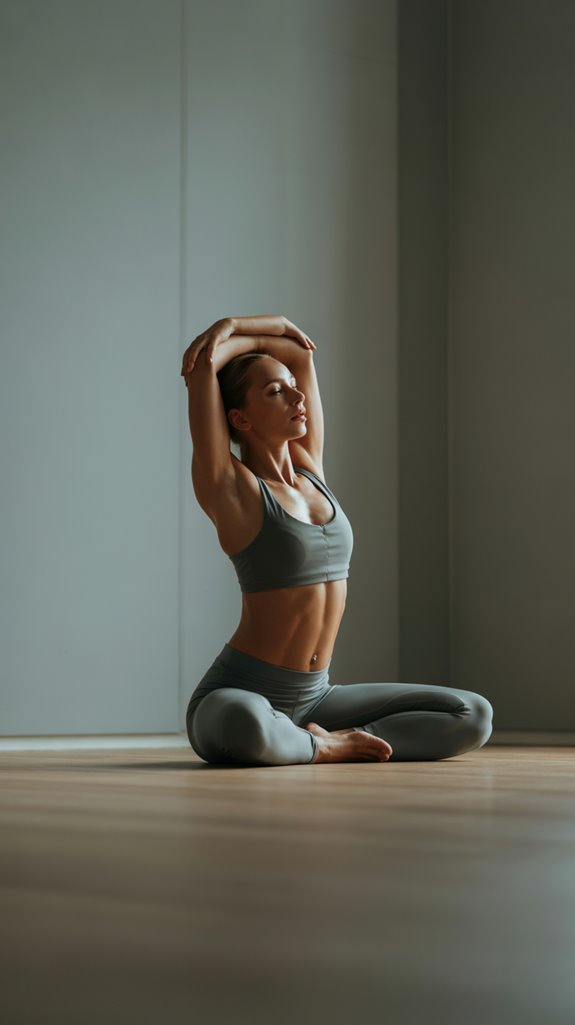
Execute this exercise with these key principles:
- Initiate from the crown of your head, rolling forward vertebra by vertebra rather than hinging at the hips
- Exhale completely during forward flexion, maximizing abdominal contraction and spinal articulation
- Restack methodically on the inhale, rebuilding your vertical alignment from pelvis to head
This movement decompresses the spine while simultaneously releasing accumulated tension throughout the upper, mid, and low back regions. Modify by bending your knees if hamstring tightness limits your range, allowing flexibility to develop progressively without compensation patterns.
Bridge: Glute Activation and Spinal Articulation
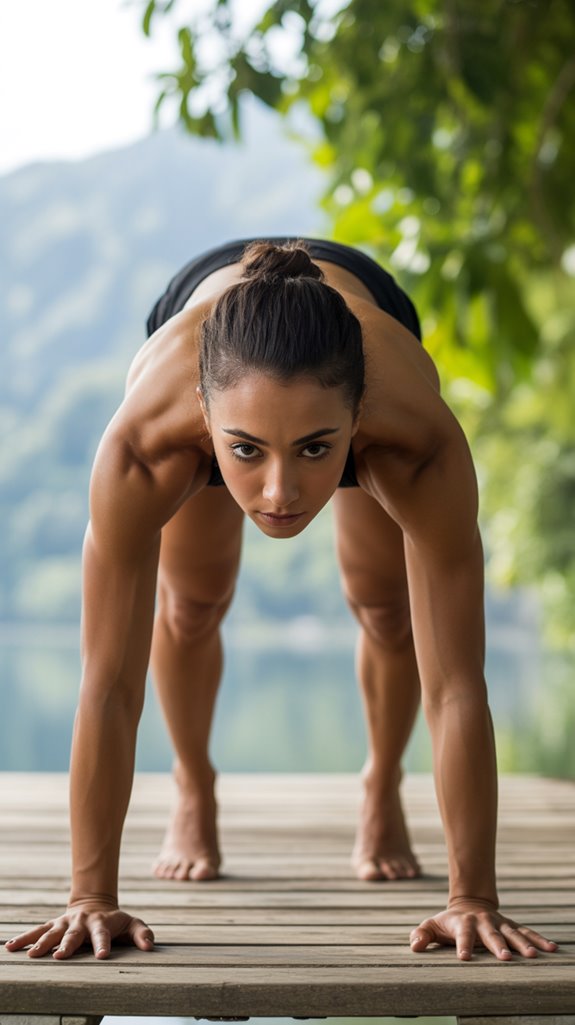
As one of Pilates’ most foundational exercises, the bridge delivers remarkable benefits for both spinal health and posterior chain strength. You’ll activate your gluteus maximus while rolling up and down vertebra by vertebra, creating segmental spinal articulation that reduces tension and increases flexibility. This mindful movement pattern counteracts gluteal amnesia from prolonged sitting, restoring proper muscle engagement throughout your hips and lower back.
Glute bridges also demand substantial core stability through deep abdominal activation, protecting your spine while strengthening your trunk. Research confirms increased transversus abdominis thickness after consistent practice. The exercise’s therapeutic value makes it suitable for post-rehabilitation settings, addressing back stiffness and pelvic instability. The bridge lengthens quadriceps while simultaneously strengthening hamstrings through hip extension and knee flexion. Progress through variations—single-leg, equipment-based, or isometric holds—to continually challenge mobility and strength, ensuring your body adapts and develops effective movement mechanics.
Mermaid Stretch: Lateral Flexibility and Core Control
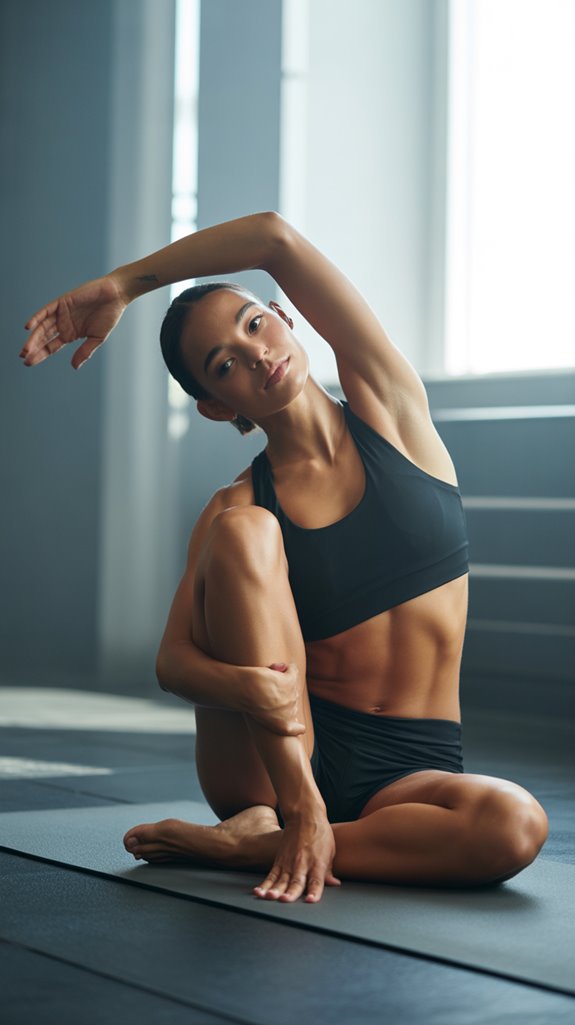
You’ll experience three distinct benefits:
- Enhanced spinal mobility through complete range of motion—combining lateral flexion with rotation and extension
- Improved breathing capacity as your ribcage opens, facilitating deeper oxygen exchange through lower lung lobes
- Balanced muscle development by strengthening and lengthening your side body simultaneously
Focus on lifting your spine upward before bending laterally—remember, “up is more important than over.” This prevents compression and maximizes oblique engagement. The challenging Z-sit position demands hip mobility, though you can use props for support as you develop proficiency. The movement also helps hydrate intervertebral discs, promoting spinal health and reducing wear and tear over time.
Conclusion
Think of your body as a garden that’s been waiting for the right care. These ten Pilates exercises are your tools—each one designed to cultivate strength, flexibility, and balance from the ground up. You’ve got the blueprint now; all that’s left is to step onto your mat and tend to what you’ve planted. With consistent practice, you’ll watch your physical foundation bloom into something resilient and beautiful.