
This post contains affiliate links. As an Amazon Associate I earn from qualifying purchases.
You’ll love these proven at-home ab exercises that require minimal equipment: W-Raise Reverse Crunches target your lower abs, Black Widow Knee Slides build anti-rotational strength, and Butterfly Sit-Ups enhance mobility while working your core. Add Spiderman Press-Ups for full-body engagement and Hanging Leg Raises for advanced challenge. Combine these with strategic supersets, proper nutrition for fat loss, and progressive overload principles to maximize results. The key isn’t just performing exercises—it’s understanding how to structure them effectively for continuous growth and visible definition.
Key Takeaways
- W-Raise Reverse Crunches target lower abs by curling the pelvis upward with controlled precision and minimal momentum.
- Black Widow Knee Slides challenge core stability by driving knees diagonally to opposite elbows in plank position.
- Butterfly Sit-Ups combine abdominal engagement with groin mobility, making them enjoyable and effective for many practitioners.
- Spiderman Press-Ups increase core demands by reducing contact points while the knee-to-elbow drive activates obliques.
- Hanging Leg Raises build lower abs progressively, starting with knee tucks and advancing to straight-leg variations.
W-Raise: The Reverse Crunch That Targets Your Lower Abs
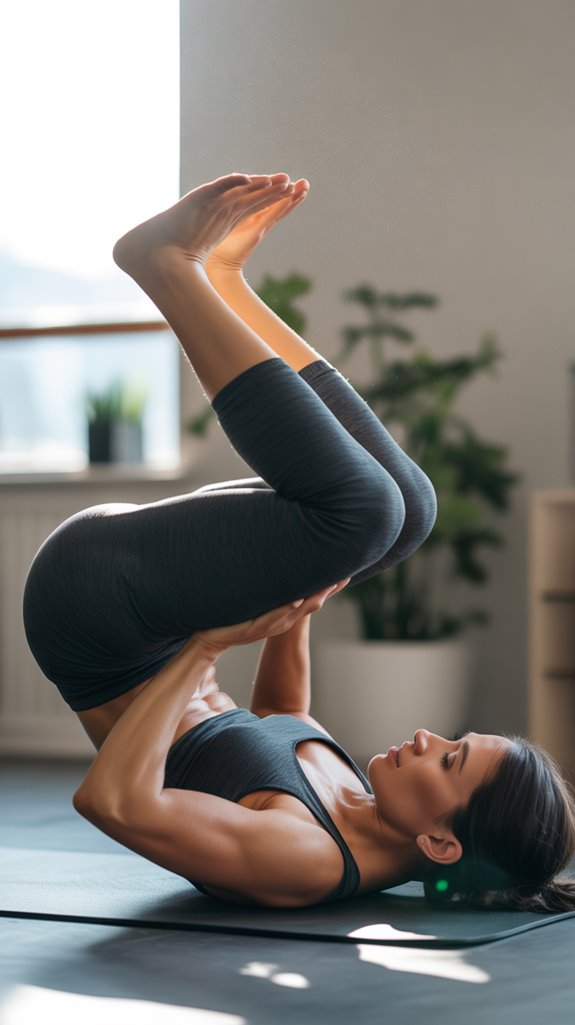
The W-Raise reverse crunch flips traditional ab training on its head by curling your hips toward your chest instead of lifting your torso off the ground. This bottom-up movement specifically targets your lower rectus abdominis while demanding complete core engagement throughout each rep.
Start by lying flat with knees bent and thighs vertical. Your leg positioning directly influences difficulty—bent knees simplify the movement, while straighter legs increase lever length and muscular tension. Curl your pelvis upward deliberately, lifting your hips slightly off the floor while keeping your upper back anchored. These movements are ideal for home workouts that require no gym equipment and can be varied for all fitness levels by adjusting reps, tempo, or adding light resistance at home.
Execute each rep with controlled precision. Avoid momentum-driven swinging or excessive arm leverage that compromises abdominal activation. Press your lumbar spine into the mat, pause briefly at peak contraction, then lower with deliberate control to maximize lower ab recruitment. Coordinate your breathing by inhaling as you lift your hips and exhaling during the lowering phase to maintain proper core activation.
Black Widow Knee Slides for Core Stability

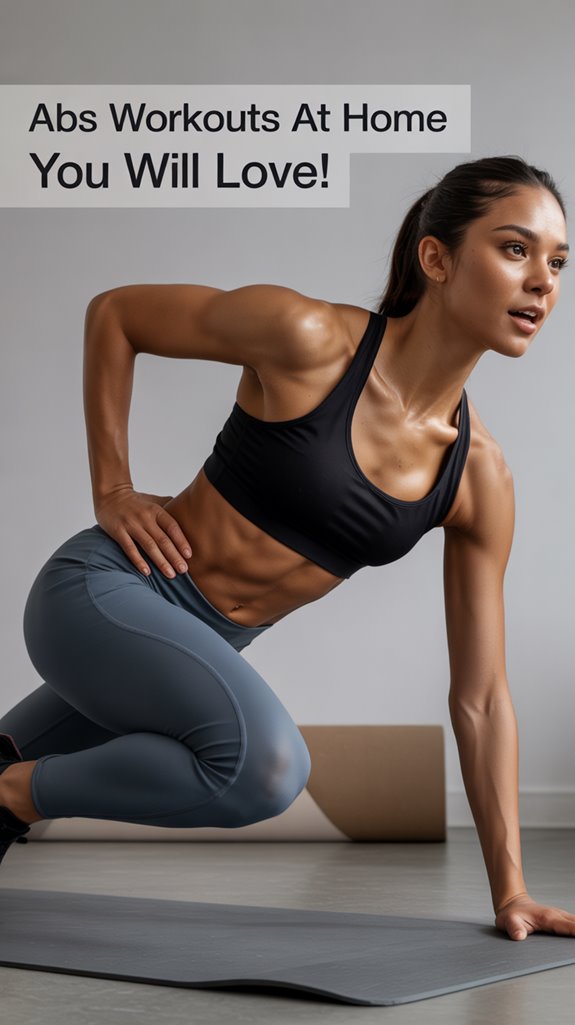
While most ab exercises lock you into a single plane of movement, Black Widow Knee Slides force your core to stabilize against rotation while managing anti-extension demands simultaneously. You’ll start in a high plank, then drive one knee diagonally across your body toward the opposite elbow while executing a posterior pelvic tilt. This cross-body trajectory activates your obliques and transversus abdominis far beyond traditional planks. These exercises are perfect for home workouts that build consistent core strength and can be done with minimal or no equipment at-home ab workouts.
These core stabilization techniques require coordinated tension through your shoulders, glutes, and deep spinal stabilizers. You’re not just moving—you’re controlling complex forces through multiple vectors. The movement also strengthens front shoulders as you maintain proper positioning throughout each repetition. Progress through knee slide variations by adjusting tempo, adding pauses at peak contraction, or extending rep ranges. Execute 8-12 controlled repetitions per side for 2-4 sets, maintaining perfect spinal alignment throughout every repetition.
Butterfly Sit Up: Double-Action Abdominal Power
- Enhanced groin mobility reduces injury risk in athletic movements
- Improved hip rotator range counteracts sedentary tightness
- Lower back decompression through controlled spinal articulation
- Pelvic health support via sustained butterfly positioning
Execute with deliberate tempo—momentum steals tension from your abs. Keep your feet grounded, chin tucked, and spine neutral. When form deteriorates, end the set. Avoid letting your feet lift off the ground, as this increases back strain and shifts work away from your core. Many women find these exercises enjoyable and effective when incorporated into a regular routine.
Spiderman Press-Up: Three-Point Contact for Maximum Engagement

When you pull one leg off the ground mid-press-up, you don’t just reduce your points of contact—you force your entire core into high-alert stabilization mode. This three point stabilization demands intense core engagement as your abs, obliques, and lower back fight to prevent rotation and maintain spinal alignment. The knee-to-elbow drive activates hip flexors and obliques while your chest, shoulders, and triceps handle the pressing load. Your glutes stabilize the pelvis as neuromuscular coordination peaks. The result? Elevated heart rate, increased calorie burn, and functional movement patterns that translate directly to athletic performance. Engage your core throughout the movement, keeping your ribs down and pelvis slightly tucked to maintain proper form. Start with incline variations if you’re new, but master the flat-ground version to release serious full-body tension and metabolic conditioning benefits.
Hanging Leg Raises: The Ultimate Challenge Exercise
Master the fundamentals with these progression strategies:
- Start with knee tucks if straight-leg variants compromise your form or cause excessive swinging
- Maintain a neutral pelvis throughout the movement to protect your lower back and maximize abdominal engagement
- Progress through hanging variations by adding ankle weights, tempo manipulations, or rotational components for oblique development
- Avoid common errors like uncontrolled momentum and limited range—aim for perpendicular leg positioning
Within two weeks of consistent practice, you’ll notice measurable improvements in hip flexor strength and movement quality. The hanging position itself relieves spinal tension while promoting better posture throughout your day.
Extinction Training: Push Every Set to Failure
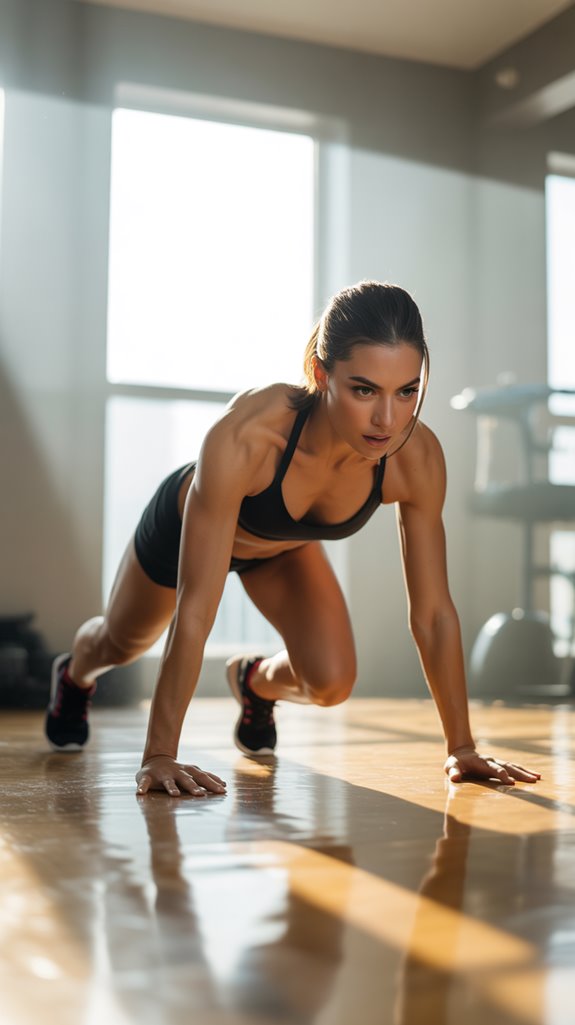
For advanced ab work, implement extinction training strategically. Use 8-15 rep ranges on bodyweight movements like planks or mountain climbers. Prioritize technical failure over absolute failure—stop when form deteriorates. Employ Reps in Reserve (RIR), leaving 1-2 reps uncommitted during most sessions. Advanced techniques like rest-pause methods can extend sets beyond initial failure while maintaining exercise quality. Cycle high-intensity periods with adequate deloads to optimize adaptation while managing accumulated fatigue.
60-Second Exercise Circuits for Complete Core Development
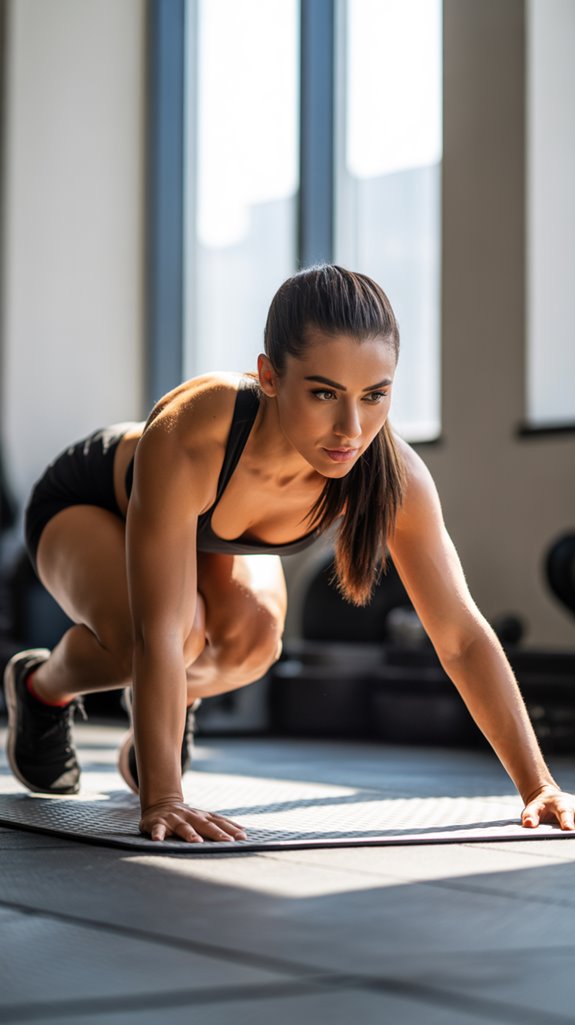
Structure your circuits with these proven elements:
- Perform each exercise for 30–60 seconds or 10–20 repetitions before shifting immediately to the next movement
- Complete 2–4 rounds total, allowing muscle fatigue to drive adaptation and strength gains
- Alternate movement patterns—pair anti-extension holds like planks with rotational moves like Russian twists
- Train 2–3 times weekly for ideal progress without overtraining
Short 8–15 minute sessions produce remarkable results when exercise density remains high. Between circuit rounds, take one-minute breaks to allow partial recovery while maintaining workout intensity.
Body Fat Reduction: The Key to Visible Six-Pack Abs
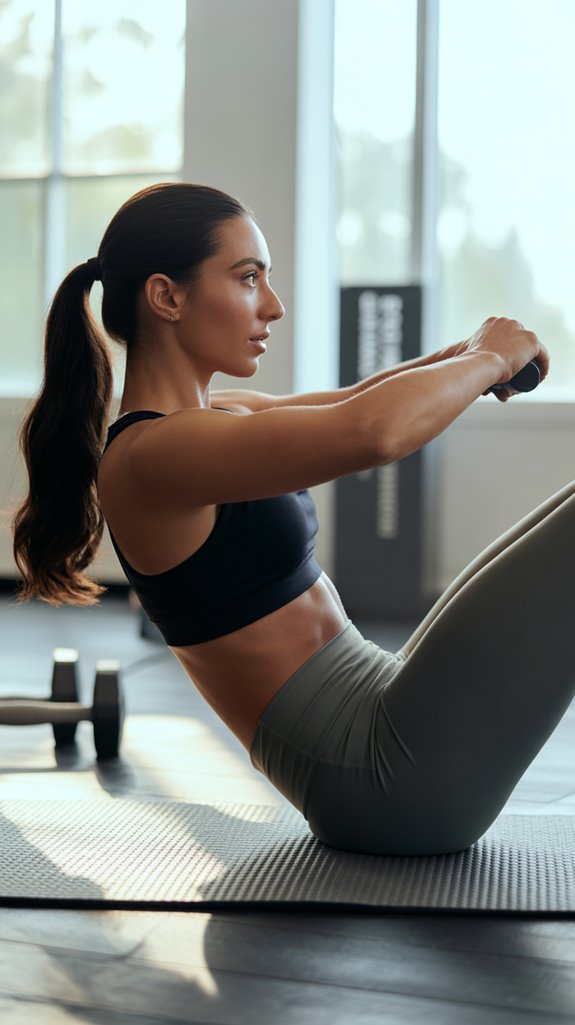
While core circuits build impressive abdominal strength, visible definition ultimately depends on reducing the layer of fat covering those muscles. Men typically need 10–12% body fat for clear six-pack visibility, while women require 16–20%. Your genetics and fat distribution patterns determine exactly when definition emerges, but these ranges consistently reveal well-developed abs.
Achieving visible abs demands a strategic calorie deficit through balanced nutrition and full-body training—spot reduction doesn’t work. Focus on lean proteins, fiber-rich foods, and cardiovascular exercise alongside your core workouts. Track progress using DEXA scans or calipers rather than BMI, which ignores body composition details. Maintaining 7-9 hours of quality sleep each night supports optimal fat loss and hormone regulation necessary for achieving your desired body composition.
Remember that extremely low body fat percentages below 6–9% (men) or 15–16% (women) carry health risks including hormonal disruption and immune compromise. Prioritize sustainable fat loss rates that preserve muscle mass and metabolic function.
Superset Combinations for All Abdominal Sections
Once you’ve built a strong foundation of lean mass through targeted nutrition, supersets become your most efficient tool for maximizing abdominal development during limited home workout sessions. Strategic superset strategies allow you to target multiple abdominal sections consecutively, enhancing muscle definition through metabolic stress and continuous tension.
- Upper abs: Pair crunches with reverse crunches or sit-ups with oblique crunches to maximize spinal flexion patterns
- Lower abs: Combine reverse crunches with flutter kicks or hanging leg raises with mountain climbers for targeted fiber recruitment
- Oblique exercises: Stack Russian twists with side planks or bicycle kicks with triangle reaches for rotational core strength
- Transverse activation: Merge plank holds with dead bugs to develop abdominal endurance and anti-rotation stability
Exercise variation through intelligent pairing accelerates your progression toward complete core mastery. When performing exercises like the star plank, maintaining core stability throughout the entire duration engages your complete body and challenges your endurance capacity.
Progressive Overload Strategy for Continuous Ab Growth
Because your abdominal muscles adapt remarkably fast to training stimuli, implementing a structured progressive overload strategy separates those who achieve continuous core development from those who stagnate after initial gains. You’ll need systematic workout tracking—logging sets, reps, resistance, and rest periods—to guarantee measurable advancement. Progress by increasing one variable at a time: add external resistance through dumbbells or bands, elevate rep counts, incorporate additional sets, or advance exercise difficulty from crunches to ab wheel rollouts. Alternatively, manipulate tempo with slow eccentrics or extend range of motion for greater time under tension. Consider applying the 2-for-2 rule by increasing resistance after you can complete 2 additional reps for 2 consecutive weeks as a practical guideline for when to progress. Assess your data every 4-8 weeks and adjust accordingly. Include deload phases to prevent overtraining while maintaining proper form throughout progressions. This methodical approach to progressive overload transforms sporadic effort into predictable hypertrophy.
Conclusion
You’ve got everything you need to build impressive abs from your living room. These ten exercises target every section of your core while challenging your stability and strength. Remember, though—what’s the point of sculpted abs if they’re hidden under body fat? Combine these workouts with smart nutrition, stay consistent with your training, and you’ll finally see those abs emerge. Your six-pack journey starts right now, so let’s make it happen!