You’ll transform your body with these beloved Pilates workouts: The Hundred builds core endurance through rhythmic breathing, while Roll Up strengthens abs with controlled spinal articulation. Teaser challenges your balance and can improve dynamic stability by 67%. Swimming extends your spine and activates back muscles, and Crisscross engages obliques with double the intensity of standard crunches. Add plank variations for full-core stabilization, Mermaid Stretch for lateral flexibility, Reformer Footwork for leg strength, and Roll Over for advanced control. Each exercise offers unique benefits that’ll enhance your strength, flexibility, and mind-body connection throughout your practice.
Key Takeaways
- The Hundred builds core endurance through rhythmic breathing and arm pumping, improving circulation and abdominal strength in a supine position.
- Roll Up develops spinal articulation and deep core engagement by rolling vertebra-by-vertebra, making it accessible across all fitness levels.
- Teaser challenges balance and functional strength in a V-position, significantly improving dynamic balance and proprioceptive awareness in practitioners.
- Swimming strengthens posterior chain muscles while enhancing spinal extension, posture awareness, and shoulder stability through alternating limb movements.
- Reformer Footwork builds foundational leg strength with spring resistance, targeting quadriceps, hamstrings, and glutes while promoting proper joint alignment.
The Hundred: Energize Your Body and Build Core Endurance
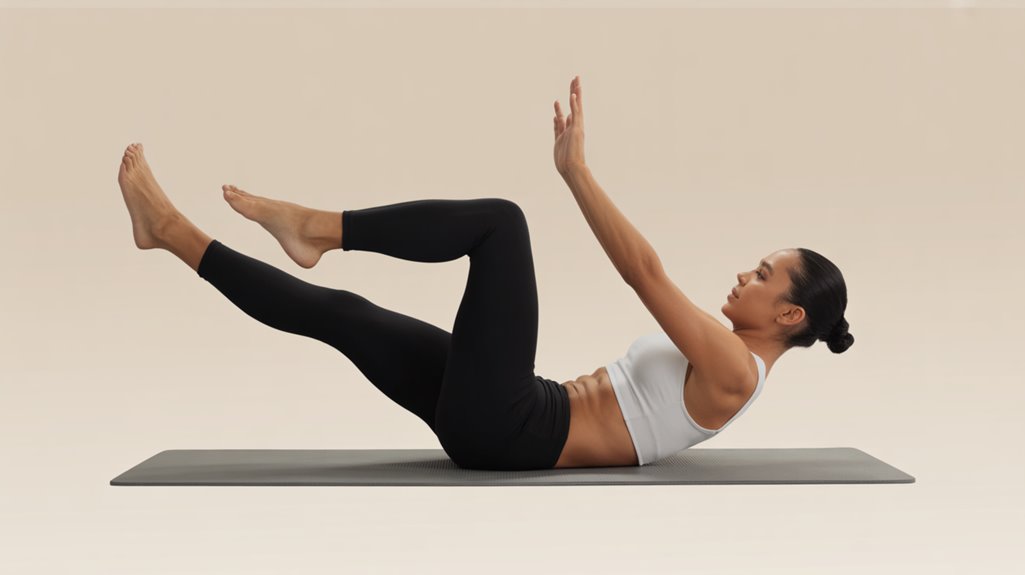
The Hundred stands as Pilates’ most iconic exercise, instantly recognizable by its rhythmic arm pumping and demanding abdominal hold. You’ll lie supine, curl your upper body forward until your shoulder blade tips touch the mat, and extend your arms to pump vigorously for 100 counts. Your legs can start in tabletop position, progressing to a challenging 45-degree extension as you advance. Master the coordinated breath control pattern: inhale for five pumps, exhale for five, completing ten cycles total. This breathing technique enhances respiratory efficiency while your abdominals work continuously to maintain core stability. You’ll simultaneously boost circulation, strengthen deep stabilizers, and build exceptional endurance. Avoid common pitfalls like neck strain or hip flexor dominance by keeping your core engaged and raising your legs higher if needed. This exercise traces back to Joseph Pilates’ 1945 book, where it appeared as one of 34 original movements designed to systematically strengthen the body. Incorporating this move into a regular routine supports overall fitness and core strength.
Roll Up: Strengthen Your Abs and Increase Spine Flexibility

Execute slowly: start seated tall, legs extended, feet flexed. Roll down vertebra by vertebra, maintaining spinal alignment. Avoid letting legs pop up. Draw shoulders from ears to maximize spinal focus and minimize tension. This exercise engages the rectus abdominis, transverse abdominis, and obliques to strengthen both superficial and deep core muscles. Pilates emphasizes mindful movement to make workouts accessible and enjoyable for all fitness levels.
Teaser: Challenge Your Balance and Functional Strength
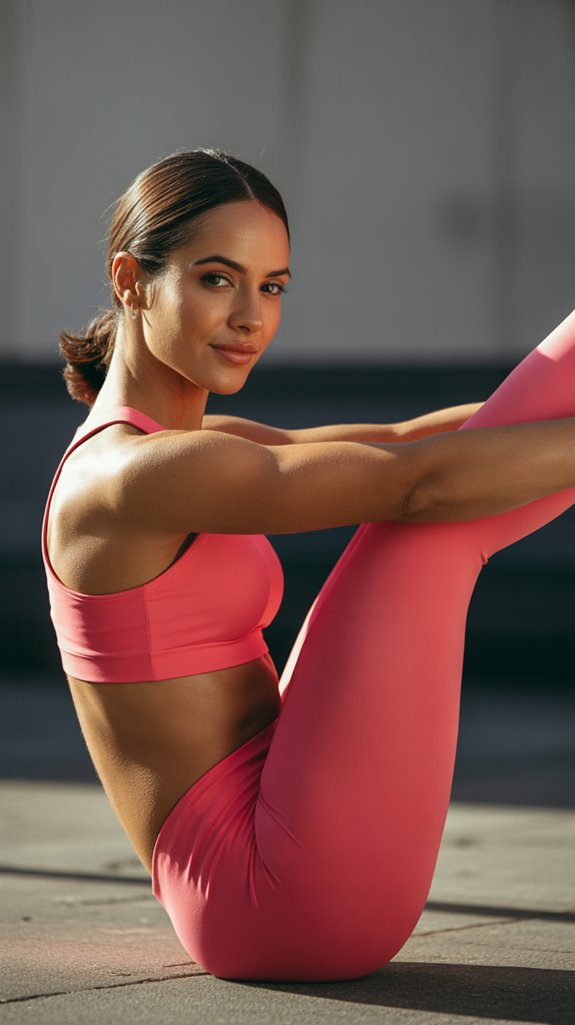
Among Pilates exercises, the Teaser stands out as a formidable test of balance and functional strength that directly translates to real-world stability. You’ll engage your entire core musculature—transverse abdominis, multifidus, and obliques—while maintaining a V-shaped position that demands precise neuromuscular coordination. The strength benefits extend beyond aesthetics: you’re building trunk stabilization that reduces fall risk and enhances proprioceptive awareness. These balance techniques mirror the dynamic challenges you face daily, from climbing stairs to recovering from unexpected movements. Your improved reach capacity and postural control create measurable protection against falls, particularly as studies show Pilates participants achieve functional mobility thresholds that appreciably lower injury risk. Research indicates that 67% of studies demonstrate significant dynamic balance improvements in older adults practicing Pilates, validating its effectiveness for real-world movement stability. Many seniors also find Pilates complements joint-friendly workouts by improving flexibility and strength without stressing the joints. Master the Teaser, and you’ll develop the integrated movement control essential for confident, stable living.
Swimming: Extend Your Spine and Activate Back Muscles
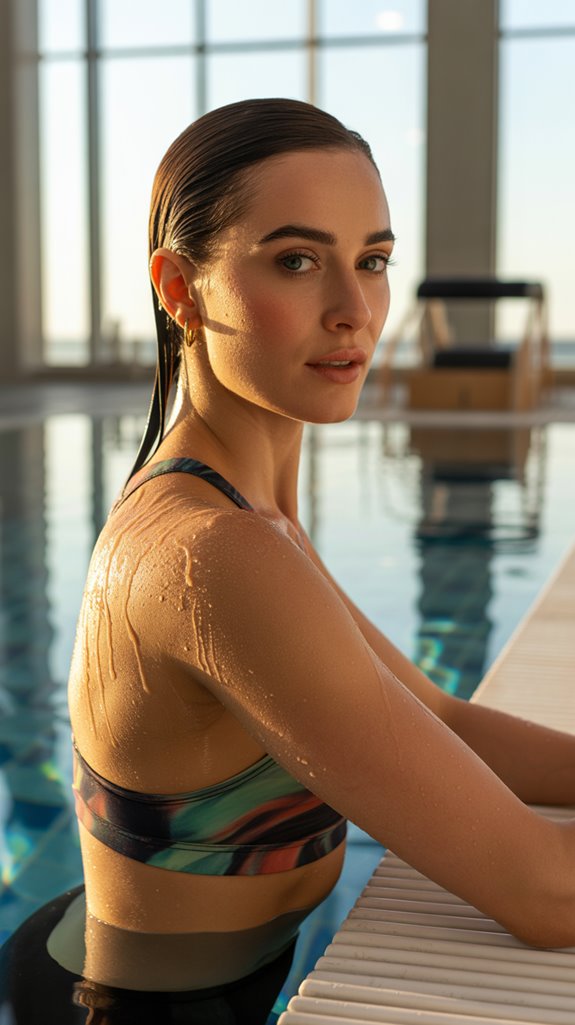
While the Teaser builds integrated core stability for daily movement, Pilates Swimming takes that foundation and extends it along your entire posterior chain. You’ll activate erector spinae, glutes, and hamstrings through dynamic spinal extension, developing the muscle endurance essential for maintaining ideal alignment under fatigue. This exercise sharpens posture awareness by demanding conscious lengthening while limbs move overhead—a skill that translates directly to streamlined positioning and reduced drag in water.
The controlled opposition of arms and legs strengthens shoulder stabilizers and promotes spinal mobility through safe, progressive extension. You’re training your body to maintain neutral alignment during complex movements, which prevents compensatory patterns that lead to overuse injuries. Enhanced thoracic opening improves breathing mechanics while building the back strength necessary for powerful propulsion and sustained performance. The low-impact, controlled movements also protect your joints while strengthening the surrounding musculature, supporting longevity in your swimming practice.
Crisscross: Engage Obliques for Rotational Power
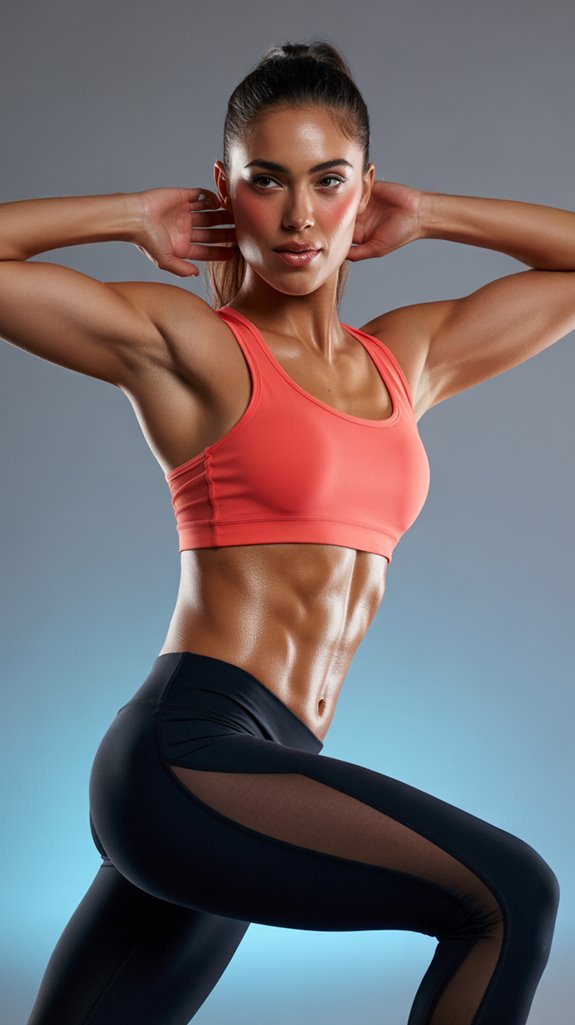
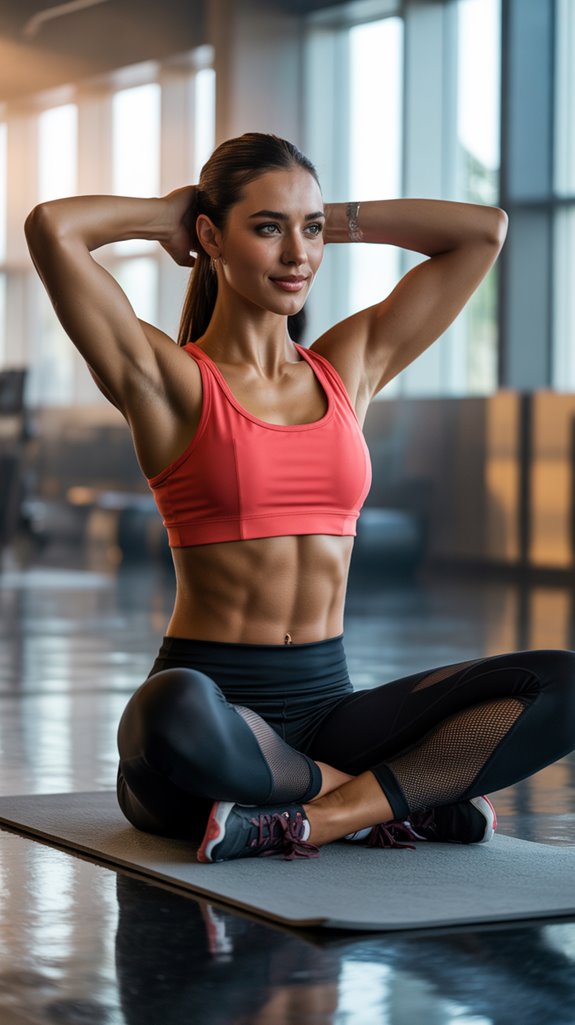
Rotational strength separates functional athletes from those who simply look strong—and the Crisscross delivers precisely that capability by targeting your obliques through deliberate spinal rotation. You’ll initiate movement from your ribcage and thoracic spine—never your shoulders—while maintaining tabletop legs and interlaced hands behind your head. As you rotate toward one knee, extend the opposite leg while keeping your pelvis absolutely still. This movement pattern challenges pelvic stability while demanding that your core maintain alignment despite the dynamic upper body rotation.
Master these technical elements for maximum oblique engagement:
- Drive rotation from your ribs, creating genuine spinal articulation that builds authentic rotational strength rather than superficial arm movement
- Maintain continuous chest lift throughout each repetition, refusing to let fatigue compromise your form or shoulder position
- Synchronize breathing with rotation—exhale as you twist, inhale to center—optimizing muscle recruitment and preventing rushed, ineffective repetitions
Side Kicks: Tone Hips and Improve Lower Body Mobility
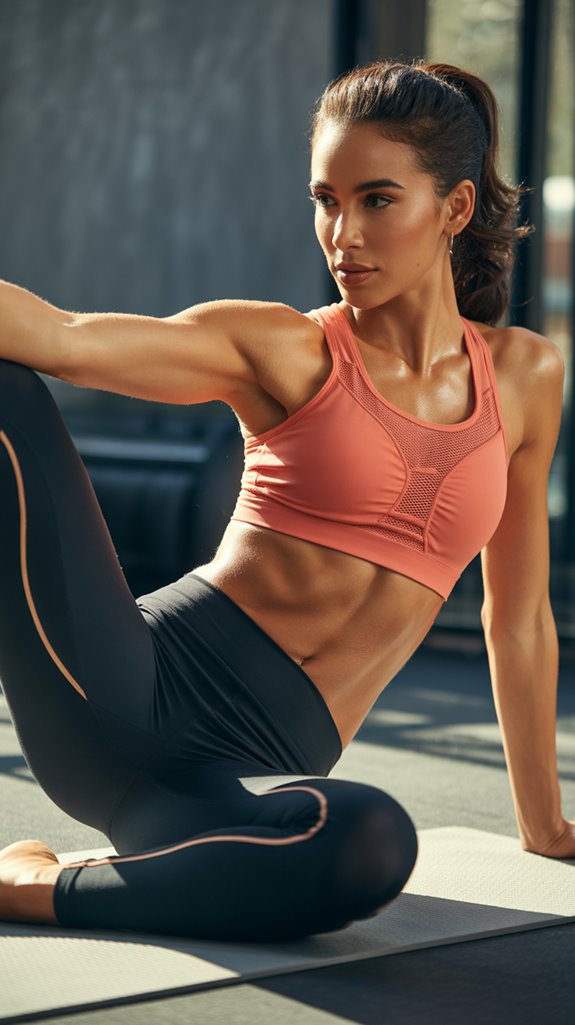
Side Kicks transform your hips from passive hinges into powerful, mobile engines that drive athletic performance and everyday movement. You’ll activate your gluteus medius, maximus, and hip abductors while demanding unwavering core stabilization—research shows side kicks generate double the trunk engagement of standard crunches. Your working leg travels through flexion, extension, and abduction as your torso remains absolutely still, building hip mobility without compensating through your spine.
Execute with precision: stack your hips, create space under your side waist, and move deliberately through small ranges before progressing. You’re training the dissociation between legs and pelvis that’s essential for walking, running, and single-leg balance. Each controlled repetition strengthens lateral stabilizers, stretches hip flexors and hamstrings, and sculpts outer thighs while protecting against injury through enhanced lower body resilience. Position your bottom leg straight below your shoulders to mimic standing posture, or angle it forward 30-45 degrees to create a wider base that enhances spinal stabilization.
Plank Variations: Stabilize Your Entire Core
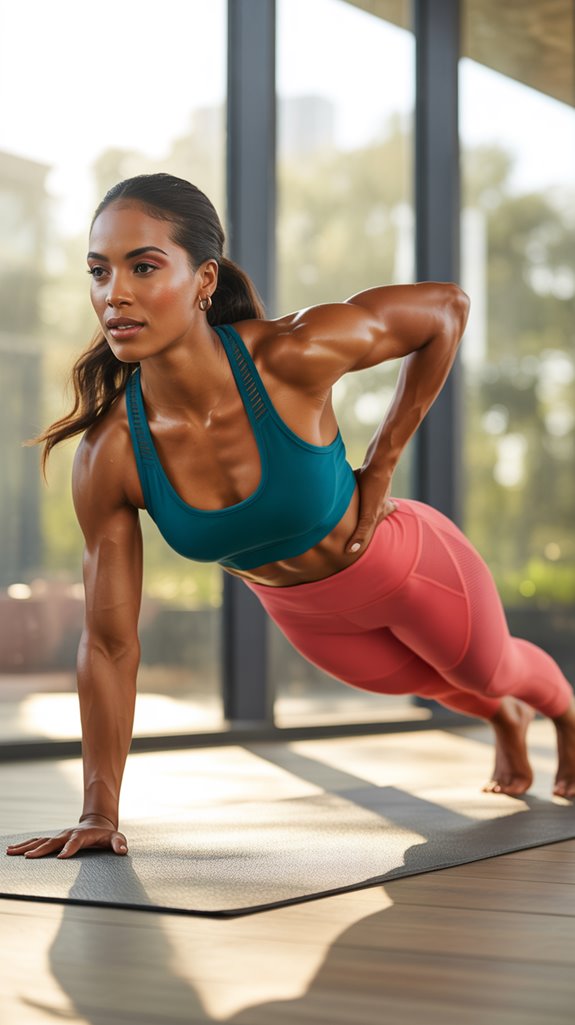
Plank variations challenge your entire core through static holds and dynamic movements that forge full-body stability from shoulders to feet. You’ll engage your transverse abdominis, obliques, and glutes while building the anti-rotational strength that protects your spine during complex movements. The plank benefits extend beyond aesthetics—you’re developing functional power that translates directly to athletic performance and injury prevention.
Master these progressive variations for superior core stability:
- Forearm plank saw creates eccentric loading that builds endurance you’ll feel in every subsequent workout
- Side plank progressions sculpt obliques and hip abductors while demanding precise balance control
- Plank hip dips train rotational resistance, transforming your trunk into an unshakeable foundation
You’ll discover that consistent practice reduces back pain while enhancing proprioception and movement efficiency across all activities. These exercises also work to boost metabolic rate, increasing your overall calorie burn both during and after your training session.
Mermaid Stretch: Enhance Lateral Flexibility and Side Body Length
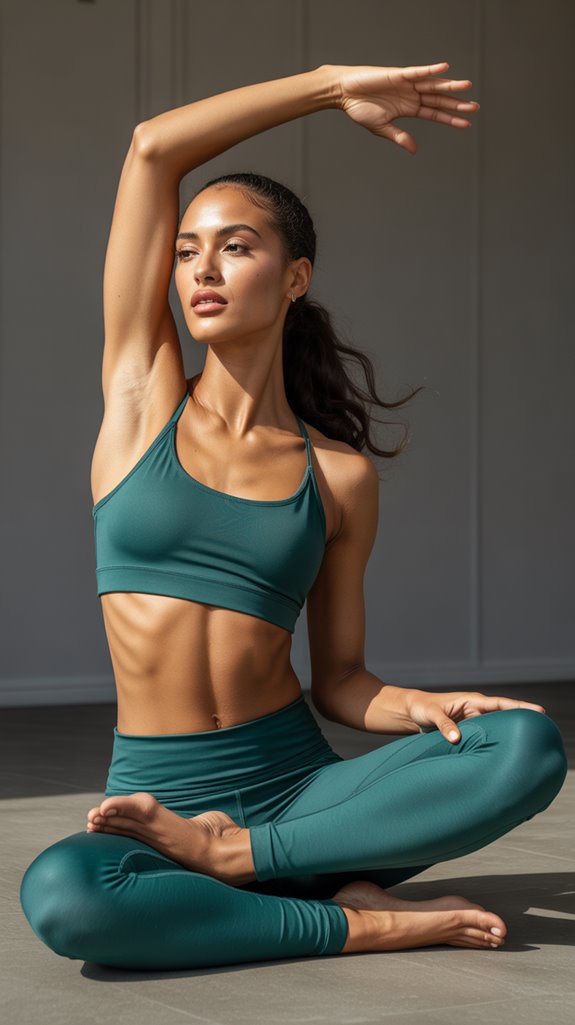
While most spine mobility work focuses on forward and backward movement, your body craves lateral flexion to maintain balanced function and prevent compensatory patterns. The Mermaid stretch directly addresses this gap by lengthening your obliques, intercostals, and side body fascia while mobilizing your ribs and thoracic spine.
This exercise combines controlled stretching with active core engagement—your abdominals work eccentrically to brake the movement, ensuring you’re building strength throughout the range. You’ll enhance spinal mobility in all planes by integrating side bending with rotation and extension, preventing the stiffness that accompanies sedentary habits.
The Mermaid also expands your ribcage, enabling deeper breathing and reducing compensatory tension in your neck and shoulders. Beyond the side body benefits, this movement engages stabilizing muscles throughout your back, shoulders, hips, and hamstrings for comprehensive postural support. Adaptable across mat and apparatus variations, this lateral movement pattern is essential for thorough spinal health.
Reformer Footwork: Build Strong, Aligned Legs
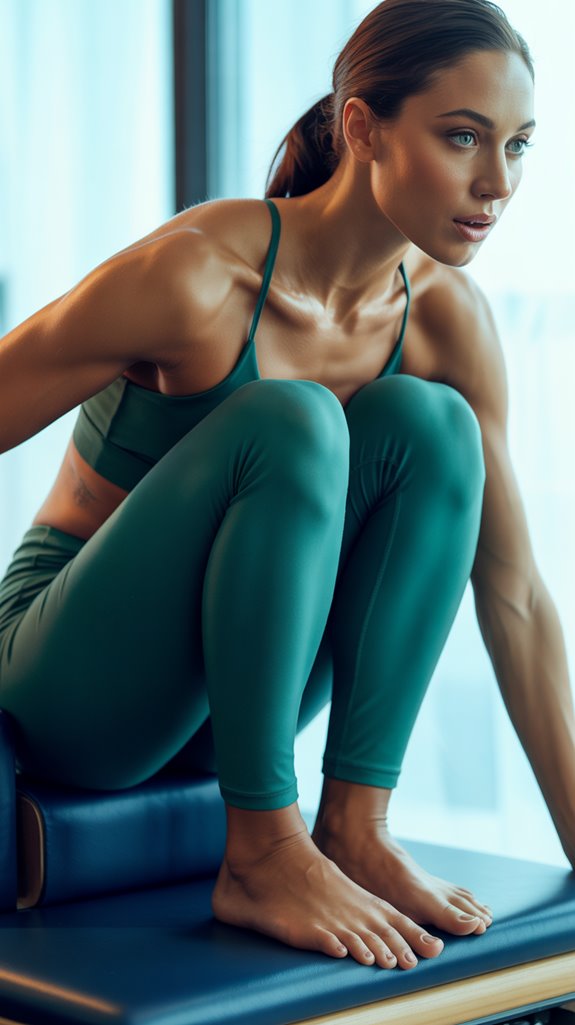
Because foundational leg strength determines how effectively you move through daily life, Reformer footwork serves as the cornerstone of most Pilates sessions. You’ll master precise foot placements—toes, arches, heels—each targeting specific muscle engagement patterns while maintaining neutral spine alignment. The carriage’s spring resistance challenges your quadriceps, hamstrings, and glutes as you push out and control the return, creating balanced strength without joint compression. This exercise warms up ankles, knees, and hips while eliminating the added pressure of gravity.
Three transformative benefits you’ll experience:
- Enhanced joint alignment through knee-over-second-toe tracking that prevents strain and builds protective movement patterns
- Sophisticated muscle wrapping sensation connecting your thighs’ outer surfaces to their backs and inner lines
- Functional carryover as these low-gravity leg presses retrain your body’s full range of motion for walking, running, and standing tasks
Progressive variations from parallel to Pilates V stance guarantee continued advancement.
Roll Over: Master Advanced Core Control and Flexibility

After building foundational strength through controlled leg presses, you’re ready to challenge your body’s capacity for sophisticated spinal movement. The Roll Over demands advanced techniques that test your articulation skills—sequencing each vertebra deliberately as you lift overhead and return with precision.
You’ll initiate this movement through deep core engagement, not momentum. Press your arms firmly into the mat while lifting legs to ninety degrees, then roll your pelvis skyward with controlled intention. At the peak, flex your feet, open your legs hip-width, and articulate downward vertebra by vertebra. This deliberate sequencing enhances overall body awareness while developing the mind-muscle connection essential for advanced Pilates work.
This exercise lengthens your hamstrings, massages your spine, and enhances flexibility throughout your posterior chain. However, it’s contraindicated for neck injuries, osteoporosis, or pregnancy. Master this movement through deliberate practice, proper breathing, and unwavering control.
Conclusion
You’ve just discovered ten transformative Pilates workouts—and here’s what’s interesting: you’re reading this at exactly the moment your body’s been craving change. It’s no accident you’re seeking strength, flexibility, and balance right now. These exercises aren’t just movements; they’re your roadmap to feeling powerful from within. Start with one today, and you’ll notice something shift. Your core knows what it needs—you’ve found it.