This post contains affiliate links. As an Amazon Associate I earn from qualifying purchases.
You’ll build powerful, functional legs with nine essential exercises that target every muscle group. Start with classic squats and walking lunges for overall strength, then add Romanian deadlifts and leg curls to develop your hamstrings. Bulgarian split squats and step-ups address muscle imbalances through single-leg training, while glute bridges activate your posterior chain. Don’t forget lateral lunges for multidirectional movement and standing calf raises for lower leg power. Each exercise offers unique benefits that’ll transform your leg training when you understand proper form and progression strategies.
Key Takeaways
- Classic squats engage quads, glutes, and hamstrings while strengthening stabilizing muscles and improving bone density and joint health.
- Bulgarian split squats isolate each leg to uncover imbalances, delivering strong quad and glute activation with reduced spinal loading.
- Walking lunges combine strength and dynamic movement, correcting muscle imbalances while elevating heart rate and improving hip mobility.
- Romanian deadlifts target hamstrings and posterior chain, maintaining bar close to legs while strengthening posture and spine stability.
- Glute bridges activate glutes and core, positioning feet shoulder-width with heels near glutes for optimal contraction and injury prevention.
Classic Squats for Total Lower Body Strength
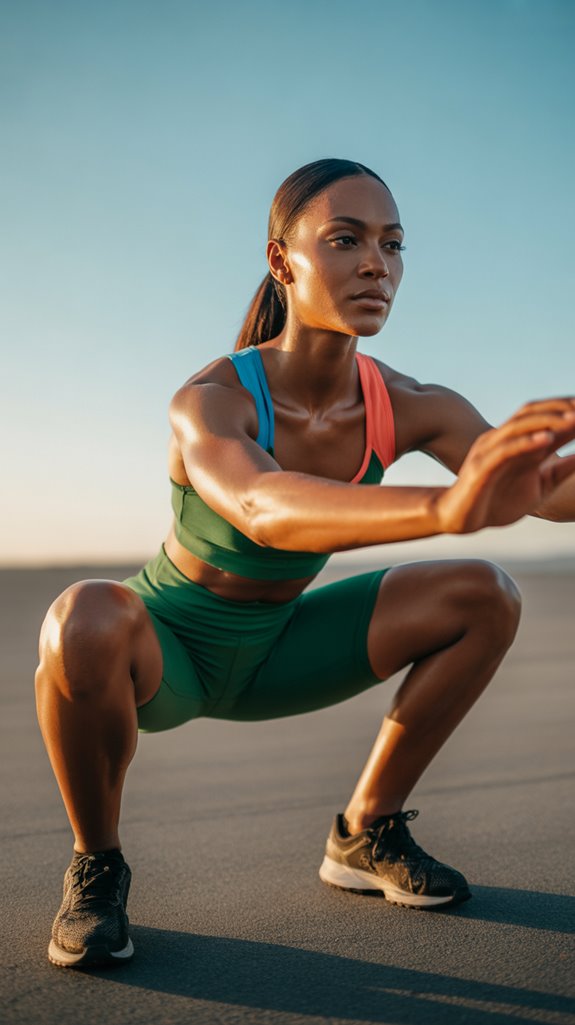
The squat stands as the cornerstone of lower body training, recruiting your quadriceps, glutes, and hamstrings simultaneously through a natural movement pattern. This compound movement delivers unmatched training efficiency while strengthening the stabilizing muscles around your knees, reducing injury risk greatly.
Your core engagement maintains torso stability throughout the movement, while your calves control ankle and knee positioning. Squat variations like goblet squats or heels-elevated positions allow you to adjust muscle activation patterns and address form limitations. Stance width and trunk inclination further modify muscle recruitment distribution.
Execute 2–3 sessions weekly with progressive overload to maximize strength gains and muscle hypertrophy. Maintain neutral spine alignment and emphasize full range of motion within your mobility capabilities. This foundational exercise enhances bone density, improves functional performance, and supports long-term joint health when performed correctly. Regular squatting stimulates bone remodeling, which increases the resilience of your hip and leg bones while lowering your risk of osteoporosis.
Layering technical fabrics and stylish pieces can keep you comfortable and visible on outdoor excursions, blending performance with fashion breathable shirts.
Walking Lunges to Build Functional Leg Power
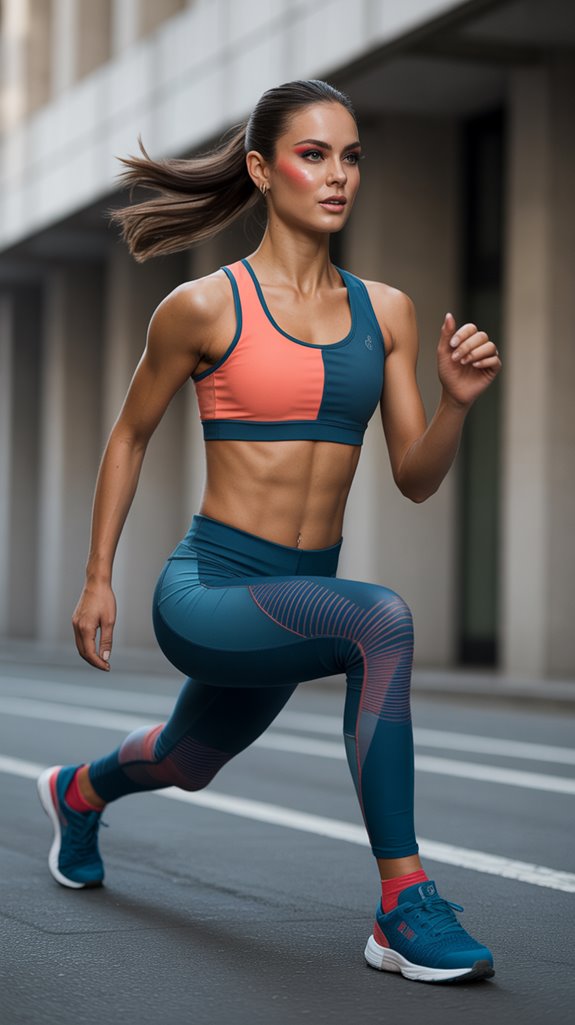
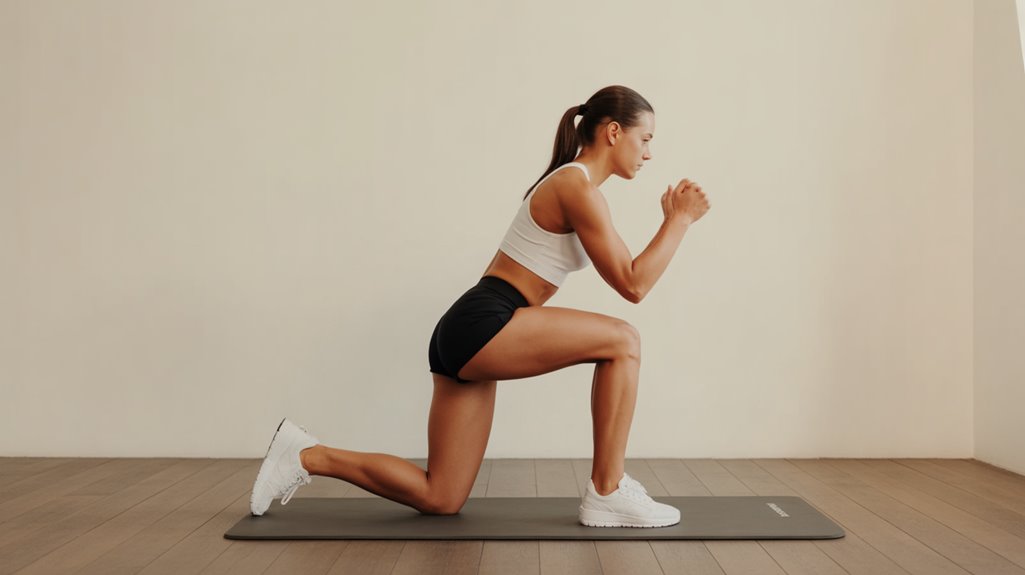
Walking lunges transform your lower body training by combining strength development with dynamic movement patterns that directly translate to real-world activities. You’ll engage your quads, glutes, and hamstrings while demanding continuous balance training through single-leg loading and forward progression. This unilateral approach delivers superior muscle activation compared to bilateral movements, forcing each leg to work independently and correcting asymmetries that lead to injury.
The exercise enhances your proprioceptive systems through dynamic stabilization requirements at the hips, knees, and ankles. You’re building functional power that carries over to running, climbing stairs, and sports-specific movements requiring directional changes. Your core remains continuously engaged to maintain balance and stability throughout the entire movement pattern. Beyond strength gains, you’ll elevate your heart rate considerably, creating cardiovascular benefits while improving hip mobility—essential for countering sedentary lifestyle effects and preventing lower back tension. Pairing walking lunges with breathable fabrics and smart layering helps keep you comfortable during outdoor workouts and hikes.
Romanian Deadlifts for Hamstring Development
- Bar travels close to your legs as you push your hips back, maintaining a flat back throughout the descent
- Stop when you feel maximum hamstring stretch—not when the weight touches the floor
- Drive through your hips to return to standing, squeezing your glutes at the top
This movement delivers superior hamstring activation compared to conventional deadlifts, building posterior chain strength that translates directly to sprint speed and injury resilience. The exercise also strengthens your erector spinae muscles, which stabilize your spine and maintain proper posture during the entire movement. Many lifters pair this with high-waisted leggings to combine function and comfort during training.
Bulgarian Split Squats for Unilateral Leg Training
While bilateral exercises like back squats remain foundational for leg development, Bulgarian split squats address a critical gap that compound movements often miss: unilateral strength and left-right symmetry. By isolating each leg independently, you’ll uncover muscle imbalances that bilateral patterns conceal, producing 70-85% force output from your lead leg while demanding enhanced stabilization from hip adductors, abductors, and core musculature.
This unilateral training delivers substantial quadriceps and gluteal activation—rivaling traditional squats for hypertrophy—while reducing spinal loading and back strain. You’ll develop improved balance, coordination, and proprioception through deep ranges of motion that enhance hip and knee mobility. The exercise requires strong core support to maintain proper alignment throughout the movement. The athletic carryover is significant: increased running speed, vertical jump height, and single-leg power critical for sprinting and change-of-direction movements. Whether targeting corrective protocols or explosive performance, Bulgarian split squats provide versatile progression through varied loading options.
Step-Ups for Single-Leg Strength and Stability
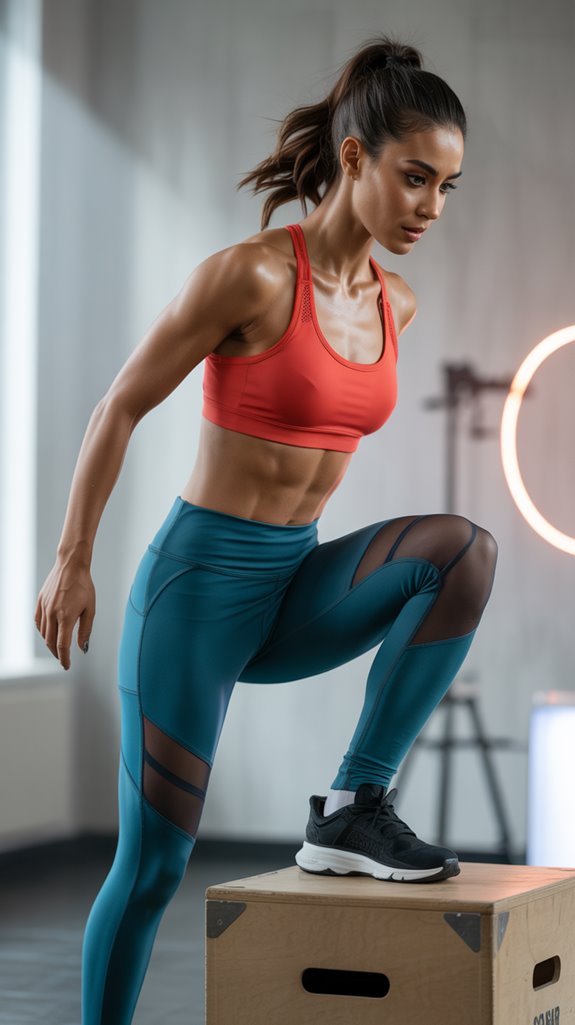
Step-ups complement Bulgarian split squats by offering another powerful unilateral tool, but with one key advantage: they better replicate the fundamental human movement of climbing. Among single leg variations, step-ups uniquely develop drive-through power while integrating balance training into every repetition.
Execute them with precision:
- Plant your entire foot on the box, weight driving through your heel as your hip, knee, and ankle align vertically—imagine pushing the platform downward rather than pulling yourself up.
- Ascend using only your elevated leg’s force, keeping your trailing foot light and passive to maximize unilateral stimulus.
- Control your descent with deliberate tension, spending three seconds lowering to amplify eccentric strength gains.
Progressive overload through height increases or added load systematically builds single-leg capacity that transfers directly to athletic performance and injury prevention. The movement targets multiple muscle groups including glutes, quadriceps, hamstrings, and core stabilizers throughout the entire range of motion.
Goblet Squats for Core and Leg Activation
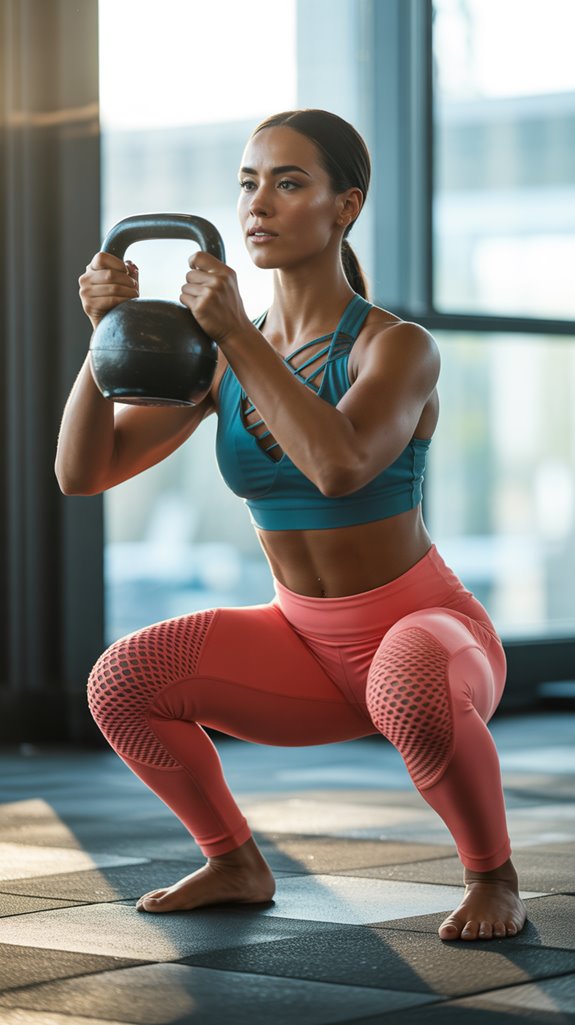
Goblet squats transform the traditional squat into a teaching tool that simultaneously builds your legs while fortifying your entire core. By holding weight at chest height, you’ll discover immediate goblet squat benefits: your abs engage isometrically to prevent spinal flexion, while your quadriceps and glutes power through each rep with remarkable efficiency.
Proper goblet technique demands you maintain an upright torso with elbows tucked, creating natural counterbalance that enables deeper squat depth than back-loaded variations. You’ll notice reduced spinal compression and enhanced knee tracking as the front load guides your movement pattern. This positioning teaches effective bracing while strengthening your upper back and grip simultaneously. The exercise activates hamstrings and calves alongside your primary movers, making it a comprehensive lower body movement.
For beginners, goblet squats offer accessible progression from bodyweight movements, building proficiency before advancing to barbell work. You’re developing functional strength that translates directly into everyday performance.
Glute Bridges to Strengthen Your Posterior Chain
Because your posterior chain powers nearly every athletic movement and daily activity you perform, glute bridges deserve a central place in your training routine. This exercise delivers exceptional glute activation while providing core stabilization and injury prevention benefits that extend throughout your lower body.
Master these technique essentials for ideal muscle engagement:
- Position your feet shoulder-width apart, heels 6–8 inches from your glutes, and drive forcefully through your heels
- Create a straight line from shoulders to knees at peak contraction, squeezing your glutes hard while keeping abs engaged
- Avoid overarching your lower back—this common mistake reduces effectiveness and compromises safety
You’ll experience mobility enhancement and rehabilitation benefits within two weeks of consistent practice. The glute bridge also engages your hamstrings, working multiple muscle groups simultaneously for comprehensive lower body development. Progress through exercise variations like banded bridges for gluteus medius activation or single-leg versions for performance improvement and advanced strength development.
Lateral Lunges for Multidirectional Movement
Most athletic movements and daily activities require you to change direction quickly, yet traditional forward-backward exercises leave critical movement patterns untrained. Lateral lunges fill this gap by delivering exceptional lateral movement benefits—strengthening your adductors, glutes, hamstrings, and quadriceps while engaging muscles in your inner and outer thighs that conventional lunges miss.
Execute this movement by stepping sideways with feet hip-width apart, keeping your chest up and core engaged. As you bend one knee, verify it tracks with your toes—critical knee alignment tips include preventing inward collapse by pushing gently outward. Your opposite leg stays straight, both feet pointing forward throughout. Beyond building strength, these lunges promote hip mobility and increase flexibility in your adductors through their dynamic stretching action.
Start with 8–12 reps per side, prioritizing form over speed. Progress by adding weight, pausing at depth, or alternating sides dynamically during warmups.
Standing Calf Raises for Lower Leg Development
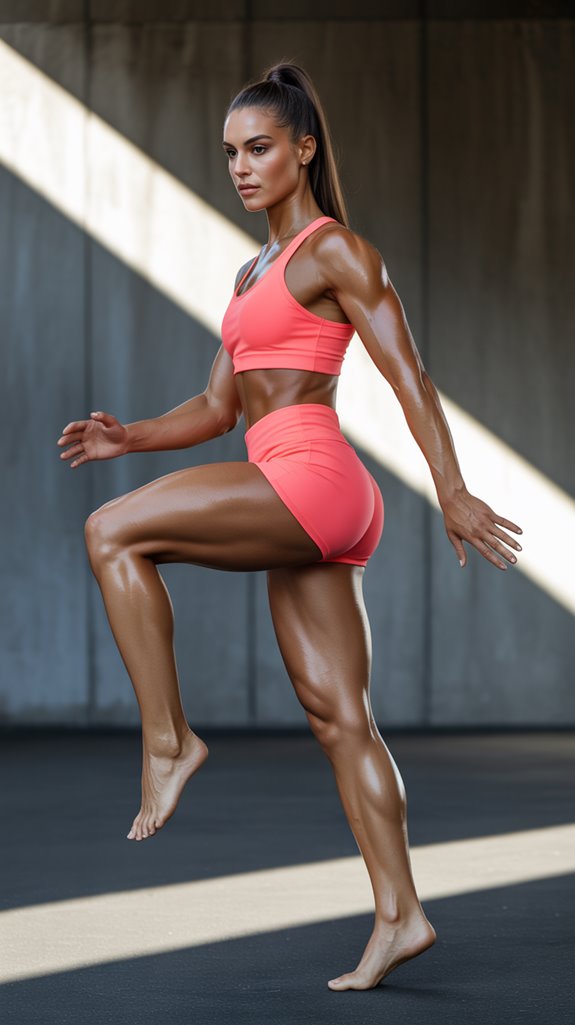
Execute standing calf raises with precision:
- Position yourself on a raised platform with your forefeet planted and heels suspended, maintaining straight knees throughout the movement
- Drive through your toes explosively, achieving maximum contraction at the peak position before controlling the descent below parallel
- Progress systematically by adding external resistance or manipulating tempo variables to intensify mechanical tension
Your enhanced lower leg strength translates directly to improved vertical jump height, sprinting efficiency, and multidirectional agility across athletic endeavors. The straight-leg position predominantly activates the gastrocnemius muscle, which contains fast-twitch fibers essential for explosive movements.
Leg Curls to Target Your Hamstrings
While compound movements like squats and deadlifts recruit your hamstrings, they don’t isolate these critical posterior chain muscles the way leg curls do. You’ll maximize hamstring activation by choosing between seated or lying variations—seated targets the inner hamstrings while lying emphasizes the outer portion. Execute each rep with controlled precision: one second concentric, three seconds eccentric. This tempo enhances muscle stimulation and builds strength effectively.
Maintain upper body stability throughout the movement to prevent lower back strain and guarantee proper targeting. Squeeze at peak contraction, then lower with deliberate control through full range of motion. Strong hamstrings provide essential injury prevention benefits during explosive movements and reduce muscle imbalances that compromise athletic performance. The hamstring complex consists of three distinct muscles that work together to facilitate knee flexion and hip extension. Position machine pads correctly for your limb length to optimize form and results.
Conclusion
Ready to transform your leg day routine? You’ve now got nine powerful exercises that’ll strengthen every muscle from your glutes down to your calves. Whether you’re building functional power with lunges or isolating those hamstrings with curls, you’re equipped to create balanced, effective workouts. Don’t overthink it—pick three to five exercises, focus on proper form, and you’ll see results. Your stronger, more sculpted legs are waiting. Let’s get started!