
You’ll love these face workouts that target your facial muscles for a naturally lifted, sculpted appearance. Start with cheek lifters and happy cheeks techniques to define your mid-face and minimize sagging. Try eyebrow lifters to tone your upper face, while facial stretching improves symmetry and coordination. Don’t forget frontalis relaxation for smoother forehead lines and tongue strengthening for enhanced facial expression. Add self-massage for scar improvement, neck elasticity exercises, and tension release techniques to complete your routine. The following exercises reveal exactly how to perform each movement for maximum results.
Key Takeaways
- Cheek Lifter exercises use “O” shape smiles and balloon blows to enhance volume and minimize nasolabial folds through consistent practice.
- Happy Cheeks Sculpting targets mid-face aging by sliding fingers upward toward cheekbones while pulsing muscles for twenty seconds.
- Eyebrow Lifter tones upper face by applying downward pressure above brows during ten-second contractions repeated ten times daily.
- Tongue Strengthening improves lower-face firmness through range-of-motion exercises and resistance training with directional tongue presses against spoons.
- Neck Elasticity Exercises like “kisses to ceiling” and chin tucks strengthen muscles and tighten structures against gravity effects.
Cheek Lifter for Defined Contours
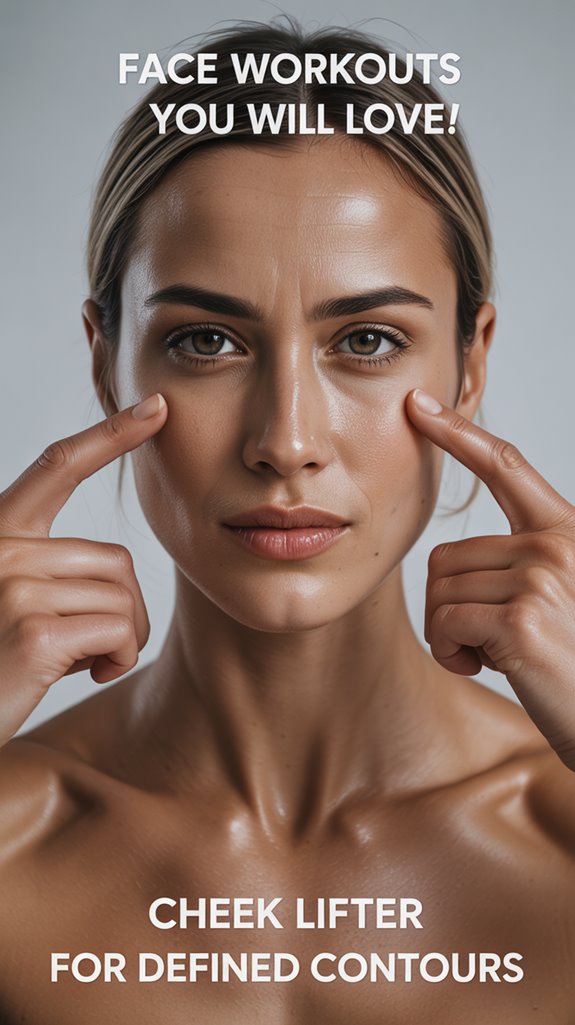
When you’re looking to sculpt more defined facial contours without surgery, cheek lifter exercises offer a practical, no-cost solution. These targeted movements engage your zygomaticus and buccinator muscles, directly enhancing cheek volume and structural definition. You’ll execute techniques like the “O” shape and smile—hiding your teeth while forming an “O,” then smiling—for six to seven reps daily. The fish face and balloon blow methods further activate these muscles, promoting improved tone and firmness. Research confirms that consistent practice lifts sagging tissue, minimizes nasolabial folds, and supports facial rejuvenation through enhanced blood circulation and lymphatic drainage. Practical routines can be adapted for beginners and advanced users to keep workouts engaging and safe while progressing over time engaging routines. Perform these exercises with steady, controlled movements, tracking progress through visible muscle fatigue and gradual contour refinement over several weeks for ideal, lasting results. For optimal effectiveness, smile without showing teeth while placing fingers at the corners of your mouth, then gently lift your cheeks up towards your eyes and hold for 10 seconds.
Happy Cheeks Sculpting Technique

Because the mid-face region often shows the earliest signs of aging, the Happy Cheeks Sculpting technique targets this vulnerable area through precise muscle engagement and manual resistance. You’ll activate your zygomaticus major and minor muscles through controlled lifting techniques that reshape your facial contours.
Execution Protocol:
- Position and pressure: Smile without showing teeth, roll your lips outward, then press your index fingers firmly at your mouth corners.
- Directional lift: Slide fingers upward toward cheekbones with sustained pressure, lifting muscle strands over the bone’s apex without exceeding this boundary.
- Isolation and duration: Pulse your mid-cheek muscles gently for 20 seconds, maintaining conscious connection while keeping your forehead relaxed. This technique strengthens facial muscles that hold fat pads in place, preventing the downward migration that contributes to jowls.
Repeat this sequence 2-3 times per session for ideal cheekbone definition and jowl elevation. Adding consistent practice and proper form can enhance core facial strength and improve long-term contouring results.
Eyebrow Lifter for Upper Face Toning

As drooping eyebrows create the illusion of exhaustion and add years to your appearance, the Eyebrow Lifter technique offers a targeted solution through direct frontalis muscle engagement. Position your index fingers above each eyebrow, applying firm downward pressure while simultaneously attempting to raise your brows against this resistance. This creates ideal muscle engagement that builds strength and definition.
Hold each contraction for 10 seconds, completing 10 repetitions daily. You’ll execute these eyebrow exercises while seated upright to maximize control and precision. The technique’s non-invasive nature delivers measurable results without costly interventions or equipment.
Consistent practice enhances upper face muscle tone, naturally elevates your brow arch, and reduces forehead tension. You’re implementing a cost-effective strategy that improves circulation while promoting skin radiance and minimizing wrinkles through controlled, deliberate movement patterns. This approach works similarly to traditional yoga for body muscles, applying the same strengthening principles to your facial structure. Additionally, incorporating varied Pilates workouts into your routine can help you explore different styles and maintain motivation.
Facial Stretching for Symmetry and Coordination

Though facial asymmetry affects nearly everyone to some degree, targeted stretching techniques can dramatically improve your face’s balance and muscular coordination. These facial balance techniques work by addressing overactive muscles on your unaffected side while strengthening weakened areas, creating harmonious movement patterns.
Advanced muscle coordination strategies include:
- Masseter relaxation protocols – Apply gentle pressure combined with mouth-opening stretches to reduce jaw tension and promote balanced movement
- Lateral pterygoid activation – Perform jaw deviation exercises by moving your jaw away from the deviated side, holding for several seconds
- Neuromuscular re-education routines – Practice slow, deliberate facial movements to retrain isolated, symmetrical muscle contractions
Daily practice yields measurable improvements in resting symmetry, voluntary movement control, and physical function scores while minimizing unwanted synkinetic patterns. Research demonstrates that incorporating visual feedback during these exercises enhances motor learning and proprioception, leading to more effective facial muscle retraining.
Frontalis Relaxation to Smooth Forehead Lines

Your forehead muscles work overtime throughout the day, constantly contracting as you express surprise, concentrate on tasks, or squint against bright light. This chronic tension in your frontalis muscle creates pronounced horizontal lines and persistent tightness. Strategic forehead massage combined with targeted relaxation techniques can greatly reduce these visible signs of tension.
Begin by applying light facial oil, then use your fingertips to perform smooth upward glides from eyebrows to hairline. Incorporate acupressure at your third eye point between the brows, holding for 10-15 seconds while breathing deeply. Follow with gentle circular motions at your temples to enhance parasympathetic activation.
Progressive muscle relaxation—deliberately tensing then releasing your frontalis—trains muscular awareness and control. This approach directly addresses the physiological responses to stress, including the muscle tension that manifests visibly in your forehead. Consistent practice improves circulation, softens fine lines, and establishes lasting tension reduction patterns.
Corrugator Exercise to Minimize Brow Wrinkles

The vertical creases between your eyebrows—those stubborn “11 lines”—develop primarily from the corrugator supercilii muscle’s repeated contractions. This small pyramidal muscle draws your brows medially and inferiorly during frowning, squinting, and concentration. While clinical evidence for corrugator exercises remains limited compared to botulinum toxin interventions, targeted brow movement techniques offer potential neuromuscular retraining benefits.
Advanced wrinkle prevention strategies include:
- Controlled resistance work: Place fingertips above each eyebrow’s midpoint, gently resist inward brow movements while consciously engaging the corrugator for 5-second isometric holds
- Antagonistic activation: Alternate between deliberate corrugator contractions and complete releases to improve voluntary muscle control
- Integration protocols: Combine these movements with massage techniques targeting the glabella region to address chronic tension patterns
Consistency determines outcomes more than intensity. The corrugator receives its motor control from the temporal branches of the facial nerve, which enables the precise movements required for these facial exercises.
Tongue Strengthening for Facial Expression
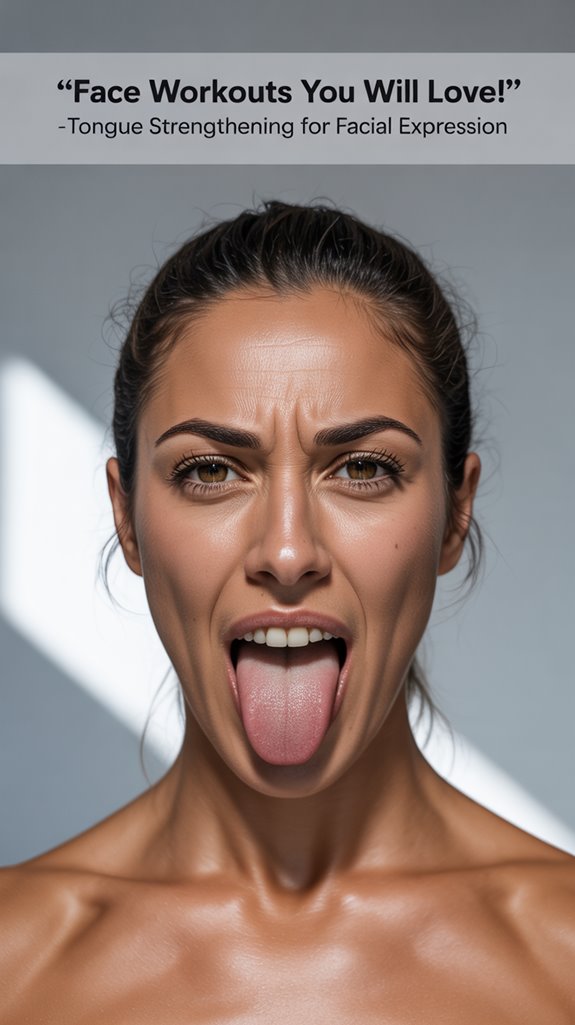
While most face workout discussions focus exclusively on external facial muscles, your tongue—the body’s most flexible muscle—creates foundational support for lower facial structure and expression dynamics. Strategic tongue strengthening directly enhances facial coordination through integrated perioral and midface activation.
Begin with range-of-motion exercises: extend your tongue between lips for 5 seconds, retract it to touch your palate, then sweep tip-to-corners building lateral balance. Progress to resistance training by pressing your tongue forward, upward, and sideways against a spoon, holding each push for 3-5 seconds. Monitor for pain and modify intensity as needed to ensure exercises remain comfortable and effective.
Advanced practitioners combine movements—smile broadly while executing tongue circles, or perform effortful swallows with maximal facial contraction. This tongue agility translates to improved articulation clarity, visible lower-face firmness, and enhanced expressiveness essential for dynamic social communication.
Self-Massage for Scar Improvement

Facial scars—whether from surgery, injury, or acne—respond remarkably well to targeted self-massage that remodels tissue throughout the critical 12–18 month healing window. Begin once your scar fully closes and scabbing resolves, understanding that ideal healing timing makes early intervention considerably more effective than delayed treatment.
Master these three essential scar massage techniques:
- Effleurage: Use long, sweeping strokes to increase circulation and prepare tissue
- Petrissage: Pinch and roll skin toward the scar’s center to break down thickened collagen
- Cross-friction: Apply firm pressure perpendicular to the scar line to release adhesions
Pair these methods with silicone-based products for superior glide and hydration. Commit to 10-minute sessions twice daily for six months. You’ll notice reduced sensitivity, improved color, flatter texture, and enhanced mobility—without clinical intervention. Beyond physical improvement, taking control over healing can enhance your confidence as you actively participate in your recovery journey.
Neck Skin Elasticity Exercises

Just as targeted massage reshapes facial scars, specific exercises can transform the appearance and resilience of neck skin—an area that betrays age faster than almost any other. You’ll strengthen neck muscle groups through chin tucks, forehead resistance, and head lifts that engage the platysma. Execute “kisses to ceiling” daily—twenty reps tighten underlying structures while combating gravity’s pull. Complement movement with cucumber paste or almond oil massage to stimulate collagen synthesis and enhance skin hydration. Stretch methodically: tilt back, rotate gently, and hold ear-to-shoulder positions to maintain elasticity. Weight management and posture correction prevent “tech neck” strain. Incorporate side neck stretches and neck rotations to further tone the jawline and improve overall neck shape. Clinical twenty-week programs demonstrate measurable improvement when you pair these protocols with sunscreen, balanced nutrition rich in fruits and vegetables, and consistent mineral water intake.
Facial Tension Release for Natural Expression

Because emotional stress and repetitive expressions create habitual contraction patterns in facial muscles, you’ll need deliberate release techniques to restore natural movement and prevent premature aging. Facial tension accumulates in the masseter, temporalis, and mimetic muscles, restricting authentic expression and accelerating tissue aging.
Master these evidence-based protocols for emotional release:
- Trigger Point Therapy: Apply sustained pressure at the zygomatic ridge and masseter insertion points for 5 minutes, advancing slowly toward temples
- Pandiculation Sequences: Gradually contract then release facial muscles to reset neuromuscular patterns and dissolve chronic holding
- Myofascial Traction: Use slow, upward strokes from jawline to temples for 5-10 minutes, incorporating diaphragmatic breathing
These techniques activate parasympathetic responses, enhance lymphatic drainage, and restore muscular elasticity—creating lasting improvements in facial mobility and expression. For optimal results, perform trigger point work early in the day when facial muscles are most responsive to release techniques.
Conclusion
You’ve discovered nine powerful exercises to sculpt, lift, and rejuvenate your face from within. Like a sculptor gradually disclosing the masterpiece hidden in marble, you’ll chip away tension and awaken dormant muscles with each deliberate movement. Your face will become your canvas, and these techniques are your tools for transformation. Consistency’s your secret weapon—just five minutes daily will reveal a more radiant, defined, and youthful version of yourself staring back from the mirror.