
This post contains affiliate links. As an Amazon Associate I earn from qualifying purchases.
You’ll love these glute-transforming workouts that build strength and power from every angle. Start with hip thrusts for maximum activation, then challenge your lower glutes with Bulgarian split squats and curtsy lunges. Shape your upper glutes using lateral band walks, fire hydrants, and clamshells, while Romanian deadlifts strengthen your entire posterior chain. Deep squats and step-ups with knee drive add explosive functional power. Each exercise targets specific glute fibers to enhance athletic performance, reduce injury risk, and create the sculpted results you’re after.
Key Takeaways
- Hip thrusts provide superior glute activation compared to squats, building strength through progressive overload while maintaining proper spine alignment.
- Deep squats recruit 25% more gluteus maximus fibers than partial squats, enhancing muscle growth and vertical jump performance.
- Bulgarian split squats target lower glutes unilaterally, correcting imbalances while replicating back squat activation with reduced spinal load.
- Lateral band walks and fire hydrants isolate upper glutes and gluteus medius, creating the shelf appearance and improving hip stability.
- Romanian deadlifts strengthen the entire posterior chain, targeting glutes, hamstrings, and lower back while enhancing athletic performance.
Hip Thrusts for Maximum Glute Activation

When it comes to building a powerful, well-developed posterior, hip thrusts stand out as the undisputed champion of glute exercises. You’ll activate your gluteus maximus, medius, and minimus more effectively than with squats, generating superior EMG readings throughout the movement. Position your upper back on a bench matching your tibia height, feet shoulder-width apart, and drive through your heels—not your toes. Squeeze hard at the top while maintaining a neutral spine to avoid lumbar hyperextension. Consistent training with progressive overload also helps ensure continual improvements in strength and muscle size progressive overload.
Master various hip thrust variations by adjusting your stance width and toe angle. Add resistance bands above your knees to enhance hip abduction and external rotation. These glute training techniques minimize quad involvement while maximizing targeted development. Hip thrusts also improve athletic performance and power output while reducing injury risk in lower body movements. Expect significant hypertrophy in 6-9 weeks with consistent execution and proper form.
Bulgarian Split Squats to Build Lower Glute Strength
Bulgarian split squats deliver unmatched lower glute development through their unique unilateral loading pattern. You’ll maximize gluteus maximus recruitment through intense hip extension while addressing muscle imbalances that bilateral movements miss. This single-leg emphasis forces each glute to work harder, creating superior strength adaptations compared to traditional squats.
Master proper glute activation techniques by positioning your shoulders directly above your hips and driving through your front heel. You’ll engage core stabilizers extensively while building hip and pelvic stability that prevents compensation patterns and reduces injury risk. The hip adductors stabilize your hips throughout the movement, helping prevent knee pain during each repetition.
Progress through split squat variations by adjusting rear foot elevation height or adding external loads. You’ll replicate back squat muscle activation using considerably less weight, sparing your lower back while developing explosive hip extension power essential for sprinting, jumping, and functional daily movements. These workouts are part of a set of glute focused workouts designed to energize your routine and keep training enjoyable.
Lateral Band Walks for Upper Glute Shelf Development
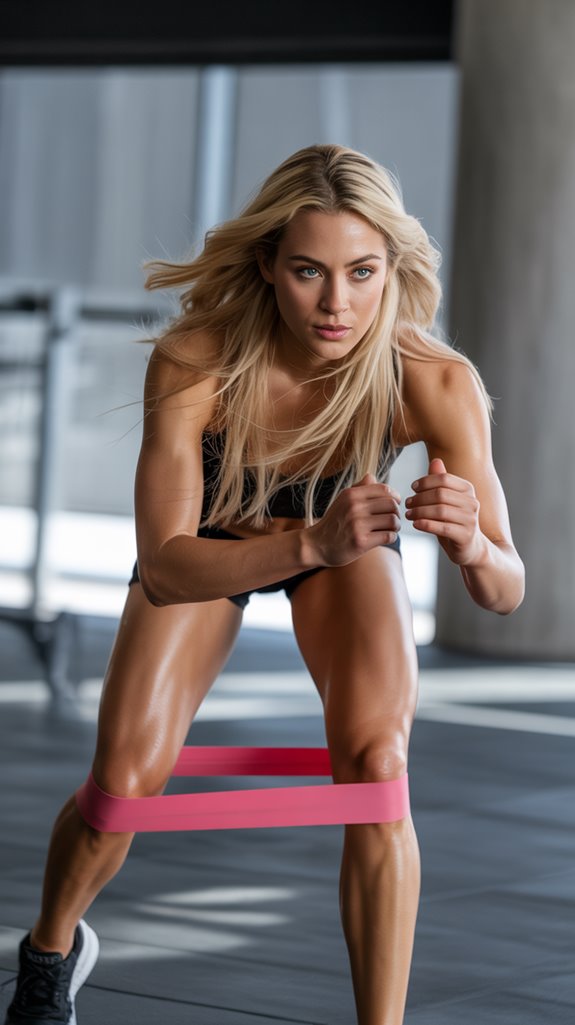
Lateral band walks strategically isolate your gluteus medius and minimus—the upper glute muscles responsible for creating that coveted shelf appearance at the top of your backside. This targeted lateral resistance generates superior glute activation compared to traditional squat variations, triggering muscle hypertrophy in precisely the right areas. You’ll enhance hip stability and pelvic alignment while performing controlled steps with bands positioned above your knees. Maintain a quarter-squat stance, driving your knees outward to maximize recruitment. Execute 2–4 sets of 10–20 steps per direction as your warm-up or finisher. Beyond aesthetics, you’re building injury prevention mechanisms and core stability essential for athletic performance. Physical therapists utilize these rehabilitation techniques to correct movement dysfunction, making them invaluable whether you’re pursuing competitive excellence or longevity in training. This exercise strengthens often under-worked glute muscles that support better lifting techniques and running efficiency. Incorporating these movements into a well-rounded lower body routine ensures balanced strength, flexibility, and improved functional performance.
Romanian Deadlifts to Strengthen Your Posterior Chain

While lateral movements build your upper glutes, you’ll need a powerhouse exercise to develop the entire posterior chain—enter the Romanian deadlift. This hip-hinge movement targets your hamstrings, glutes, and lower back with superior muscle engagement compared to conventional deadlifts.
You’ll start with the bar at hip level, maintaining a neutral spine as you execute controlled eccentric phases. Keep your feet shoulder-width apart, shins vertical, and focus on the hip hinge rather than knee bend. This technique reduces lower back strain while maximizing hamstring recruitment. The movement also engages your adductor magnus to stabilize and support your hips throughout the lift.
The RDL’s compound nature elevates your metabolism, builds grip strength, and enhances athletic performance through improved functional core strength. You’ll use lighter loads than traditional deadlifts, prioritizing form and muscle activation that translates directly to better posture, balance, and injury prevention.
Glute Bridges You Can Do Anywhere
The glute bridge stands as one of fitness’s most accessible yet powerful exercises—you’ll need nothing but floor space and your own bodyweight to activate your entire posterior chain. EMG studies confirm exceptional gluteus maximus recruitment, while research demonstrates improved lumbar strength and reduced low back pain. You’ll counteract prolonged sitting’s negative effects by addressing hip flexor tightness and glute dormancy.
Glute bridge benefits extend beyond muscle building—expect enhanced core stability, balance, and functional strength for daily movements. Execute with precision: press through heels, maintain neutral spine with ribs down, and squeeze glutes at full hip extension. For optimal results, perform 10-20 work sets per week across 2-5 training sessions.
Progress through strategic glute bridge variations: single-leg execution intensifies demand, band resistance amplifies hip abduction, feet elevation increases range of motion, and isometric holds maximize time-under-tension for hypertrophy adaptation.
Curtsy Lunges for Multiplanar Glute Engagement

Unlike conventional forward-and-backward leg movements, curtsy lunges introduce rotational and lateral force vectors that activate your gluteus maximus, medius, and minimus simultaneously. This three-dimensional engagement produces up to 20% greater glute fiber recruitment than standard lunges, making curtsy lunge benefits substantial for thorough lower body development.
The exercise targets quadriceps, hamstrings, adductors, and calves while demanding core stabilization. Your gluteus medius and minimus work to prevent hip drop, enhancing pelvic stability by over 30%. These glute activation techniques address weaknesses that sagittal-plane-only movements miss. The movement also strengthens hard-to-activate inner thigh muscles essential for functional movements and athletic performance.
Progress from bodyweight execution to loaded variations using dumbbells or kettlebells. Add side kicks or repeater variations to challenge stabilizers further. Maintain neutral spine alignment, verify your front knee tracks forward, and descend to 90° for maximal glute engagement and injury prevention.
Fire Hydrants to Shape Your Outer Glutes
Building on multiplanar movements, fire hydrants deliver targeted outer glute development through hip abduction and external rotation. This exercise specifically activates your gluteus maximus and medius, sculpting the lateral hip contours while enhancing hip stability essential for single-leg movements and daily activities.
Execute fire hydrants from a quadruped position, lifting your bent knee laterally while maintaining a neutral spine and engaged core. Avoid torso rotation—movement originates solely from the hip joint. Progress intensity through resistance bands above the knees, ankle weights, or end-range pulses that maximize time-under-tension. Position shoulders above hands and hips above knees to establish proper foundational alignment.
Integrate 3 sets of 10 repetitions per leg into your glute-focused circuits or warm-up protocols. This accessible exercise strengthens hip stabilizers, reduces lower back and knee pain, and promotes ideal outer glute activation without equipment requirements.
Deep Squats for Full Glute Complex Activation

Deep squats activate your entire glute complex more effectively than any partial-range variation, recruiting up to 25% more gluteus maximus fibers compared to shallow squats. By descending below parallel to a knee angle of 120° or more, you’ll maximize time under tension and stretch-mediated muscle hypertrophy through the complete length of your glutes.
This full range of motion shifts your center of mass, demanding greater hip extensor torque while shortening your hamstrings to prioritize glute recruitment. Studies demonstrate markedly superior glute growth over 10 weeks when you train at depth versus using heavier loads with restricted range.
You’ll also strengthen your gluteus medius and minimus for enhanced stability. Deep squats deliver improved vertical jump performance compared to partial squats, thanks to greater post-activation potentiation that enhances explosive power generation. Maintain neutral spinal alignment and progress gradually if mobility limits you. Master proper form to release extensive lower body development and functional strength.
Clamshells to Target Glute Medius and Minimus
While deep squats excel at developing your gluteus maximus, clamshells directly target the often-neglected gluteus medius and minimus—the smaller hip stabilizers that prevent injuries and improve your movement quality. You’ll maximize glute activation by lying side-positioned with knees bent 45–90°, maintaining stacked hips and shoulders as you lift your top knee while keeping feet together. Hold the peak contraction for 2-3 seconds, controlling your pelvis to prevent rolling—this isolation is vital for proper muscle engagement.
Execute 2–3 sets of 10–15 reps per side, progressing through clamshell variations by adding resistance bands above your knees or attempting side plank clamshells for combined core activation. These targeted strengthening exercises enhance pelvic stability during gait, protect against knee valgus collapse, and reduce lower back strain—essential adaptations for runners and athletes. Activating your glutes through exercises like clamshells increases power and explosiveness, which translates to improved athletic performance in various sports and activities.
Step-Ups With Knee Drive for Functional Glute Power
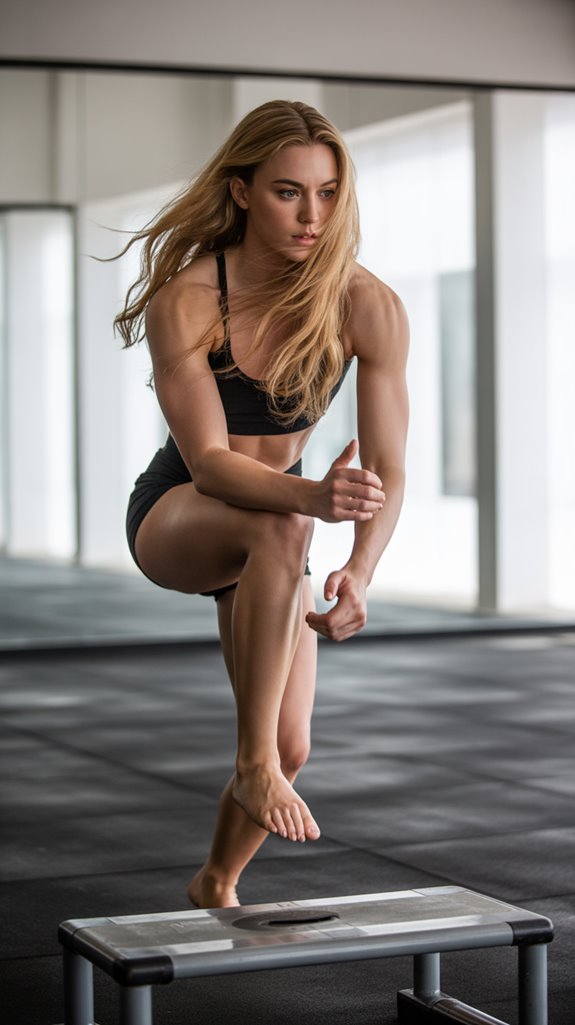
Step-ups with knee drive transform your glute training by combining explosive hip extension with dynamic stabilization—a movement pattern that directly mirrors athletic actions like sprinting and jumping. You’ll maximize glute recruitment by driving your lead foot downward into the platform rather than pushing off your back leg. Focus on aligning your knee, nose, and toe to enhance glute bias while minimizing quad compensation—proper knee alignment guarantees peak force transfer through the hip.
Incorporate pelvic rotation during ascent to target your glute medius and outer fibers, enhancing glute stability vital for injury prevention. Keep your step height below maximum hip flexion to maintain form integrity. Control your eccentric descent slowly, maintaining tension throughout the movement. This deliberate approach builds functional power while strengthening the stabilizers that support everyday movements and athletic performance.
Conclusion
You’ve got the perfect program to power up your peach! These brilliant booty-building movements will sculpt, strengthen, and shape your glutes from every angle. Whether you’re working out at home or hitting the gym, you’ll find fantastic, fun exercises that deliver real results. Don’t delay—dedicate yourself to these dynamic drills and you’ll develop a stronger, shapelier backside. Start today, stay consistent, and watch your glutes grow gloriously!