
This post contains affiliate links. As an Amazon Associate I earn from qualifying purchases.
You’ll build serious strength with resistance bands through nine powerhouse exercises that target your entire body. Start with banded squats and lateral walks to fire up your lower body, then move to chest presses and rows for upper body development. Don’t skip bicep curls, tricep extensions, and banded deadlifts for complete arm and posterior chain work. Add the Pallof press for core stability and finish with burpee-to-pull-apart combos for full-body conditioning. These versatile, joint-friendly movements deliver real results when you master the techniques ahead.
Key Takeaways
- Banded squats develop explosive lower body power while improving mobility and preventing knee valgus across multiple squat variations.
- Lateral band walks activate gluteus medius for hip stability, requiring controlled steps with constant tension in quarter squat position.
- Resistance band chest press targets pectorals, deltoids, and triceps while maintaining constant tension for upper body strength development.
- Pallof press builds core stability by resisting rotation, engaging abdominals and obliques through controlled holds and presses.
- Full-body burpee to band pull-apart combines explosive cardio with resistance training for comprehensive strength and metabolic conditioning.
Banded Squats for Lower Body Power

When you wrap a resistance band around your thighs and drop into a squat, you’re activating muscle groups that traditional bodyweight squats often miss. The external resistance forces your glutes—maximus, medius, and minimus—to fire harder while simultaneously engaging your quadriceps, hamstrings, and adductors. Band tension benefits extend beyond muscle activation: you’ll develop explosive power during the concentric phase, enhance joint stability, and improve movement mechanics by preventing knee valgus. Strategic band placement above your knees cues proper form while challenging stabilizers throughout the entire range of motion. You can integrate squat variations from air squats to weighted back squats, adjusting intensity for progressive overload. This versatility makes banded squats essential for athletes seeking functional strength and anyone committed to mastering lower body power development. The exercise also enhances range of motion in your hips, knees, and ankles, contributing to better mobility and performance in daily activities. Incorporating banded squats into a routine of leg workouts can improve overall strength, balance, and athletic performance.
Resistance Band Chest Press for Upper Body Strength

While banded squats build explosive lower body power, the resistance band chest press develops comparable strength through your upper body’s primary pushing muscles. Understanding chest press benefits starts with muscle activation—you’ll target your pectoralis major and minor while engaging anterior deltoids and triceps as stabilizers. Proper form requires precise setup: anchor bands at chest height, stand with feet shoulder-width apart, and position handles level with your chest. Press forward until arms nearly extend, then return with control while maintaining constant tension. Keep your core engaged and spine neutral throughout. Progress systematically by layering bands or adjusting hand positions to target different muscle fibers. The serratus anterior aids in shoulder blade movement during these pressing exercises, enhancing overall stability. Always inspect bands before use and secure anchor points properly. Master lighter resistances first—this foundation guarantees joint safety and ideal muscle recruitment patterns for advanced training. Consistency is key for results, so incorporate these exercises into regular workouts to see steady improvement.
Lateral Band Walks to Activate Your Glutes

Your glutes need targeted lateral work to function at their best, and resistance band walks deliver precisely that stimulus. This movement prioritizes the gluteus medius—essential for hip stability and proper alignment during compound lifts. Position your resistance band above or below your knees, establish shoulder-width stance, then assume a quarter squat with engaged core. Take controlled 3–4 inch steps laterally while actively driving your knees outward, maintaining constant tension throughout. Resistance bands are a versatile tool that improve strength, flexibility, and overall fitness by providing variable tension throughout the movement (band workouts).
Avoid common pitfalls: don’t let knees collapse inward, take excessively large steps, or release band tension between movements. Program 10–15 steps per direction for 2–3 sets as your warm-up before squatting or deadlifting. For progression, use heavier bands or extend duration. The exercise also incorporates forward and backward stepping variations to challenge your glutes from multiple angles. This focused glute activation corrects imbalances, prevents compensatory injuries, and builds the lateral strength required for athletic performance and functional movement mastery.
Banded Rows for a Stronger Back

Though often overlooked in favor of pressing movements, rowing exercises form the cornerstone of balanced upper body development and functional strength. Banded rows deliver exceptional muscle engagement across your rhomboids, trapezius, rear deltoids, and biceps while promoting scapular retraction that corrects rounded shoulders.
You’ll maximize results by maintaining a neutral spine with your core braced and chest elevated. Keep your elbows tight to your torso throughout each rep, squeezing your shoulder blades together at peak contraction. Start with moderate resistance—typically 10-15 reps for 2-4 sets. Starting with lighter resistance helps prevent injury while you perfect your form.
This exercise excels at injury prevention by strengthening stabilizing muscles around your shoulder joints and building balanced posterior chain development. Progress systematically by increasing band tension or volume. Whether you’re performing seated, standing, or single-arm variations, banded rows construct the resilient back musculature essential for athletic performance and postural integrity.
Resistance Band Bicep Curls for Arm Definition
Resistance band bicep curls deliver targeted arm development through variable tension that intensifies as you curl upward, creating constant muscle engagement throughout the entire movement. You’ll achieve superior muscle isolation by keeping your elbows stationary against your sides while maintaining neutral wrists throughout each repetition. Anchor the band securely under both feet, then execute controlled curls with full extension and contraction to maximize bicep activation.
Implement resistance variation through wide-grip curls for outer bicep emphasis, hammer curls for brachialis development, and crucifix curls for unique fiber recruitment. You’ll build balanced arms by training both long and short bicep heads while strengthening supporting forearm muscles. Program 12–20 repetitions for hypertrophy across 2-3 weekly sessions, adjusting resistance by spreading your feet wider or crossing bands. Switch exercises on different training days to target biceps from all angles and prevent adaptation. This joint-friendly approach delivers consistent strength gains and definition.
Standing Band Shoulder Press for Deltoid Development

The standing band shoulder press activates all three deltoid heads simultaneously while delivering variable resistance that intensifies precisely when your muscles reach their strongest position at lockout. This unique resistance profile maximizes deltoid engagement throughout the entire range of motion, with strongest emphasis on your anterior deltoid during the pressing phase.
Anchor the band securely beneath your feet, grip handles at shoulder height with palms forward, and press overhead until arms fully extend. Maintain strict core bracing to prevent lower back arching while controlling the descent phase to sustain band tension. Your triceps and upper trapezius assist the movement while your core stabilizers work continuously to counteract the band’s variable pull. Resistance bands offer portability and versatility that make them ideal for training at home or the gym.
Progress systematically by selecting heavier bands or widening your stance, ensuring each repetition approaches muscular fatigue for ideal hypertrophy stimulus.
Banded Deadlifts to Target Your Hamstrings

Banded deadlifts revolutionize hamstring development by introducing accommodating resistance that targets your posterior chain exactly where traditional barbell deadlifts fall short. As band tension increases toward lockout, you’ll recruit considerably more hamstring fibers throughout the movement’s full range—especially at the sticking point where your leverage weakens. This modified strength curve forces you to generate maximal force precisely when your hamstrings need it most.
The bands enforce proper bar path and penalize technique deviations, making your hamstrings and lats work synergistically to stabilize against forward tension. Research validates that variable resistance training delivers measurable improvements in maximum strength compared to constant-resistance methods. Program 3–6 sets of 1–5 reps at ≥85% 1RM with 20–25% band tension for ideal hamstring strength gains. You’ll break plateaus while reducing spinal compression—perfect for targeting posterior chain development without excessive axial loading.
Core-Crushing Pallof Press With Resistance Bands
While deadlifts build raw posterior chain power, your core demands its own specialized resistance training to handle rotational forces that threaten spinal integrity during compound lifts and athletic movements. The Pallof press delivers precisely that—forcing your rectus abdominis, transverse abdominis, and obliques to resist band-induced rotation while maintaining strict vertical posture.
Anchor your band at chest height, stand perpendicular to the anchor point, and press forward with extended arms while your torso fights rotational pull. This anti-rotation mechanism builds core stability that transfers directly to performance and injury prevention. The exercise also activates your glutes, providing a strong foundation that enhances overall lifting performance.
Execute 8–15 controlled reps per side across 2–4 sets. Progress through half-kneeling and double-kneeling variations as your stability increases. Move deliberately—rushing compromises the anti-rotational tension that makes this exercise effective for reducing lower back pain and enhancing functional strength.
Resistance Band Tricep Extensions for Sculpted Arms
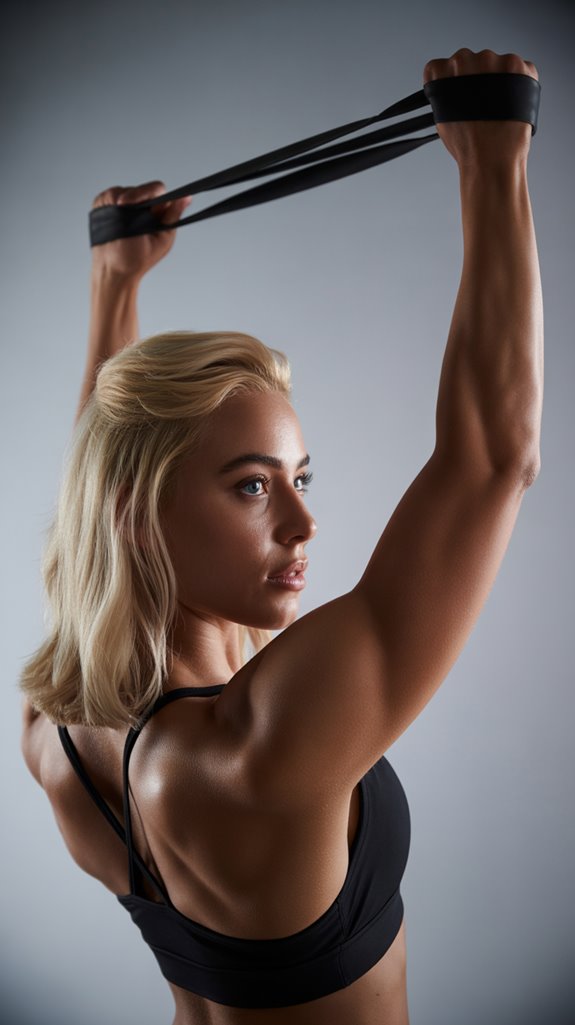
Execute 8–15 reps across 2–4 sets, selecting resistance that challenges your final repetitions. Keep your core engaged and spine neutral to prevent lumbar arching. Control tempo deliberately; slower movements eliminate momentum and enhance tricep extension techniques. Progress systematically from lighter to heavier bands as form solidifies. Breathe out during the extension phase and inhale as you return to the starting position.
Full-Body Burpee to Band Pull-Apart Combo
Transform your cardio routine by merging explosive burpees with targeted resistance band pull-aparts, creating a metabolic powerhouse that trains strength and endurance simultaneously. You’ll place the band under your feet, squat down with chest elevated, then kick back to plank while maintaining tension. Execute a push-up, jump forward, stand explosively, and finish with a controlled pull-apart engaging your posterior deltoids and scapular stabilizers.
This integration addresses standard burpee modifications by adding direct upper-back work often neglected in traditional formats. Select appropriate band resistance matching your strength level—excessive tension compromises form while insufficient load limits adaptation. Program intervals of 60 seconds work with 30 seconds rest, scaling volume progressively. This combination enhances metabolic conditioning while promoting fat loss through the challenging pairing of cardiovascular and resistance movements.
Keep your core engaged throughout, preventing hip sag during plank phases. This compound movement pattern reinforces functional coordination while maximizing calorie expenditure and muscle activation across all major groups.
Conclusion
You’ve now got ten powerful resistance band exercises to transform your workouts anywhere, anytime. Here’s something remarkable: studies show that resistance band training can build muscle strength just as effectively as traditional weight training, with 25-30% less joint stress. That means you’re getting maximum results while protecting your body for long-term fitness. So grab your bands and start building the stronger, more defined physique you’ve been working toward. Your future self will thank you.