
This post contains affiliate links. As an Amazon Associate I earn from qualifying purchases.
You’ll transform your fitness routine with resistance band workouts that target every major muscle group. These versatile exercises include squats with bands for lower body strength, reverse flys to correct posture, lunges with torso twists for core power, and plank jacks for explosive conditioning. Add bent-over rows, bicep curls, lateral band walks, overhead presses, and standing chest presses to build balanced strength throughout your entire body. Bands provide variable resistance that adapts to your strength level while reducing injury risk compared to free weights. Discover how each movement maximizes muscle activation and delivers results.
Key Takeaways
- Squats with bands activate quads, glutes, and hamstrongs while reducing knee valgus through variable resistance and hip abductor engagement.
- Lunge with torso twist combines lower body power and core rotation, targeting glutes, quads, hamstrings, and obliques effectively.
- Lateral band walks strengthen hip abductors and gluteus medius, preventing injuries when performed 2-3 times weekly with proper form.
- Reverse fly corrects forward shoulder posture by targeting rear deltoids, rhomboids, and trapezius while improving scapular control and stability.
- Bicep curls with resistance bands maintain constant tension throughout lifts, reducing joint impact while enhancing muscle activation and portability.
Squats With Bands
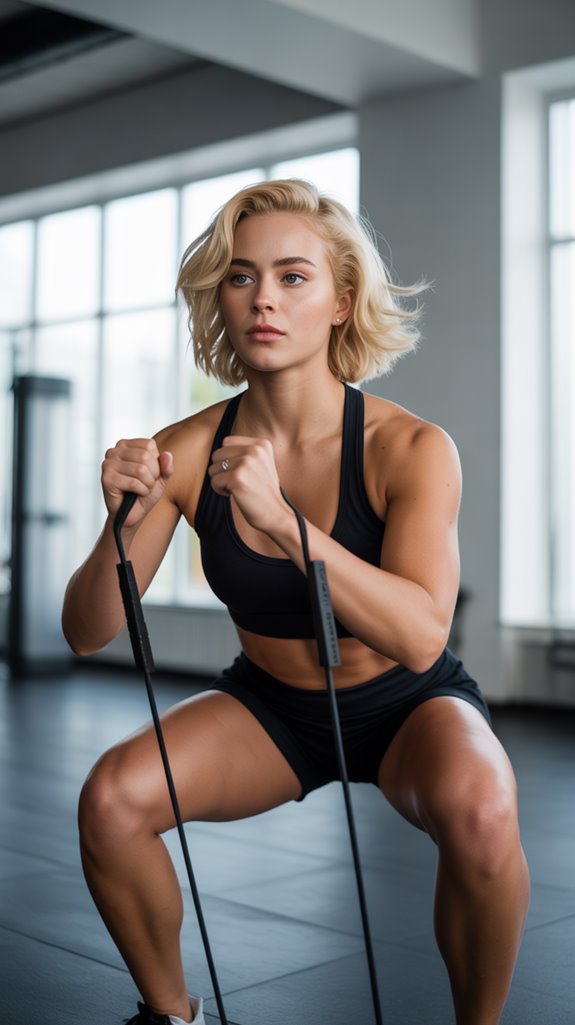
Resistance band squats transform a classic bodyweight exercise into a dynamic strength-building movement that targets your lower body from multiple angles. You’ll activate your quadriceps, glutes, hamstrings, and core while improving balance and stability throughout the movement. Band placement greatly impacts muscle recruitment—positioning bands above your knees engages hip abductors and external rotators, reducing knee valgus while maximizing gluteus medius activation.
The variable resistance from bands creates progressive tension, challenging your muscles differently than traditional weights. You’ll experience increased muscle activation during both eccentric and concentric phases, with particular emphasis on the lockout position. Choose from loop bands, mini bands, or free bands depending on your squat variations and training goals. Resistance bands are low-cost and convenient, making them an effective option for building muscle and strength in your glutes without requiring expensive equipment. Maintain proper form by keeping tension constant, tracking your knees over your toes, and actively resisting the band’s inward pull throughout each repetition. Consistency and progression are key to seeing results, so incorporate these movements into your routine to support glutes workouts you will love.
Reverse Fly
The reverse fly stands as one of the most effective exercises for correcting forward shoulder posture and building a balanced upper body. You’ll engage your rear deltoids, rhomboids, and trapezius while strengthening rotator cuff muscles for enhanced shoulder stability. Master this movement through controlled tempo and proper scapular retraction.
Key reverse fly benefits include:
- Enhanced posture through upper back strengthening and spinal alignment
- Improved scapular control, reducing injury risk and increasing mobility
- Superior athletic performance in swimming, tennis, and overhead activities
- Balanced anterior-posterior shoulder development preventing muscle imbalances
- Functional strength for daily lifting and reaching movements
Explore reverse fly variations—bent-over, seated, or standing positions—to target specific muscle groups. Maintain soft elbows at shoulder height, brace your core, and focus on the stretch-contract-squeeze sequence for maximum effectiveness. Incorporating resistance bands or cables can enhance the workout by providing constant tension throughout the movement range. This exercise is also easy to add to short daily routines for consistent results and long-term posture improvement.
Lunge With Torso Twist
Combining lower body power with core rotation, the lunge with torso twist delivers a thorough movement that’ll transform your functional fitness. You’re simultaneously targeting glutes, quads, hamstrings, and obliques while building core stability through controlled rotation. Step forward, twist your ribcage toward your lead leg—keeping hips squared forward—then return and alternate sides.
Among lunge variations, this movement excels at developing rotational strength and balance. Your front knee should track at 90°, weight distributed through your heel, while your torso twists from the ribs, not the hips. Adding band resistance intensifies the challenge considerably. The exercise also improves hip flexibility while engaging multiple muscle groups in coordinated movement.
Execute 10–15 reps per side with deliberate control. Whether you’re performing static, walking, or reverse variations, maintain proper alignment: chest upright, shoulders back, and smooth shifts. This trains authentic movement patterns you’ll utilize in athletics and daily activities. Incorporate these moves into a regular gym routine to systematically strengthen and tone your lower body.
Plank Jacks

While lunges with torso twists develop rotational power through movement, plank jacks build explosive core strength from a static foundation. This dynamic exercise combines cardiovascular conditioning with intense core activation, making it one of the most efficient plank variations available.
You’ll engage your entire kinetic chain as the jumping motion targets your glutes, quads, hamstrings, and calves while maintaining plank position. Your rectus abdominis, transverse abdominis, and obliques work continuously to stabilize against dynamic resistance. The exercise also activates your adductors and abductors, strengthening inner thighs and stabilizing the hip and pelvis during each repetition.
Key benefits you’ll experience:
- Elevated heart rate for superior cardio-strength integration
- Enhanced spinal stability through erector spinae strengthening
- Improved postural alignment and reduced back pain risk
- Significant calorie burn from compound muscle engagement
- Scalable intensity accommodating progression toward mastery
Add resistance bands around your thighs to amplify glute activation and increase difficulty.
Bent-over Row
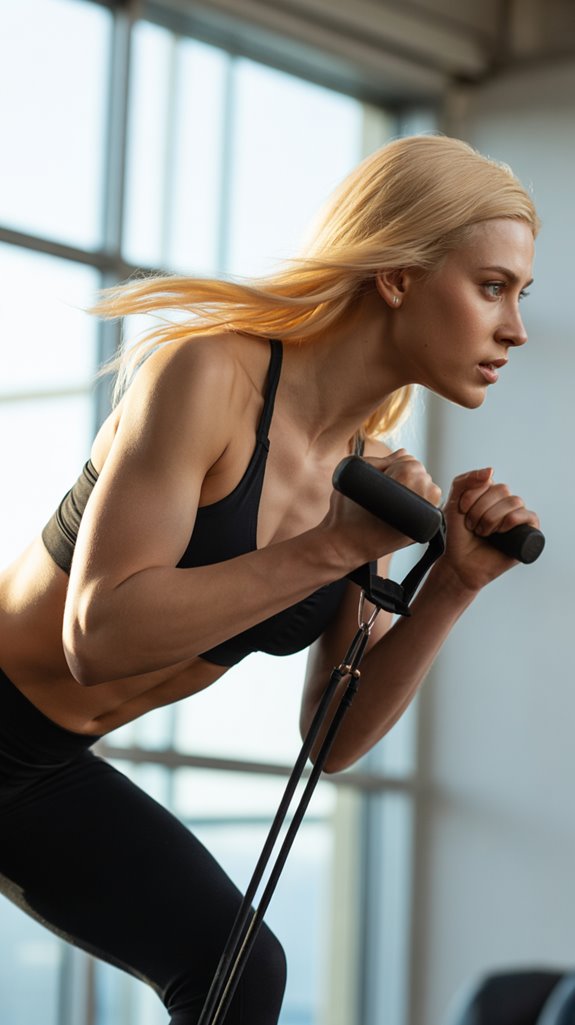
Bent-over rows stand as one of the most effective compound exercises for building a powerful, well-developed back. You’ll primarily target your latissimus dorsi while engaging rhomboids, trapezius, and scapular stabilizers for complete posterior chain development. Proper bent over form requires a flat back, slight knee bend, and engaged core to protect your spine. Keep your torso just above parallel, pull your shoulders down and back, and track the bar close to your shins.
Bent over row variations include resistance bands for home training, single-arm dumbbell rows to correct imbalances, and chest-supported rows to reduce lower back strain. You’ll enhance posture, prevent muscular imbalances, and support functional movement patterns. The exercise also develops grip strength as you maintain control of the weight throughout each repetition. Avoid this exercise if you have herniated discs or poor core stability without modifications.
Pull Apart
If you’re looking for a simple yet powerful exercise to strengthen your upper back and improve shoulder health, resistance band pull-aparts deliver exceptional results with minimal equipment. This movement targets your rear deltoids, rhomboids, and trapezius while enhancing scapular control and posture.
Execution and Benefits:
- Hold the band at shoulder width with arms extended at shoulder level
- Pull horizontally while squeezing your shoulder blades together, keeping arms straight
- Perform 10–25 reps, adjusting resistance by shortening the band
- Vary hand positions (palms up, down, neutral) to shift muscle activation patterns
- Integrate into warm-ups or rehabilitation programs for injury prevention
You’ll find pull-aparts exceptional for correcting rounded shoulders, reducing injury risk, and building work capacity through high-repetition training that strengthens shoulder stabilizers without fatigue. This exercise also strengthens the rotator cuff muscles, which are critical for overall shoulder stability and injury prevention during overhead movements.
Bicep Curls With Resistance Bands
Resistance band bicep curls transform a classic isolation movement into a variable-resistance exercise that maintains constant tension throughout every phase of the lift. You’ll experience enhanced muscle activation as the elastic resistance challenges your biceps differently than traditional free weights while reducing joint impact. Key band benefits include portability, versatility in grip positions, and increased metabolic stress from extended time under tension.
Master proper form by keeping your elbows locked against your torso, maintaining neutral wrists, and controlling both concentric and eccentric phases deliberately. The lying position requires you to anchor the band below your feet while keeping your back flat against the floor throughout the movement. Explore curl variations like hammer-grip, single-arm, or lying positions to target different bicep heads and address strength imbalances. Avoid swinging momentum or releasing tension too quickly—these mistakes diminish isolation and muscle stimulation. Engage your core throughout to protect your lower back.
Lateral Band Walks

Lateral band walks strengthen your hip abductors and glutes through controlled sideways stepping against elastic resistance, creating targeted activation that’s difficult to achieve with traditional exercises. This movement pattern directly addresses common weaknesses in your gluteus medius and minimus, which are essential for injury prevention during athletic activities and everyday movement.
Key Technical Points:
- Position the band above your knees or ankles, maintaining hip-width stance in a partial squat
- Take controlled lateral steps while preserving constant tension throughout the movement
- Keep your spine neutral and core engaged for ideal stabilization
- Perform 10–12 repetitions per side with appropriate resistance
- Integrate with clamshells and fire hydrants for thorough glute activation
You’ll notice improved hip stability, enhanced athletic performance, and reduced risk of knee valgus when executing compound movements. For optimal muscle recovery and injury prevention, practice this exercise 2-3 times weekly rather than daily.
Overhead Press
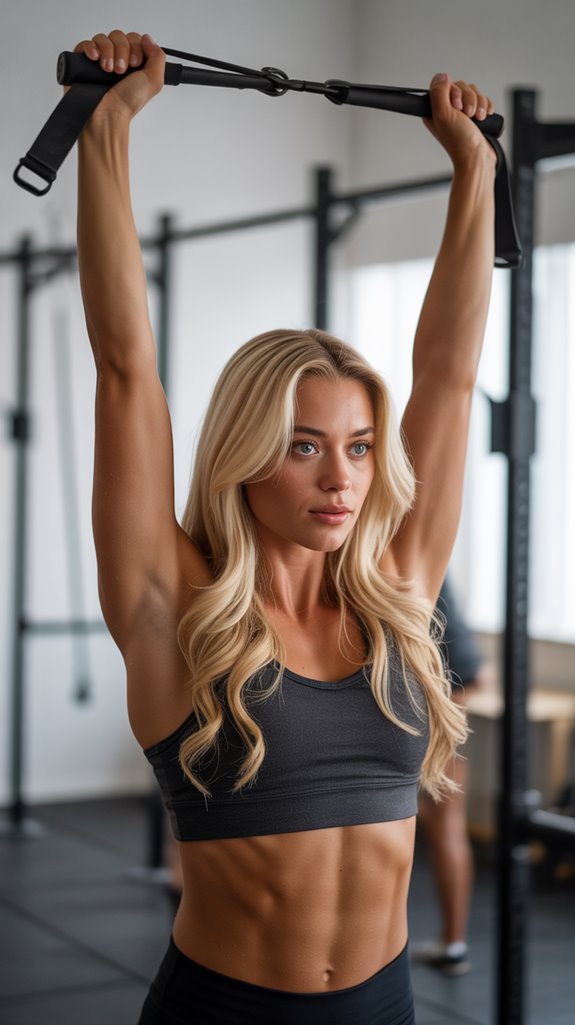
The band overhead press transforms traditional shoulder training by delivering variable resistance that intensifies as you approach lockout, forcing your deltoids, triceps, and stabilizers to work harder precisely where they’re strongest. You’ll discover band benefits like enhanced core engagement and joint-friendly loading—ideal for injury recovery or avoiding shoulder strain altogether.
Master these technique tips: anchor the band beneath shoulder-width feet, engage your core and glutes aggressively, then press to full extension while bringing your arms together at the top. Control the descent to chin level without momentum or excessive stretch. Position your elbows slightly in front of the bar at the start and press head through arms at full lockout to maintain proper bar path and maximize pressing efficiency. Progress through single-arm variations for unilateral strength or combine bands with barbells for amplified lockout resistance. Program 8-12 reps for strength building or 12-20 for warm-up activation, training shoulders 1-2 times weekly within your push sessions.
Standing Chest Press

While overhead pressing builds vertical pushing power, you’ll develop explosive horizontal strength with the standing chest press—a band movement that hammers your pectorals through a full range of motion while demanding total-body stability.
Secure proper band anchoring at chest height behind you, then adopt your stance: feet shoulder-width, core braced, slight forward lean. This foundation maximizes chest activation while protecting your lower back.
Execute with precision:
- Press forward with both arms simultaneously, maintaining wrist alignment
- Squeeze hard at full extension to intensify pectoral contraction
- Control the return phase—don’t let bands snap back
- Avoid shoulder shrugging or scapular protraction throughout
- Alternate arms unilaterally to address muscular imbalances
Your standing position recruits stabilizers that bench pressing neglects, building functional strength that transfers beyond isolated chest work. The fixed-line movement pattern of resistance bands reduces your injury risk compared to free-weight alternatives that demand more complex stabilization.
Conclusion
You’ve got nine powerful exercises to transform your workouts, and here’s the kicker: studies show that resistance band training can increase muscle strength by up to 30% in just eight weeks. That’s serious progress you can achieve anywhere, anytime. You don’t need a gym membership or fancy equipment—just your bands and commitment. So grab those bands, pick your favorites from this list, and start building the stronger, more toned body you’re after. You’ve got this!