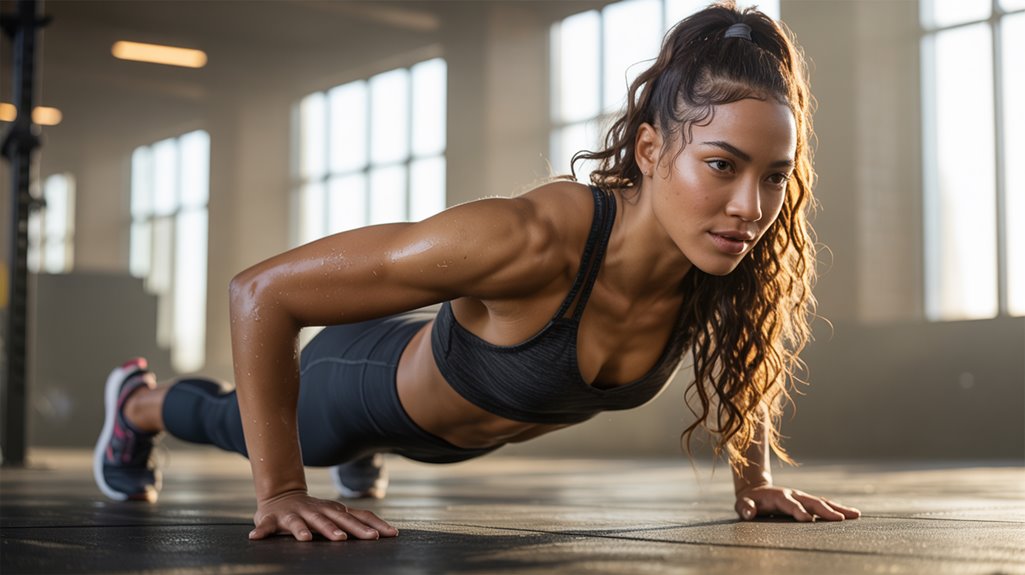
You’ll love these 10 effective upper body workouts you can do at home: push-ups for chest and core strength, triceps dips using a chair, lateral arm raises for shoulder definition, biceps curls with dumbbells or bands, overhead presses for powerful deltoids, bent-over rows targeting your back, skull crushers for triceps development, shadow boxing for cardio and power, and back extensions to strengthen your spine. Each exercise requires minimal equipment while delivering maximum results, and the detailed guide below reveals proper form, variations, and progression strategies to transform your home fitness routine.
Key Takeaways
- Push-ups, triceps dips, and biceps curls build upper body strength effectively without equipment or with minimal resistance tools.
- Shoulder presses and arm raises develop powerful deltoids while enhancing shoulder stability and rotator cuff strength at home.
- Bent-over rows target back muscles including trapezius, rhomboids, and lats using dumbbells or loaded backpacks for resistance.
- Skull crushers isolate all three triceps heads using dumbbells, resistance bands, or an EZ bar for maximum arm development.
- Shadow boxing provides cardiovascular benefits while strengthening shoulders, arms, and core through dynamic punching movements.
Push-Ups
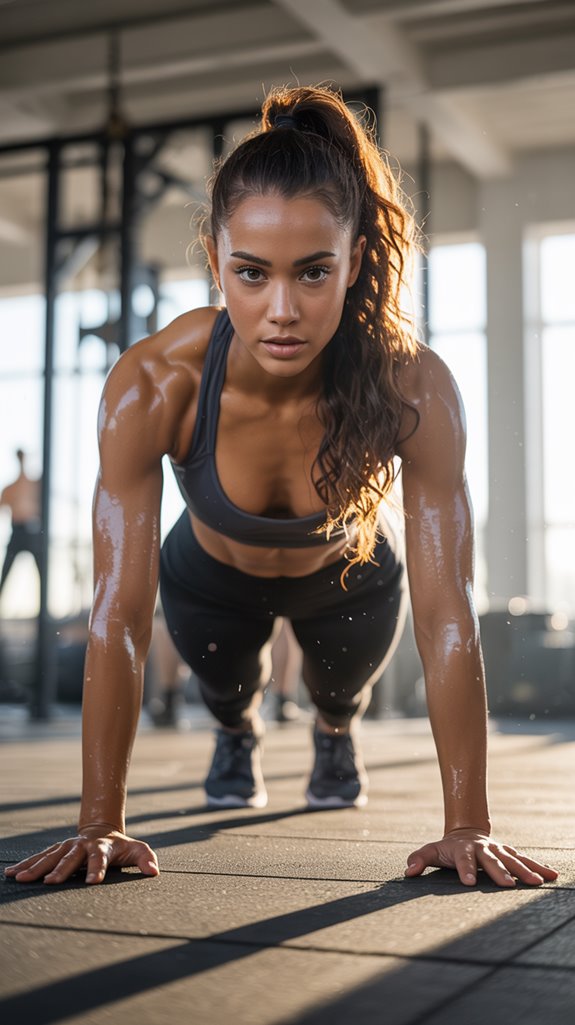
Push-ups stand as one of the most accessible and effective exercises for building upper body strength without any equipment. You’ll engage your pectorals, deltoids, triceps, and core simultaneously while building functional stability. Position your hands slightly wider than shoulder-width at chest level, keep elbows tight to your sides, and maintain a rigid body line from head to heels by bracing your core and squeezing your glutes. Ensure proper body alignment and technique throughout the movement to minimize the risk of pain and injury while maximizing performance benefits. Many people enjoy incorporating different arm-focused movements into their routine because engaging arm workouts help strengthen and tone the arms in complementary ways.
Push up benefits extend beyond muscle development—research shows greater push-up capacity correlates with reduced cardiac risk. Master the standard form first, then explore push up variations like incline, diamond, or archer push-ups to target specific muscle groups. Execute 3–5 sets of 10–20 repetitions with controlled tempo, ensuring your chest, nose, and belly button reach the same depth for maximum effectiveness.
Triceps Dips (Floor or Chair)
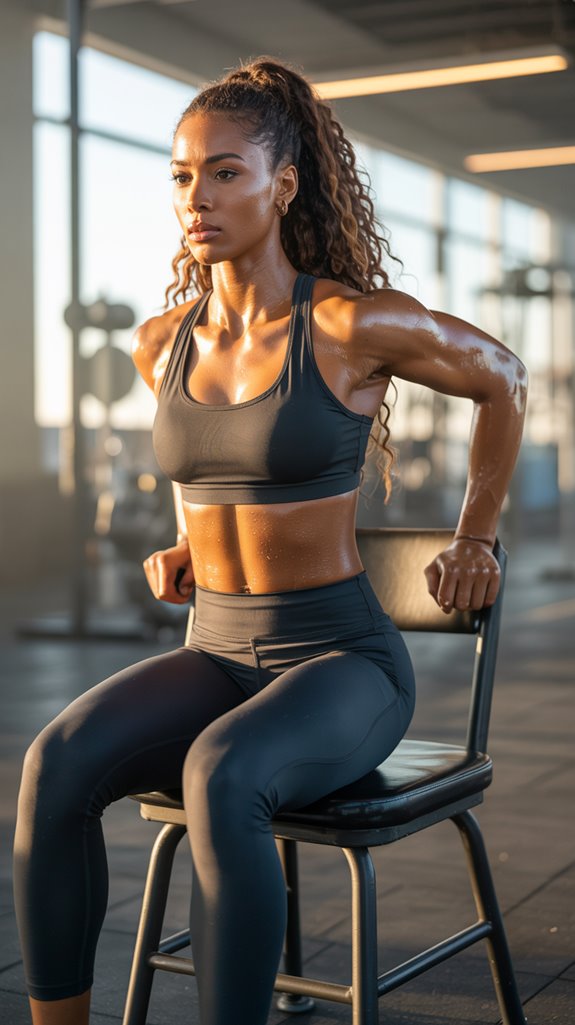
Triceps dips deliver targeted arm development that complements the chest-focused work you’ve already established with push-ups. This compound movement engages your triceps brachii primarily while recruiting pectorals, anterior deltoids, and core musculature for complete upper body integration.
Position yourself on a stable chair or bench with arms extended, then lower until elbows reach 90 degrees before pressing upward. Maintain an upright torso to emphasize triceps; lean slightly forward to increase chest activation. These triceps variations offer substantial dip benefits including progressive overload capacity through added weight, enhanced shoulder mobility, and functional strength applicable to daily pushing movements.
Begin with partial-range repetitions if needed, progressing toward full depth as strength develops. Once you can comfortably complete 12-15 repetitions with bodyweight, consider introducing additional resistance through a weighted backpack or dip belt. Prioritize controlled form over volume—avoid elbow flare and excessive swing to protect joints while maximizing muscle engagement throughout each repetition. For a well-rounded program, include a mix of exercises from the broader list of at-home workouts to ensure balanced arm development.
Arm Raises (Side and Lateral)
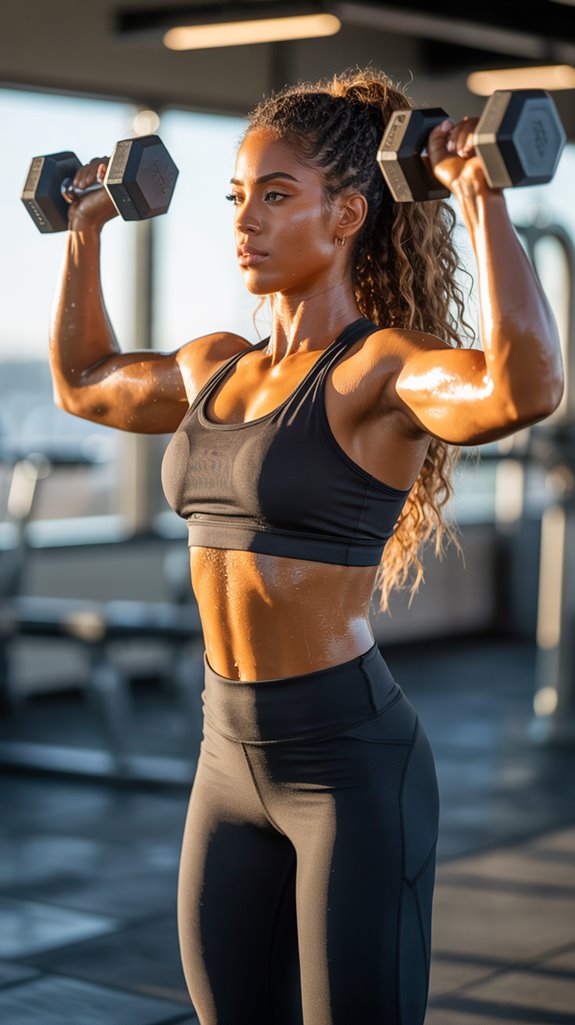
While compound movements build foundational strength, isolation exercises like arm raises sculpt specific muscle groups that create visual dimension and functional balance. Lateral raise techniques directly target your medial deltoids, the muscles responsible for shoulder width and that coveted three-dimensional appearance. You’ll lift your arms laterally until parallel with the ground, maintaining slightly bent elbows and strict form to maximize muscle activation.
This movement enhances shoulder stability by strengthening your rotator cuff and scapular stabilizers simultaneously. You can execute variations using dumbbells, resistance bands, or cables—each offering distinct tension profiles. Master the fundamental pattern with lighter loads before progressing, focusing on controlled tempo and eliminating momentum. Include 8-12 reps in your upper body sessions, potentially incorporating supersets for intensified stimulus. Proper execution corrects strength imbalances while improving shoulder mobility and injury resilience. The exercise also engages your trapezius and rhomboid muscles, which provide essential support for shoulder blade movement and contribute to overall upper back development. Many readers find combining these moves with 10 shoulder workouts from a structured routine helps accelerate progress and keeps training interesting.
Biceps Curls
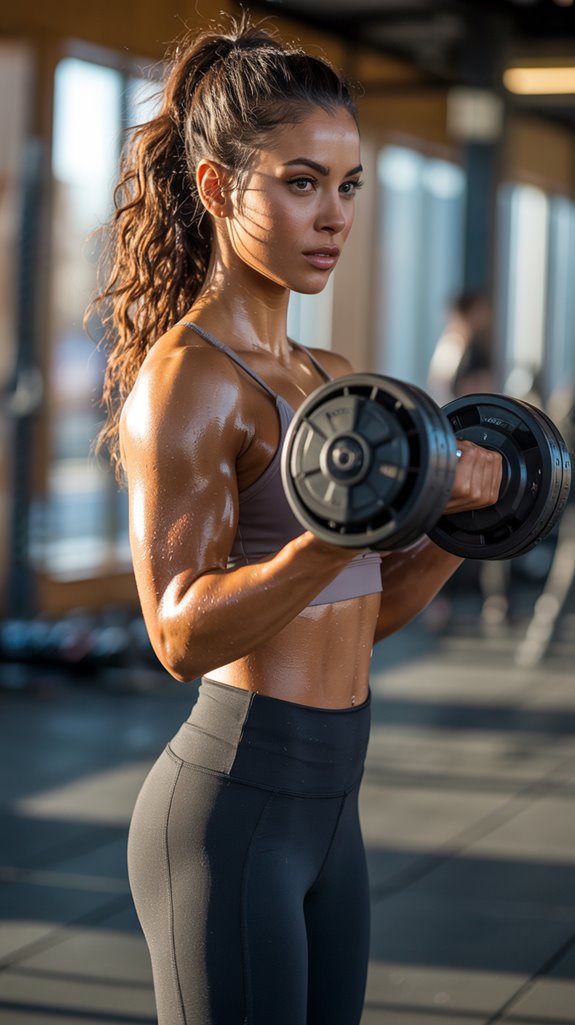
Biceps curls isolate and develop the biceps brachii—the prominent two-headed muscle on your upper arm’s anterior surface—while simultaneously engaging supporting muscles like the brachialis and brachioradialis. Master proper curl techniques by maintaining an upright posture with elbows anchored to your torso, palms supinating during the concentric phase. Control each rep’s tempo, exhaling during flexion and inhaling through extension. Squeeze at peak contraction without resting, then lower deliberately through the full range of motion. Explore biceps variations like concentration curls for stricter isolation, slow eccentric curls for enhanced fiber recruitment, or kneeling variations to increase core activation. You’ll need minimal equipment—dumbbells, resistance bands, or household objects suffice. Perform 3 sets of 12–15 reps, prioritizing form precision over load. Beyond aesthetics, curls build strength for pulling movements like pull-ups, rows, and everyday lifting tasks. Frequency of 1-3 sessions weekly optimizes hypertrophy while allowing adequate recovery.
Overhead Press/Shoulder Press
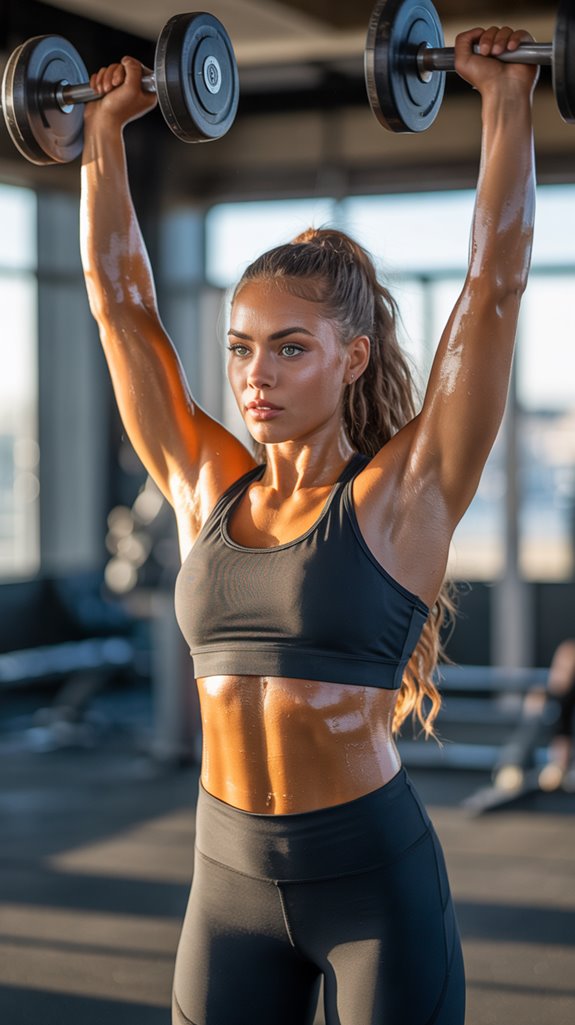
The overhead press stands as a fundamental compound movement that builds powerful shoulders while recruiting your entire upper body and core. You’ll activate your deltoids, triceps, trapezius, and rotator cuff while developing exceptional shoulder mobility through controlled scapular upward rotation. Position your feet hip-width apart, press from shoulder height with elbows slightly forward, and drive the weight overhead in a straight path. Keep your core engaged and glutes squeezed—never arch your back excessively. This movement enhances overall stability and helps prevent injuries throughout your upper body.
Master strength variations like the barbell press for raw power, dumbbell press for stability corrections, or the Arnold press to target all deltoid heads. Progress with 6-12 reps for hypertrophy or 1-5 reps for maximum strength. Control both the ascent and descent, maintain neutral wrists, and prioritize form over momentum to maximize results.
Inchworms

Inchworms deliver a deceptively simple full-body movement that’ll transform your warm-up routine while building genuine strength across your entire kinetic chain. You’ll engage shoulders, chest, core, glutes, and hamstrings simultaneously while improving flexibility through your posterior chain. The inchworm benefits extend beyond mobility—you’re developing dynamic stability and muscular endurance with each controlled repetition.
Execute proper form by hinging at your hips, walking hands to a high plank with engaged core, then reversing the movement. Program 3 sets of 5-10 reps before your training sessions or within HIIT circuits. This movement also enhances body awareness and proprioception through its coordinated full-body sequence.
Explore inchworm variations to match your development: beginners should focus on controlled tempo with bent knees, while advanced practitioners can add push-ups at the plank position or increase time under tension for greater mechanical stress.
Bent-Over Rows
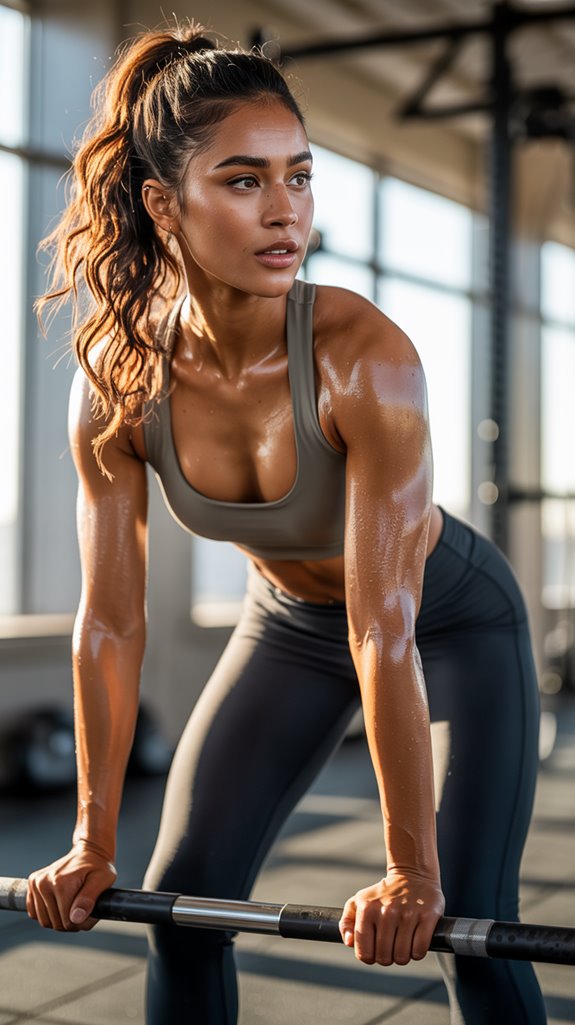
Mastering bent-over rows will pack serious muscle onto your back while strengthening the pulling patterns you’ll use daily. You’ll engage your trapezius, rhomboids, and lats while your biceps and rear delts provide essential support. Position yourself with a flat back, knees slightly bent, and torso nearly parallel to the floor. Pull the weight toward your hip with elbows tucked close, maintaining core tension throughout each rep.
The bent over row benefits extend beyond hypertrophy—you’re building postural strength and functional pulling power. This compound movement increases basal metabolic rate, helping you manage weight more effectively even during rest periods. Explore row variations like single-arm rows for unilateral stability, underhand grip rows for increased biceps activation, or dumbbell rows to challenge each side independently. You can even substitute loaded backpacks when equipment’s limited.
Avoid rounding your spine or using momentum that compromises form and dilutes muscle engagement.
Skull Crushers
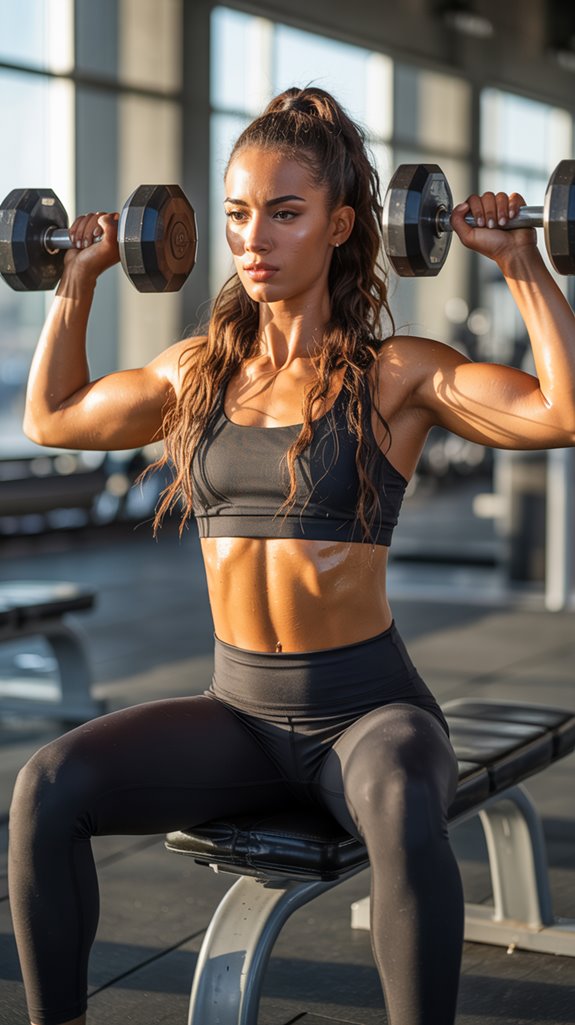
Building horseshoe-shaped triceps demands an isolation movement that’ll stretch and contract all three heads through their full range, and skull crushers deliver exactly that. You’re targeting maximum triceps activation by keeping your upper arms fixed while lowering the weight just past your forehead—only your elbows move. This precision recruits the long head more effectively than most pressing variations.
Execute them with an EZ bar, dumbbells, or resistance bands on your floor when a bench isn’t available. Maintain shoulder-width elbow positioning throughout; flaring wide diminishes tension and stresses your joints. Control the eccentric phase for three seconds, then explosively extend.
Skull crusher variations using different implements let you adjust wrist angles and accommodate mobility limitations while preserving the movement’s hypertrophy-inducing stimulus. They’ll also enhance your bench press strength, translating directly to improved performance in compound pressing movements. Master this exercise, and you’ll notice carryover to your pressing strength.
Punches (Alternating or Shadow Boxing)

When programmed boxing gyms aren’t accessible, shadow boxing transforms your living room into a metabolic furnace that’ll torch calories while sculpting your shoulders, arms, and core. The shadow boxing benefits extend beyond aesthetics—you’ll strengthen bones, tendons, and ligaments while building athletic power that transcends simple muscle growth. Proper punch technique requires coordinated upper and lower body engagement, forcing your neuromuscular system to adapt through repetitive movement patterns that enhance muscle memory and instinctive reactions. You’ll experience significant cardiovascular improvements and lipid profile optimization, increasing HDL while reducing LDL. The mental health advantages are equally compelling: endorphin release manages stress, focused repetition sharpens concentration, and mindful striking provides healthy emotional regulation. This low-impact, equipment-free modality offers complete scalability—adjust intensity based on your current capacity while maintaining workout consistency. Adding light dumbbells of 1-2 pounds increases workout intensity while strengthening your back, arms, shoulders, and core simultaneously.
Back Extensions
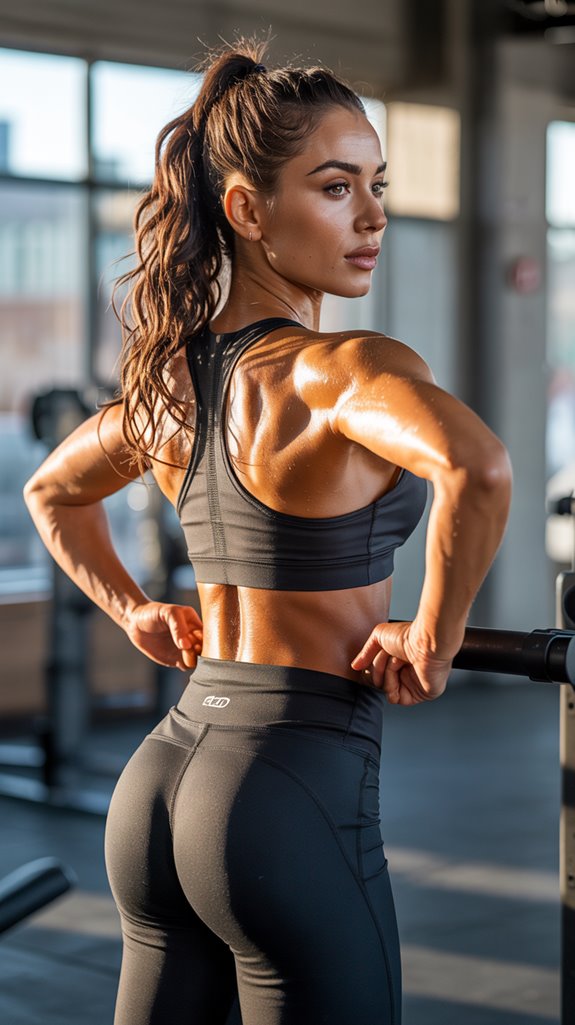
While countless exercises promise a stronger back, back extensions deliver targeted strengthening for your spinal erectors, glutes, and hamstrings—the critical posterior chain muscles that protect your spine and power athletic movement.
You’ll achieve peak muscle activation by maintaining controlled movement throughout each rep. Start with floor extensions: lie face-down, hands behind your head, and lift your chest by contracting your lower back and glutes. Progress by adjusting hand positions—from your sides to chest, temples, or overhead “Y” formation for trap engagement.
Core stability improves as you master proper technique: neutral spine alignment, controlled tempo, and avoiding hyperextension at the top. For advanced progression, add resistance with weight plates or dumbbells held at your chest, or challenge your pelvic stabilizers with single-leg variations. This low-impact exercise makes it particularly valuable for those recovering from back injuries or working within mobility limitations.
Conclusion
You’ve got ten powerful moves in your arsenal now. Picture yourself flowing through push-ups, feeling your muscles engage with each rep. Imagine the satisfying burn as you crush those triceps dips, the strength radiating through your shoulders during overhead presses. You’ll transform any space into your personal training ground—no gym required. Your stronger, more defined upper body isn’t just a dream anymore; it’s within arm’s reach. Now go make it happen.