
Medicine ball workouts deliver explosive power and core stability through dynamic movements you can master at any fitness level. You’ll build rotational strength with Russian twists, challenge your abs with V-ups, and develop full-body conditioning through burpees and slams. These exercises integrate lower body power with core control through lunges with twists and overhead squats, while plank variations target deep stabilizers. Each movement can be progressed by adjusting weight, tempo, or complexity to match your goals and reveal your athletic potential.
Key Takeaways
- Russian twists build rotational strength by targeting obliques; start with six-pound balls for three sets of ten reps per side.
- Medicine ball slams develop explosive power through full-body integration; perform six to eight reps with controlled, forceful movements.
- V-ups challenge core stability by lifting upper and lower body simultaneously, emphasizing proper form over repetition count.
- Lunge with twist combines lower body strength and core rotation; execute ten reps per side using eight to twenty-five pound balls.
- Overhead squats enhance shoulder mobility and full-body coordination while demanding core control and proper breathing technique throughout movement.
Russian Twist

The Russian Twist stands out as one of the most effective core exercises for targeting your obliques and building rotational strength. You’ll sit with knees bent, holding a medicine ball a few inches from your chest with extended arms. For advanced work, lift your feet slightly off the floor while maintaining core engagement throughout the movement.
Initiate torso rotation from your waist—not your arms—keeping your back straight to prevent spinal rounding. Your obliques drive the motion while deep abdominal muscles stabilize your entire torso as an integrated unit.
Start with a 6-pound medicine ball, performing three sets of 10 reps per side. Progress by lifting your heels higher or increasing weight to 12 pounds. Train 3-4 times weekly for ideal results. Incorporating a variety of engaging routines from a list of fun core workouts can help maintain consistency and enjoyment, like trying different core workouts to match your fitness level.
Medicine Ball V-Ups

While Russian Twists build rotational power through your core, Medicine Ball V-Ups challenge your abs through a different plane of motion—requiring you to lift your upper and lower body simultaneously while managing external resistance.
This advanced movement demands exceptional core engagement as you form a “V” shape while controlling the medicine ball overhead or between your hands and feet. It also complements other exercises by improving core stability and functional strength.
Master these V up variations to progress strategically:
- Standard hold: Keep the ball overhead throughout, emphasizing anti-extension control
- Hand-to-foot pass: Transfer the ball at the top position for enhanced coordination
- Pulse holds: Add small pulses at peak contraction to intensify time under tension
- Tempo manipulation: Slow your descent to maximize eccentric loading
Keep your limbs straight, exhale during the lift, and never sacrifice form for repetitions. As you build proficiency, this exercise increases core stability that translates to improved performance in compound movements and athletic activities.
Medicine Ball Burpee

Combining explosive power with cardiovascular conditioning, the Medicine Ball Burpee transforms a classic bodyweight exercise into a full-body metabolic challenge. You’ll hold the ball at chest level, descend into a squat, plant it on the ground, and thrust back into a plank position with hands gripping the ball. Return to squat, then explode upward while pressing the ball overhead. This variation demands exceptional core stability as the ball’s weight and instability recruit deep stabilizing muscles throughout the movement. The dynamic movements in this exercise boost metabolic activity significantly, contributing to increased energy expenditure and supporting your weight management goals. Among burpee variations, this ranks highest for developing explosive strength across your entire kinetic chain. You can modify intensity by adjusting ball weight, incorporating push-ups on the ball, or adding slams. Master proper mechanics with lighter resistance before progressing to heavier loads or higher speeds. These medicine ball variations pair well with arm workouts to further strengthen and tone your upper body.
Medicine Ball Plank Rollouts
From explosive movements that spike your heart rate, medicine ball training shifts gears to challenge pure core stability through controlled, deliberate motion.
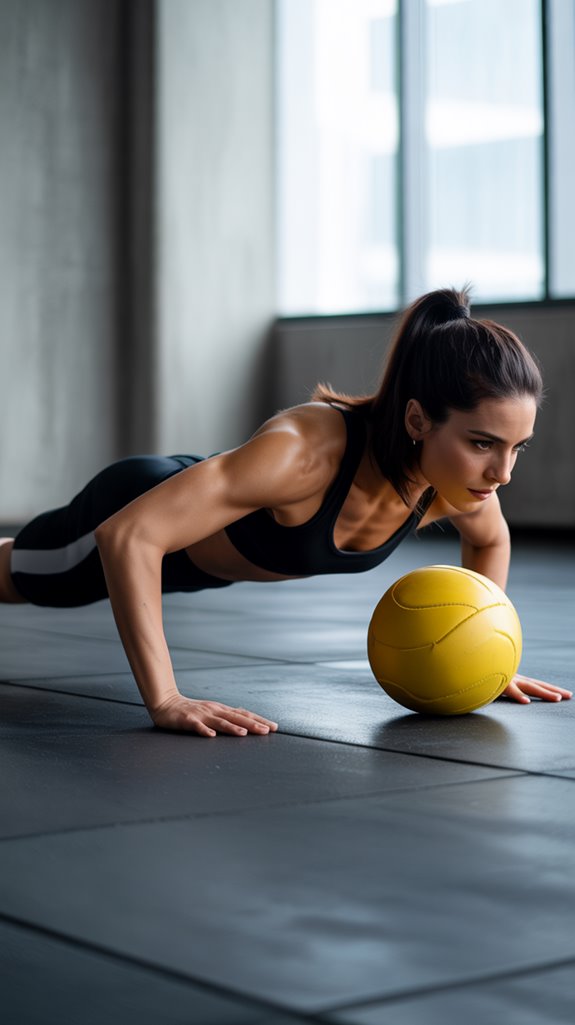
Medicine ball plank rollouts deliver exceptional results by targeting your rectus and transverse abdominis while recruiting triceps, lats, and shoulders. Research shows isometric exercises at longer muscle lengths can produce up to three times more muscle hypertrophy than shortened positions. This exercise trains your abs in an extended range of motion, building both muscle and strength without the spinal flexion associated with traditional crunches.
Master this movement through:
- Neutral spine maintenance – Brace your core and glutes to prevent hip sag
- Controlled tempo – Roll out slowly, pausing at full extension
- Progressive range – Extend only as far as form allows
- Strategic programming – Execute 2-3 sets of 4-10 reps with 60-90 second rest
The ball’s slower roll reduces lower back injury risk compared to ab wheels while maximizing anti-extension strength development.
Medicine Ball Plank With Knee Tuck

The medicine ball plank with knee tuck transforms static core work into a dynamic movement that’ll test your stability, strength, and coordination simultaneously. Position your shins on the ball while maintaining a rigid plank with hands under shoulders. Your core engagement must remain constant—no sagging hips or arched backs.
Execute by drawing your knees toward your chest, rolling the ball forward until your knees align under your hips. Pause briefly, then extend back to plank. This controlled tempo maximizes muscle recruitment while building dynamic stability through an unstable surface. Distribute weight evenly across fully extended arms to maintain proper form throughout the movement.
Target your rectus abdominis, obliques, and hip flexors primarily, with secondary activation in shoulders and quads. Progress by moving the ball toward your toes, or regress by limiting tuck depth. Exhale during the tuck, inhale during extension for peak performance.
Medicine Ball Plank Pass

While knee tucks challenge your core through forward-backward motion, shifting a medicine ball laterally across your plank position introduces an entirely new dimension of instability. This advanced movement demands exceptional core engagement as you transfer weight between hands while rolling the ball side to side.
Mastering the Medicine Ball Plank Pass:
- Establish your foundation in high plank with feet hip-width apart and the ball centered between your hands
- Control the transfer by shifting weight onto one hand while grabbing and rolling the ball laterally with the opposite hand
- Maintain strict alignment from head to heels, preventing hip rotation or dropping throughout the movement
- Progress strategically by incorporating partner passes or heavier balls once you’ve perfected solo execution
Among plank variations, this exercise delivers unmatched functional strength development. This routine may elevate your heart rate more significantly than standard strength workouts, combining the challenge of stability work with cardiovascular conditioning.
Kneeling Medicine Ball Slam

Exploding upward from a kneeling position transforms the traditional medicine ball slam into a lower-body power generator that spares your joints while maximizing core engagement. You’ll initiate movement through a hip hinge, then explosively extend while driving the ball overhead—never overarching your spine. The descending slam demands intense rectus abdominis and oblique activation as you forcefully compress through your core.
Kneeling variations like half-kneeling positions enhance unilateral stability and rotational demands. Program 3–5 sets of 6–8 explosive reps with adequate rest to maintain technique and power output. Select moderate ball weights that don’t compromise speed or form. This movement pattern effectively mirrors functional athletic movements by replicating the explosive hip extension used in jumping and throwing.
Avoid relying solely on your arms—integrate your glutes, hip flexors, and shoulders for maximum force generation. Control the slam trajectory to prevent joint strain from errant rebounds.
Scoop Toss

Unlike upper-body dominant throws, the scoop toss generates rotational power from the ground up, forcing you to integrate your lower body explosively while maintaining controlled separation between hips and trunk.
Scoop toss benefits extend beyond raw power—you’ll develop triple extension mechanics, improved ground reaction forces, and multi-planar strength that translates directly to sprinting, jumping, and rotational sports performance. This movement pattern enhances rate of force production, making it integral for athletes seeking explosive power in competition.
Essential execution points:
- Load properly: Squat deep, shifting weight into your back hip while keeping arms extended
- Drive explosively: Extend hips, knees, and ankles simultaneously through the release
- Control rotation: Maximize hip turn while minimizing excessive lower back motion
- Reset completely: Full loading between each rep guarantees quality power output
Scoop toss variations—partner catches, wall tosses, split-stance positions—allow precise progression matching your training phase and sport-specific demands.
Lunge With Twist

The lunge with twist bridges explosive power and controlled mobility, demanding stability through rotation while your body manages significant postural challenges. You’ll hold the medicine ball at chest level, step forward into a deep lunge, then rotate your torso toward your lead leg. This sequencing optimizes lunge mechanics while maximizing core activation through the obliques.
Your glutes, quads, and hip flexors engage during the lunge phase, while the rotational component recruits deep stabilizers. Programming typically includes 10 reps per side across 2–3 sets, with medicine balls ranging from 8–25 pounds.
Progress through variations: reverse lunges increase hip internal rotation and glute engagement, while walking lunges demand greater coordination. Tempo modifications—particularly slowing the eccentric phase—amplify difficulty. Maintain an anchored lead foot and upright torso throughout to protect your knees and lower back.
Overhead Squat

Holding a medicine ball overhead while squatting creates one of the most demanding stability challenges you’ll encounter in functional training. This movement combines lower body power with exceptional shoulder and core control, delivering overhead benefits that translate directly to athletic performance and functional strength.
Master the overhead squat through these essential cues:
- Lock your arms straight throughout the entire range of motion, engaging your shoulders and upper back
- Drive through the balls of your feet while keeping your chest lifted and torso upright
- Prevent knee valgus by maintaining external hip rotation and proper tracking
- Breathe strategically—inhale during descent, exhale during ascent
Among squat variations, this movement stands apart by developing proprioception, scapular stability, and full-body coordination simultaneously. The exercise also enhances shoulder mobility while building strength throughout the lower body musculature.
Conclusion
Picture yourself stronger, sweat glistening as you power through that final rep. You’ve discovered ten dynamic moves that’ll transform that weighted ball into your favorite training partner. Feel your core tightening with each twist, your heart pumping through every slam, your muscles burning with purpose. You’re not just working out—you’re sculpting power, building endurance, and releasing your athletic potential. Grab that medicine ball and make it happen.