This post contains affiliate links. As an Amazon Associate I earn from qualifying purchases.
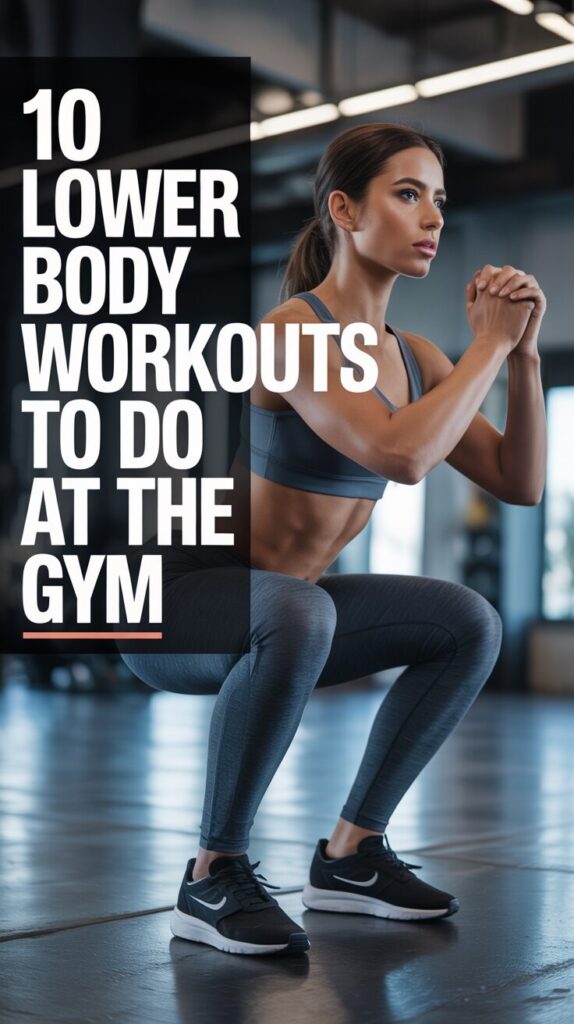
You’ll build serious lower body strength by incorporating these proven exercises: barbell back squats engage over 200 muscles for full-body development, while Romanian deadlifts isolate your hamstrings and glutes. Bulgarian split squats and dumbbell step-ups correct muscle imbalances through unilateral training. Barbell hip thrusts maximize glute activation, and walking lunges enhance balance. Box jumps develop explosive power with 11.4% improvements in vertical performance. Kettlebell swings build posterior chain strength, leg presses help break through plateaus, and standing calf raises target often-neglected lower legs. Each movement below reveals specific techniques to maximize your results.
Key Takeaways
- Barbell back squats and Bulgarian split squats build comprehensive leg strength by targeting quadriceps, hamstrings, glutes, and stabilizing muscles effectively.
- Romanian deadlifts and barbell hip thrusts develop the posterior chain, enhancing hamstring resilience and maximizing glute activation for power.
- Leg press machines allow safe progressive overload with adjustable foot placement to emphasize either quadriceps or posterior chain development.
- Walking lunges and dumbbell step-ups improve unilateral strength, balance, and coordination while correcting muscle imbalances between legs.
- Box jumps and kettlebell swings build explosive power and cardiovascular conditioning through rapid force production and hip drive mechanics.
Barbell Back Squat for Full Lower Body Development
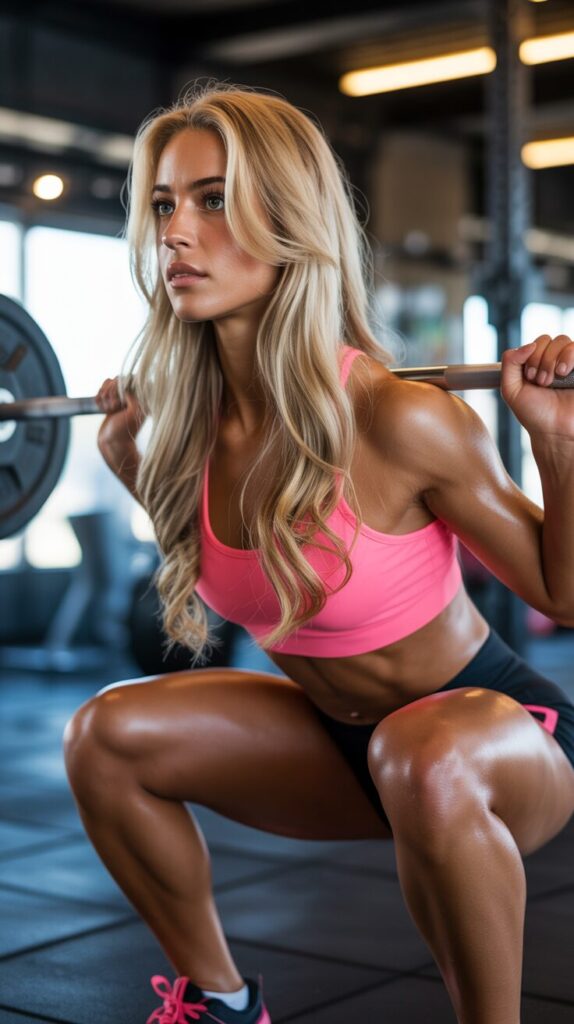
The barbell back squat stands as the cornerstone of lower body training, engaging over 200 muscles in a single movement. You’ll target your quadriceps, hamstrings, glutes, and adductors while demanding substantial core engagement for torso stabilization. The squat benefits extend beyond muscle growth—you’ll build bone density, enhance functional movement, and trigger powerful hormonal responses that accelerate strength progression. Many gym programs include a variety of leg workouts to ensure balanced development and progression, including 10 leg workouts that mix traditional and innovative routines.
Master technique tips before loading heavy: maintain full foot contact, keep your chest upright, and track your knees over your toes. Form corrections become critical for injury prevention and ideal program design. Start with squat variations like goblet squats to establish movement patterns, then progressively overload your workout routine. Position your grip wider than shoulder-width and step back with feet wider than shoulder-width to establish proper stance mechanics. This compound lift transforms your lower body while supporting muscle recovery through improved joint resilience and metabolic adaptation.
Romanian Deadlift to Target Glutes and Hamstrings
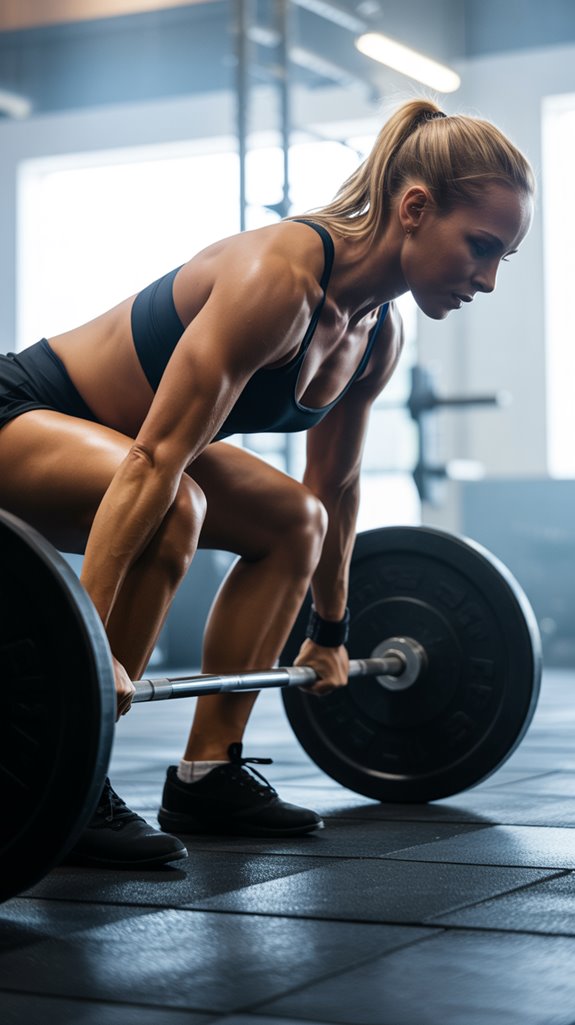
Romanian deadlifts transform your posterior chain development by isolating your hamstrings and glutes through a controlled hip hinge movement. The Romanian deadlift benefits extend beyond muscle growth—you’ll enhance hip mobility, strengthen your entire kinetic chain, and reduce injury risk through improved hamstring resilience. They are also an excellent complement to other leg exercises for building balanced lower-body strength and size, especially when paired with squats and lunges.
Master Romanian deadlift technique by focusing on these critical elements:
- Position your feet shoulder-width apart with the weight held close to your legs throughout the movement, maintaining vertical shins as you hinge at the hips
- Keep your back straight and core braced while pushing your hips backward until you feel a deep hamstring stretch
- Drive through your glutes and hamstrings to return to standing, avoiding lower back rounding
Unlike conventional deadlifts, you’ll start from standing position and use lighter loads to maximize muscle engagement rather than maximal strength. This exercise also activates your adductor magnus to stabilize the movement and support hip adduction throughout the range of motion.
Bulgarian Split Squat for Unilateral Leg Strength
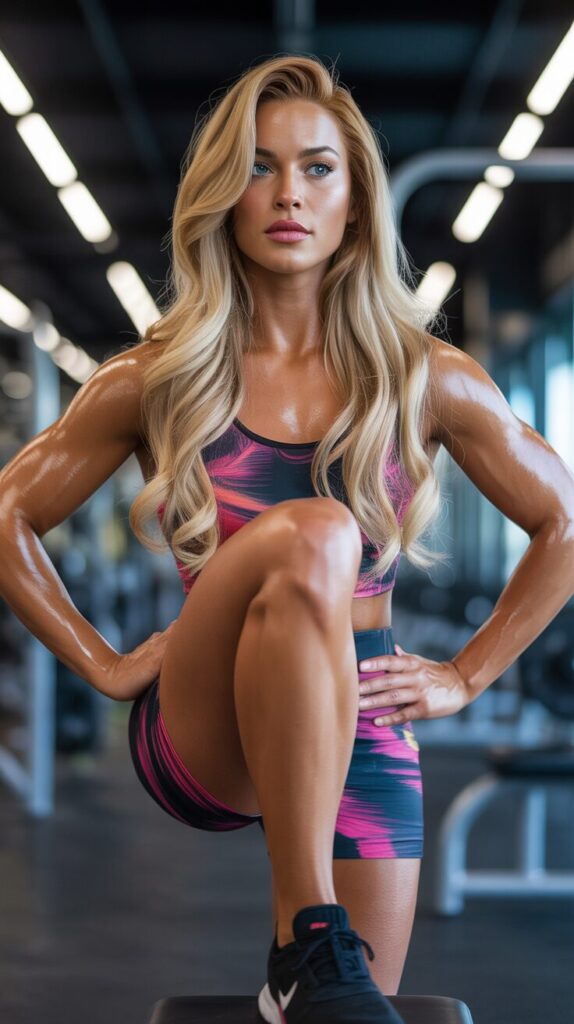
Bulgarian split squats deliver unparalleled unilateral leg development by challenging each leg independently while you maintain balance on an elevated rear foot. This exercise activates your quadriceps, glutes, hamstrings, and calves with exceptional intensity, making it superior for correcting muscle imbalances that bilateral movements can’t address. The rear-foot elevation enables heavy loading while preserving single-leg focus, enhancing force generation throughout your hips and thighs.
Beyond raw strength, you’ll develop critical core stability and proprioception as your trunk muscles work to maintain equilibrium during each repetition. The movement pattern provides greater glute and hamstring isolation compared to traditional squats while reducing lower back and knee stress. Hip adductors engage throughout the movement to stabilize your hips and prevent knee pain during the descent and ascent phases. Athletes leverage this exercise to improve vertical jump height, sprint speed, and change-of-direction capabilities. Its scalable nature and minimal equipment requirements make unilateral training accessible across all experience levels. Many gym-goers pair them with glute bridges to further target posterior-chain strength and muscular balance.
Barbell Hip Thrust to Maximize Glute Activation
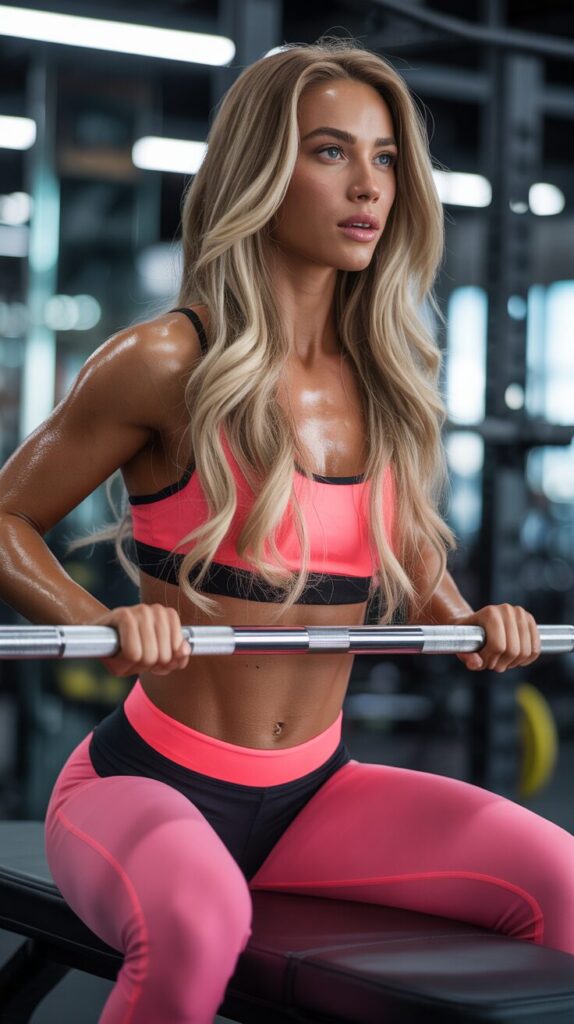
Barbell hip thrusts stand as one of the most effective exercises for isolating and maximizing glute development, surpassing traditional compound movements in direct posterior chain activation. Position your upper back against a sturdy bench with the barbell centered across your hips using a pad for protection. Place feet flat, hip-to-shoulder-width apart, with a slight 15-degree toe flare.
Execute proper hip thrusts by:
- Engaging your core before driving through your heels, focusing on glute activation rather than quad dominance
- Achieving full hip extension at the top with maximum glute contraction and a brief pause
- Controlling the descent for two seconds to maximize eccentric tension
Common mistakes include incomplete lockouts, excessive lower back pressure, and uncontrolled descents. Target 8-15 reps for hypertrophy or 4-8 for strength development. Beyond building stronger glutes, hip thrusts improve hip power for explosive movements like sprinting and jumping.
Walking Lunges for Balance and Coordination
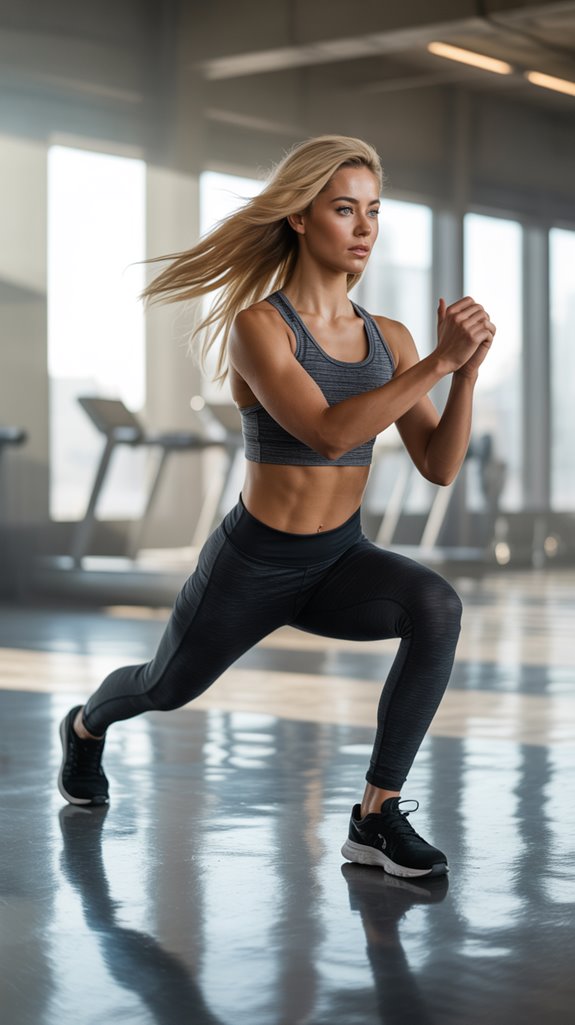
While compound exercises like squats and deadlifts build raw lower body power, walking lunges deliver something equally valuable—enhanced balance and coordination that translates directly to real-world movement. This unilateral movement pattern forces your nervous system to refine single leg stability through proprioceptive exercises that engage stabilizing muscles often neglected in bilateral lifts. You’ll address strength imbalances between limbs while improving neuromuscular control through coordination drills that challenge your body’s spatial awareness.
Walking lunges excel as functional fitness tools, training deep hip mobility enhancement through dynamic movements that counteract sedentary postures. The alternating pattern builds lower body endurance while elevating heart rate for cardiovascular conditioning. The continuous movement challenges overall coordination, helping athletes and active individuals quickly change direction and perform complex movements more effectively. Experiment with lunges variations—forward, reverse, or lateral—to maximize adaptation. Each step reinforces balance training principles that reduce fall risk and sharpen athletic performance across demanding activities.
Leg Press Machine for High-Resistance Training
The leg press machine offers a powerful alternative when you’re ready to load serious weight onto your lower body without the balance demands of free-weight exercises. This apparatus delivers exceptional leg press benefits through controlled motion that targets your quadriceps, hamstrings, glutes, and calves with surgical precision. The guided path reduces spinal loading while enabling progressive overload that builds both strength and hypertrophy.
Key advantages include:
- Resistance adjustments via simple pin-select or plate-loading systems allow precise progression from rehabilitation-level loads to elite-strength demands
- Bone density enhancement through mechanical loading that stimulates osteoblast activity, particularly valuable for aging athletes
- Muscle isolation specificity achieved by manipulating foot placement—higher positioning emphasizes posterior chain development, while lower placement maximally recruits quadriceps fibers
You’ll find this machine indispensable for breaking through strength plateaus while minimizing injury risk. The machine’s design makes it easier to maintain proper form compared to traditional squats and lunges, which proves especially beneficial when working near maximal loads.
Box Jumps to Build Explosive Power
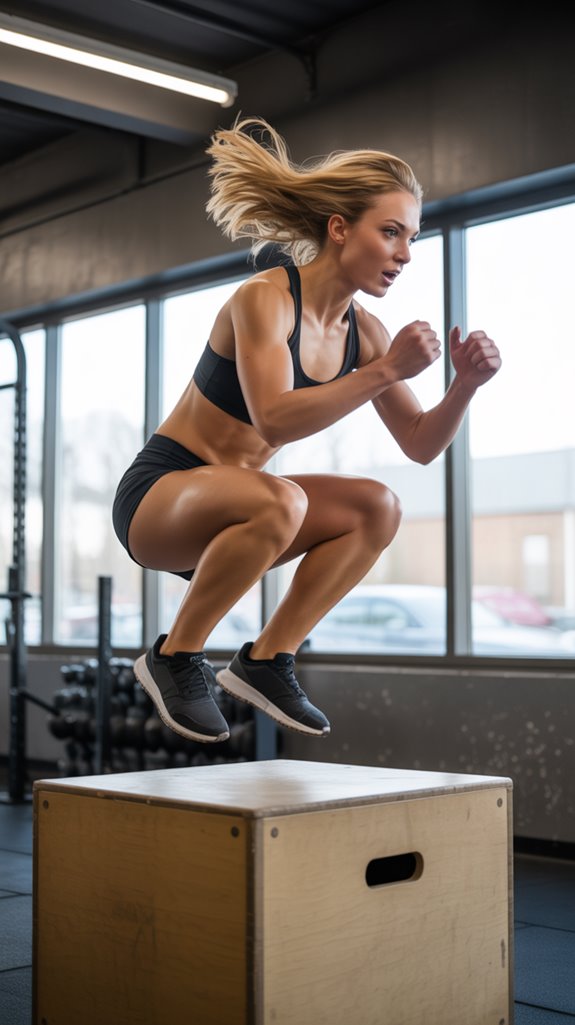
When strength plateaus demand a different stimulus, box jumps deliver explosive power development that transforms your lower body’s capacity for rapid force production. This explosive training modality enhances neural adaptations through improved motor unit synchronization, yielding 11.4% countermovement jump improvements while reducing landing forces by 51% compared to ground-based alternatives. Proper jump technique emphasizes maximal concentric effort with controlled landing mechanics, making plyometric progression safer for injury prevention during high-intensity phases.
Program box jumps at heights matching your vertical jump capacity, performing 3-5 reps across 2-4 sets with complete recovery. Integrate them post-squats for complex training benefits, exploiting post-activation potentiation. This strategic pairing maximizes performance enhancement while maintaining joint integrity—critical for athletes requiring explosive power without accumulated impact stress. Research demonstrates that box jumps produce ~50% less peak impact force than hurdle jumps and countermovement jumps, making them particularly valuable for managing training load during high-volume phases. Quality trumps volume; each repetition demands peak training intensity.
Kettlebell Swings for Hip Drive and Posterior Chain
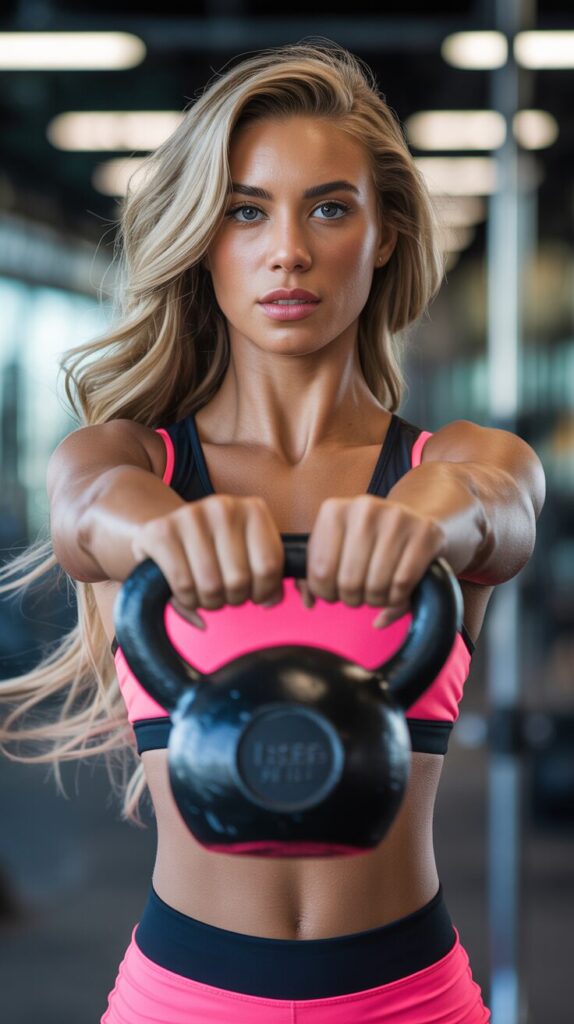
Kettlebell swings stand apart as one of the most efficient exercises for developing explosive hip power and posterior chain strength in a single, fluid movement. You’ll activate your glutes, hamstrings, and spinal erectors while demanding total-body coordination through core engagement and lat activation. The hip hinge pattern drives the kettlebell—not your arms—producing peak power outputs exceeding 11 W·kg⁻¹ with overhead variations.
Kettlebell benefits extend across multiple training domains:
- Cardiovascular conditioning: Swings elevate heart rate above 85% maximum, delivering vigorous metabolic stimulus in 10–20 minutes
- Muscle endurance: High-repetition sets build posterior chain stamina while torching substantial calories
- Swing variations: Overhead swings generate 21.9% more hip work than shoulder-height styles, though load progression should precede technique advancement
You’ll develop rate of force production essential for sprinting and jumping while reinforcing joint-friendly movement patterns. Overhead swings also produce 42.1% greater peak hip extension power compared to single-hand swings at shoulder height, making them a superior choice for advanced practitioners seeking maximum power development.
Dumbbell Step-Ups for Functional Strength
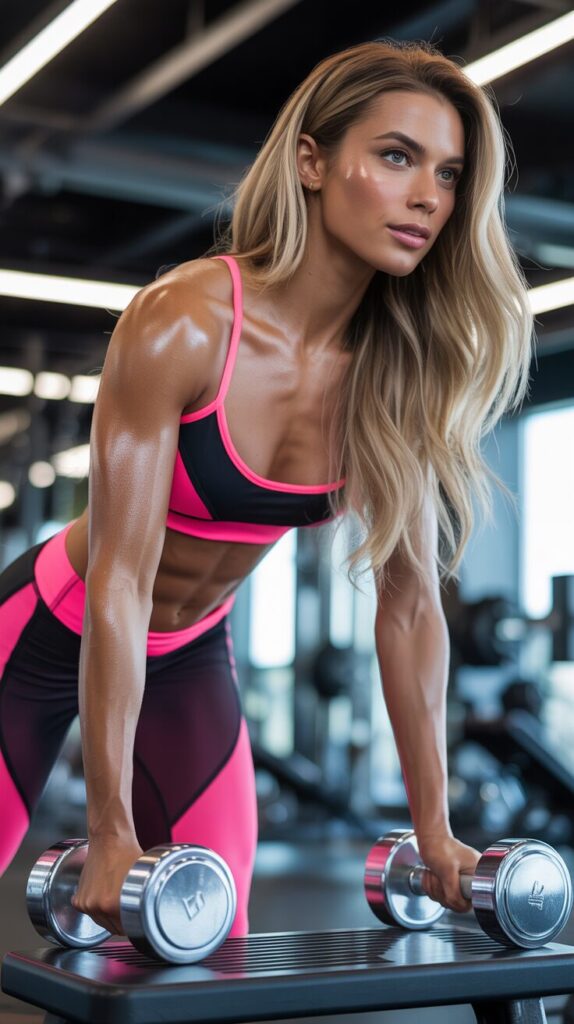
While kettlebell swings build explosive bilateral power through ballistic hip extension, dumbbell step-ups challenge each leg independently to reveal and correct strength asymmetries that bilateral movements often mask. This unilateral training approach reduces muscle imbalances by up to 15% while delivering 12–17% greater glute activation than traditional squats.
Position your entire foot flat on a box just below knee height. Drive through your front heel—not your toes—keeping your torso upright and ribcage slightly forward. Your back heel should lift to prevent momentum theft from the working leg. Control your descent to maximize eccentric loading. Externally rotating your thumbs while gripping the dumbbells helps maintain proper posture and form throughout the movement.
Progress by increasing box height or dumbbell load. Step-ups improve single-leg power output, boost vertical leap by 5–8%, and reduce spinal compression compared to barbell squats—making them essential for balanced lower body development.
Standing Calf Raises for Lower Leg Development
Though bilateral exercises like squats and deadlifts dominate most training programs, your calves demand targeted isolation to overcome their stubborn resistance to growth. Understanding calf muscle anatomy—particularly the gastrocnemius and soleus—allows you to strategically target each through variations in knee positioning. Progressive overload starting around 70–80 lbs proves essential, as these muscles adapt to constant daily loading.
Effective injury prevention strategies include:
- Controlling tempo during descents to minimize Achilles tendon stress
- Incorporating full range of motion via elevated platform positioning
- Alternating foot angles to balance medial and lateral gastrocnemius development
Single-leg variations expose imbalances while enhancing ankle stability. You’ll improve vertical jump power, sprint mechanics, and overall lower leg resilience. Prioritize slow, controlled repetitions over momentum-driven shortcuts to maximize hypertrophy and functional strength adaptations. Both muscles connect to the Achilles tendon, which serves as a crucial structure for all leg movement and power transfer.
Conclusion
You’ve seen how these nine movements target every angle of your lower body—but here’s what you’ll discover when you try them: the theory that variety prevents plateaus isn’t just gym folklore. It’s biomechanics in action. You’ll feel muscles activate that’ve been dormant for months. Your strength won’t stall because you’re constantly challenging different movement patterns. Don’t pick favorites. Rotate through them all, and you’ll build legs that’re both powerful and resilient.