
You’ll love these ten crunch variations that transform your core workouts: traditional crunches, weighted crunches, captain’s chair crunches, tabletop crunches, bicycle crunches, cable crunches, stability ball crunches, reverse crunches, oblique crunches, and seated variations. Each targets different abdominal muscles while building functional strength and improving posture. You can progress from bodyweight exercises to advanced weighted movements, incorporating equipment like stability balls, cables, and dumbbells. These variations prevent plateaus by challenging your core in new ways, enhancing both muscle activation and calorie burn. Below, you’ll discover proper techniques and benefits for each exercise.
Key Takeaways
- Traditional and weighted crunches build foundational core strength with progressive resistance options using dumbbells, plates, or medicine balls.
- Captain’s chair and tabletop crunches reduce injury risk while targeting multiple muscle groups through controlled, spine-protective movements.
- Bicycle crunches elevate heart rate and burn more calories than static variations while developing rotational power for athletic performance.
- Cable and stability ball crunches provide constant tension and increased muscle activation, achieving superior results compared to floor exercises.
- Reverse and oblique crunches enhance pelvic mobility and target side muscles with controlled diagonal movements for balanced core development.
Traditional Crunches

However, common mistakes can undermine your results. Avoid pulling on your neck—keep it neutral throughout the movement. Maintain controlled motion rather than momentum-driven reps, and make sure your lower back stays grounded. While excellent for building abdominal definition and endurance, progression requires incorporating resistance or variations to prevent plateaus and achieve thorough core development. As your strength increases, body weight resistance alone may become insufficient to provide an adequate challenge for continued muscle growth. Consistency and a variety of at-home ab workouts will help you build sustainable core strength.
Captain’s Chair Crunches

One of the most effective pieces of equipment for building core strength is the captain’s chair, which targets your rectus abdominis, obliques, and hip flexors simultaneously. This apparatus stabilizes your back while you execute controlled leg movements, reducing injury risk while maximizing core engagement. Consistency in performing these exercises, paired with a balanced diet, helps achieve a flat stomach over time.
Master the fundamental technique first: rest your forearms on the armrests, press your back firmly against the pad, and brace your core before initiating any movement. Keep your neck straight and face forward throughout each exercise to maintain proper alignment. Begin with knee raises, progressing to straight leg raises as your strength develops.
Exercise variations include knee side raises for oblique development, bicycle knee raises for dynamic conditioning, and advanced horizontal leg crosses. You’ll increase difficulty by adding a dumbbell between your feet or extending hold durations. If you’re dealing with mobility constraints, seated variations provide accessible alternatives.
Tabletop Crunches
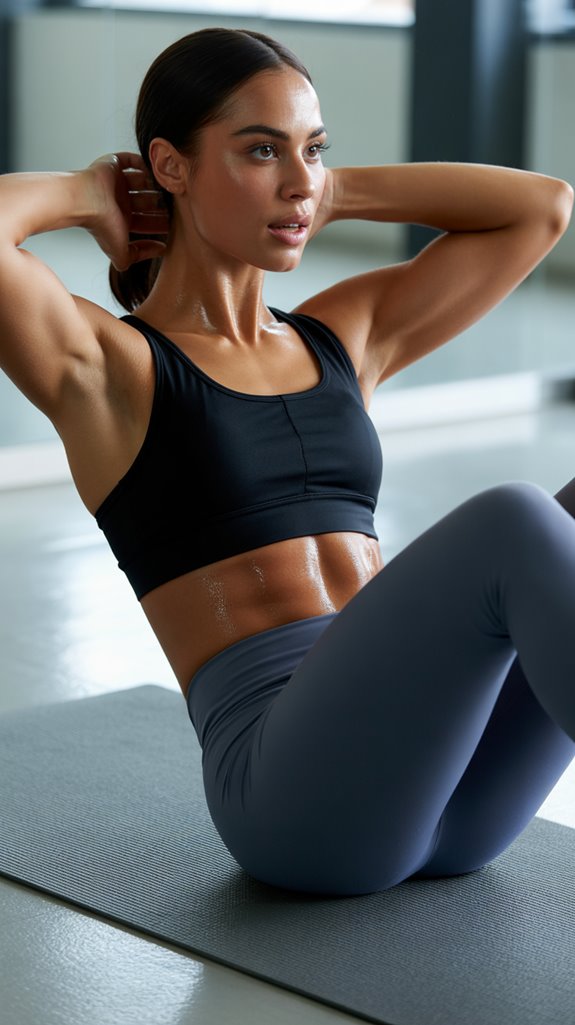
Tabletop crunches deliver maximum core activation while protecting your spine through strategic leg positioning. This exercise engages your rectus abdominis, obliques, and transverse abdominis simultaneously while reducing neck strain through proper alignment.
Tabletop Benefits extend beyond basic core work—you’ll strengthen lower abs more effectively than traditional crunches while improving posture and stability. The elevated leg position minimizes hip flexor dominance, ensuring your abs do the work. This approachable variety is perfect for different fitness levels and keeps workouts enjoyable.
Tabletop Technique demands precision: maintain thighs perpendicular to the floor with calves parallel throughout. Keep your hands lightly behind your head, chin slightly tucked, and lift your rib cage toward your hips with controlled motion. Avoid pulling your neck or arching your lower back. Prioritize controlled, deliberate movements rather than jerky or rapid motions to maximize muscle engagement.
Progress by adding weights, extending one leg, or incorporating twists. Perform 2–3 sets of 10–15 reps consistently for best results.
Bicycle Crunches
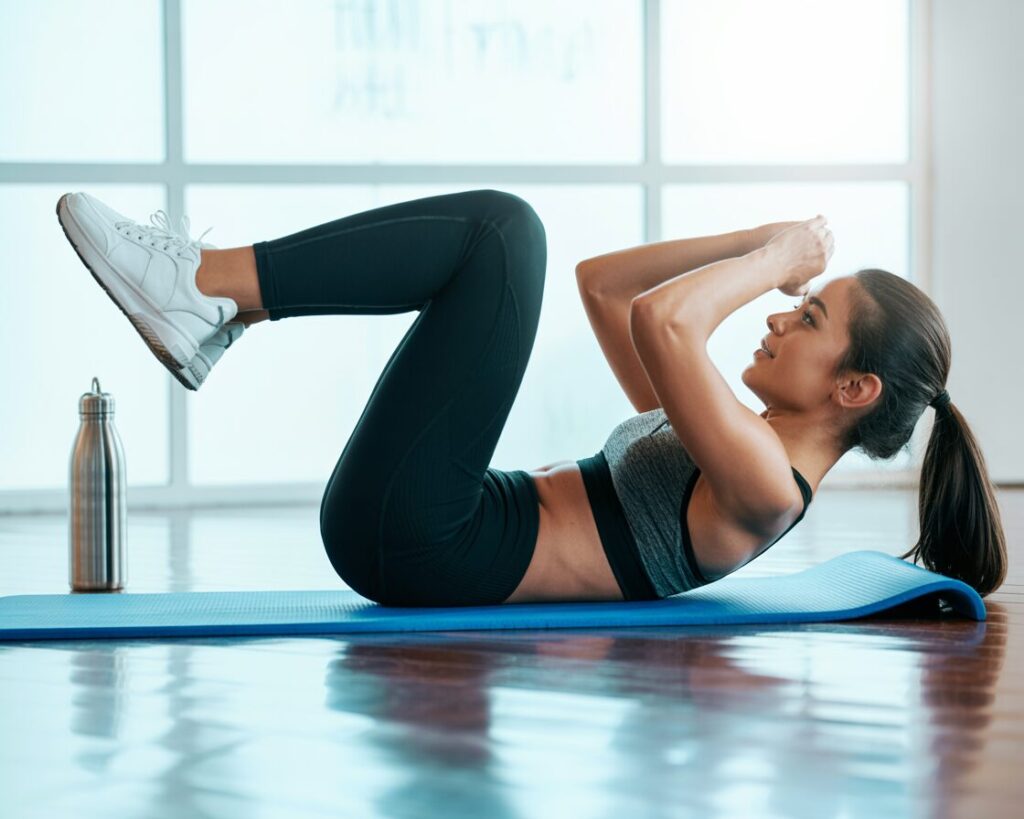
Bicycle crunches activate more muscle groups simultaneously than any other abdominal exercise, making them the gold standard for thorough core development. You’ll engage your rectus abdominis, obliques, hip flexors, and transverse abdominis through dynamic rotational movement. This extensive muscle engagement strengthens both upper and lower abdominal regions while challenging deep stabilizers that enhance core stability.
The twisting motion directly translates to athletic performance in sports requiring rotational power—tennis, soccer, basketball. You’ll build functional strength that supports daily activities involving lifting and twisting while improving spinal alignment. Studies show proper core stability reduces overuse injuries in runners by 52%. A strong core stabilizes the spine and pelvis during dynamic movements, creating a foundation that protects against common athletic injuries.
The continuous cycling motion elevates your heart rate, burning more calories than static crunches. You’ll maximize results by maintaining a neutral lumbar spine throughout execution, performing 15–20 controlled repetitions per side.
Cable Crunches

While bicycle crunches excel at engaging multiple muscle groups through bodyweight resistance, cable crunches introduce variable loading that transforms your core training entirely. You’ll target your upper rectus abdominis with constant tension throughout each rep, creating superior muscle activation compared to traditional variations. The cable resistance allows precise progressive overload—simply adjust the pin to increase intensity as you adapt.
Master proper execution by kneeling, grasping the rope attachment, and crunching forward while maintaining a posterior pelvic tilt. Focus on controlling tempo during 12–15 reps per set to maximize time under tension. Beyond aesthetics, you’ll develop exceptional core stability that enhances athletic performance and spinal health. This equipment-dependent exercise delivers targeted abdominal development with measurable load progression, making it indispensable for serious physique enhancement. The constant tension provided by the cable machine also boosts metabolism, aiding in fat loss around the midsection while building lean muscle mass.
Hover Crunches

By merging the static hold of a plank with the dynamic contraction of a crunch, hover crunches amplify core engagement beyond what isolated movements provide. You’ll execute this by lying supine, fingertips behind your head, extending one leg to hover inches above the floor while bending the opposite knee at 90 degrees. As you crunch upward, maintain that hovering leg position to intensify rectus abdominis, transverse abdominis, and oblique activation.
This integrated approach trains upper and lower core simultaneously while challenging hip flexors and deep stabilizers. Prioritize spinal alignment throughout—preserve neutral lumbar and thoracic curves, brace continuously, and avoid sagging through your midsection. Keep your gaze directed downward to maintain neck alignment and prevent unnecessary cervical strain. Advanced practitioners can incorporate rotational variations or progressive ladder protocols. Beginners should modify by performing the movement on their knees until sufficient strength develops.
Reverse Crunches

Reverse crunches flip the traditional crunch formula by anchoring your upper body and driving your hips toward your ribcage, creating a bottom-up movement that zeros in on your lower abdominal fibers. You’ll engage your rectus abdominis, transverse abdominis, and obliques while reducing neck and back strain through controlled hip elevation rather than upper body curling.
The reverse crunch benefits extend beyond aesthetics—you’re building functional core stability that protects your lumbar spine and enhances pelvic mobility for athletic performance. Execute the movement by pressing your lower back into the floor, exhaling as you lift your knees toward your chest, and maintaining deliberate control throughout. Avoid using momentum by focusing solely on your abdominal muscles to power both the lifting and lowering phases.
Explore reverse crunch variations by adding ankle weights, performing them on an incline, or incorporating pauses at peak contraction to amplify intensity and metabolic demand.
Oblique Crunches

Execute with precision:
- Position correctly: lie supine, one ankle crossed over the opposite knee, hands supporting your head without pulling.
- Initiate from obliques: crunch diagonally toward the elevated knee, avoiding neck strain and momentum.
- Control the tempo: slow, deliberate contractions maximize muscle fiber recruitment and minimize injury risk.
Perform 2–3 sets of 10–15 reps per side, prioritizing form over volume for ideal development. This movement specifically strengthens oblique muscles, unlike standard crunches that primarily target the front abdominal wall.
Weighted Crunches
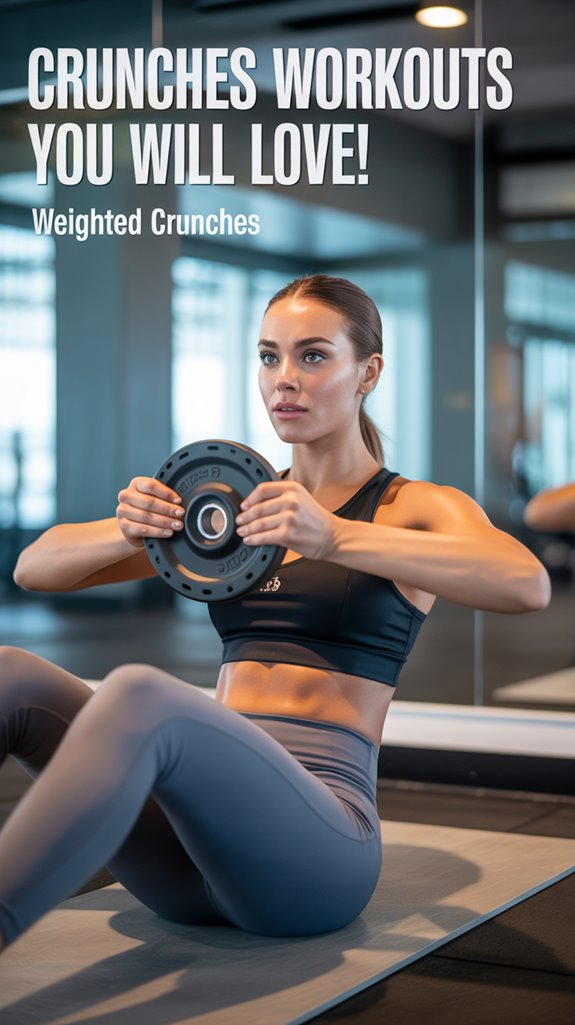
Weighted crunches transform a fundamental core exercise into a powerful muscle-building movement by introducing external resistance that challenges your abdominal muscles beyond bodyweight limitations. The weighted benefits include enhanced mechanical tension on your rectus abdominis, stimulating superior hypertrophy compared to standard variations. You’ll recruit more muscle fibers while building functional strength that transfers to compound lifts and athletic performance.
Master various resistance techniques by incorporating dumbbells, weight plates, cables, or medicine balls across your chest. Progress systematically by increasing load while maintaining controlled, deliberate movement patterns. This approach activates your obliques and transverse abdominis for thorough core stability. You’ll overcome adaptation plateaus that halt development with traditional crunches. Combine progressive overload principles with proper form to maximize abdominal muscle size, strength, and definition while supporting spinal health and postural alignment. The flexion-based spinal movements inherent in weighted crunches effectively develop your rectus abdominis through targeted contraction patterns.
Stability Ball Crunches

While weighted crunches challenge your core through added resistance, stability ball crunches amplify muscle activation by introducing an unstable surface that forces your body to work harder throughout each repetition. EMG studies reveal you’ll achieve 24–38% greater abdominal activation compared to floor crunches, engaging your rectus abdominis, transverse abdominis, and obliques simultaneously.
Master proper technique with these essentials:
- Position your lower back fully on the ball with knees bent at 90 degrees
- Execute slow, controlled movements without momentum or excessive spinal arching
- Maintain neutral neck alignment while focusing upward throughout the motion
The ball’s curvature allows deeper spinal flexion and expanded range of motion, maximizing core engagement. You’ll simultaneously strengthen stabilizer muscles, improve balance and proprioception, while burning additional calories through multi-muscle recruitment. This exercise also involves your legs and glutes, creating a more comprehensive workout that extends beyond traditional abdominal isolation movements.
Conclusion
You’ve now got a knight’s arsenal of ab exercises at your disposal—ten powerful crunches that’ll transform your core from soft to steel. Don’t just bookmark this page and forget it; you’ll need to actually do the work. Pick three variations that challenge you most, rotate them throughout your week, and watch your midsection become the fortress you’ve always wanted. Your six-pack journey starts today, so stop scrolling and start crunching!