
You can build an impressive chest at home with these ten proven exercises: regular push-ups for full pectoral activation, diamond push-ups to target your inner chest and triceps, wide push-ups for maximum engagement, and decline push-ups to strengthen your upper chest. Add plyometric push-ups for explosive power, close grip chest presses for deep muscle contraction, deficit push-ups for extended range of motion, hip bridge chest fly combinations, and one-leg push-ups for advanced stability challenges. Each variation offers unique benefits that’ll transform your upper body when you explore the complete techniques and programming strategies below.
Key Takeaways
- Regular, diamond, wide, and decline push-ups target different chest regions using only bodyweight and minimal equipment.
- Deficit push-ups using dumbbells or blocks increase range of motion for deeper pectoral fiber activation and muscle growth.
- One-leg push-ups enhance core stability while maintaining chest engagement, progressing difficulty beyond standard variations.
- Plyometric push-ups develop explosive power, while floor presses with household items provide hypertrophy stimulus at home.
- Combining proper breathing, tempo control, and peak contractions maximizes chest development without requiring gym equipment.
Regular Push-Ups for Full Chest Activation

Regular push-ups remain the cornerstone of home chest training because they activate your pectoralis major, deltoids, and triceps while simultaneously engaging your core and stabilizing muscles. You’ll achieve balanced muscle activation across both upper and middle chest portions when you position your hands slightly wider than shoulder-width with fingers pointing forward. Your chest must descend within inches of the floor with elbows flexed to at least 90 degrees—insufficient range of motion dramatically reduces fiber recruitment and limits stretch-mediated hypertrophy. The closed-chain nature creates superior stability demands compared to other push up variations, recruiting your serratus anterior and stabilizers throughout your upper back. You’re building functional strength while improving joint proprioception and cardiovascular endurance simultaneously, making this movement indispensable for complete chest development. This compound exercise targets multiple large muscle groups at once, providing an efficient full-body workout that saves valuable training time. Including innovative exercises from diverse arm and upper-body routines can keep workouts engaging and enhance overall strength gains.
Diamond Push-Ups to Target Inner Chest and Triceps
Diamond push-ups fundamentally shift the mechanical demands of traditional push-ups by narrowing your hand placement into a diamond configuration, which dramatically increases the load on your triceps brachii while simultaneously targeting the often-underdeveloped inner chest region. Position your hands directly beneath your sternum with thumbs and index fingers forming a diamond shape. This adjustment maximizes triceps activation while your pectoralis major and anterior deltoids provide secondary drive. You’ll immediately notice heightened demands on your core stability—your abs, glutes, and lower back must work harder to maintain rigid body alignment throughout each repetition. Keep your elbows tight against your ribcage as you descend with control. This intermediate-to-advanced variation delivers superior arm definition and pressing strength when executed with proper form and deliberate tempo. Incorporating a mix of classic lifts and innovative movements promotes balanced upper body development and can enhance overall strength when combined with appropriate progression and recovery balanced upper body development.
Wide Push-Ups for Maximum Chest Engagement

Position your hands wider than shoulder-width, aligned with mid-chest. Maintain a rigid plank with engaged core and glutes. Lower until your elbows reach 90 degrees, emphasizing controlled tempo throughout. Focus on scapular upward rotation rather than retracting your shoulders—think “wide shoulders” to prevent impingement. The increased muscle engagement extends to your anterior deltoids and serratus anterior, enhancing shoulder stability. Keep your neck in a neutral position by looking at a spot on the floor throughout the movement. Program 3–4 sessions weekly, prioritizing quality repetitions over volume. Track progression by adding sets or time-under-tension. For balanced development, also include bench press variations in your overall routine.
Decline Push-Ups to Build Upper Chest Strength

When you elevate your feet above your hands, decline push-ups transform into a precision tool for targeting the often-neglected upper chest. By adjusting your decline angle—ideally keeping it under 45 degrees—you’ll maximize clavicular head activation while minimizing unwanted shoulder dominance.
Start with a modest elevation: a sturdy box or step suffices. As you descend, verify your chest reaches the floor first, maintaining elbow angles around 45 degrees and a rigid core throughout. This upper chest focus fills developmental gaps that standard push-ups simply can’t address.
Progressive overload becomes intuitive through decline angle adjustments—incrementally raise your feet as strength improves. You’re also recruiting stabilizers intensely, fortifying shoulder integrity while burning significant calories. For optimal results, aim for 3 sets of 10-15 reps or continue each set until you reach muscular failure. Master this movement, and you’ll build balanced, thorough chest development without leaving home.
Plyometric Push-Ups for Explosive Power
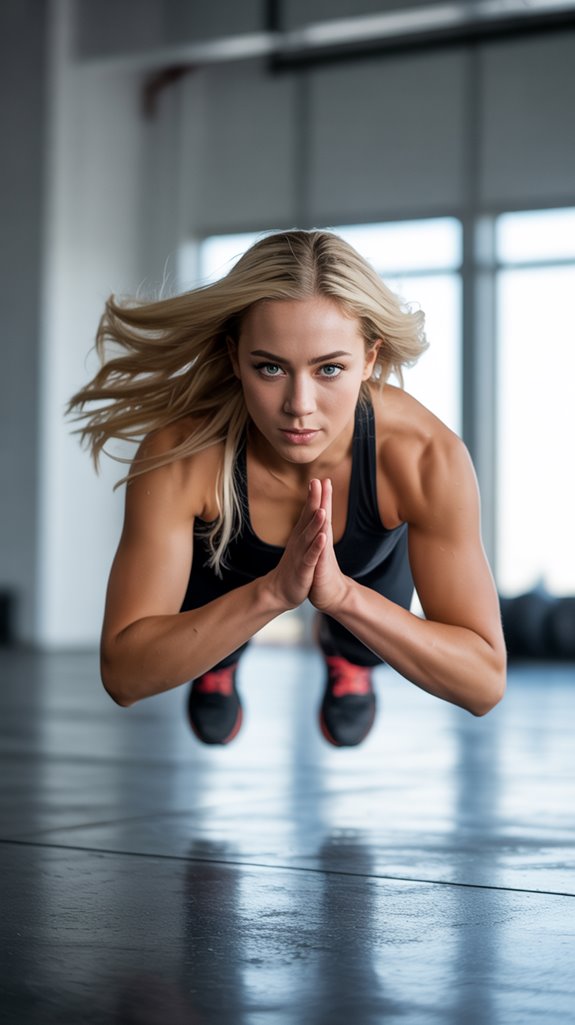
Explosive power emerges when you propel your body forcefully off the ground during plyometric push-ups, forcing your chest, shoulders, and triceps to contract at maximum velocity. This explosive training triggers fast twitch activation in your pressing muscles, recruiting the powerful type II fibers that remain dormant during standard push-ups. Your nervous system adapts by firing motor units more rapidly, translating directly to enhanced bench press and overhead press performance.
The metabolic demands are substantial—your heart rate spikes as you execute repeated explosive reps, simultaneously building strength and cardiovascular capacity. Your core muscles stabilize each violent push-off and landing, while your chest absorbs eccentric force upon descent. Your upper back muscles engage during the lowering phase, creating tension throughout the descent that prepares your body for the next explosive repetition. Include plyo push-ups as finishers after heavy pressing work to develop rate of force production that carries over to maximal lifts.
Floor Press With Household Items
Your chest training doesn’t require explosive movements alone—horizontal pressing with makeshift weights delivers comparable hypertrophy stimulus while sparing your shoulders from excessive stress. The floor press benefits include increased stability through direct ground contact and limited range of motion that protects shoulder joints while effectively targeting chest, triceps, and anterior deltoids.
Household item alternatives like backpacks filled with books, water jugs, or weighted suitcases provide adjustable resistance without specialized equipment. Position yourself supine with elbows at 45 degrees, press to lockout, then lower until your triceps contact the floor—avoiding excessive bounce maintains tension and reduces injury risk. The movement improves triceps lockout strength that transfers directly to more complex pressing variations you’ll encounter in future training progressions. Progress through unilateral variations, offset loading, or combining movements with leg raises to challenge core stability. This accessible approach builds legitimate pressing strength while accommodating your available resources and training environment.
Close Grip Chest Press for Pec Squeezing
While standard push-ups and wide-grip presses dominate home chest routines, the close grip chest press delivers targeted pectoral development through enhanced muscle contraction and inner chest activation. Position your hands shoulder-width apart—narrower than standard bench markings—to optimize muscle activation across your pectoralis major and triceps. Tuck your elbows at 45 degrees from your torso, then lower the bar to your lower-mid chest while maintaining scapular retraction. The critical component: consciously squeeze your pecs at lockout, extending time under tension for superior fiber recruitment. Proper breathing techniques during each rep enhance core stability and maintain consistent tension throughout the movement.
You’ll implement effective grip variations using dumbbells, loaded backpacks, or resistance bands at home. Floor presses and close-grip push-ups replicate this movement pattern when equipment’s limited. Slower tempos with deliberate contractions maximize hypertrophy even with lighter loads, making this technique invaluable for home training protocols.
Deficit Push-Ups for Extended Range of Motion

By placing your hands on elevated surfaces like dumbbells, kettlebells, or sturdy blocks, deficit push-ups release greater chest development through extended range of motion that standard floor variations can’t achieve. You’ll activate deeper pectoral fibers as your chest descends below hand level, intensifying both stretch and contraction phases.
The deficit benefits include enhanced shoulder mobility, stronger scapular stabilizers, and increased tricep engagement through deeper elbow flexion. Your core works harder maintaining alignment throughout the amplified movement pattern. Using angled dumbbells can mimic the bar path of a traditional bench press, providing a more natural pressing motion.
For range considerations, elevate hands 2-4 inches initially—enough depth to challenge muscles without compromising shoulder integrity. Descend until your chest hovers an inch from the floor, then drive upward explosively. Master standard push-ups first; premature progression risks injury. Program 2-4 sets of 6-12 controlled reps for peak hypertrophy.
Hip Bridge With Chest Fly Combination
Push-ups challenge your chest through bodyweight alone, but combining movements transforms standard exercises into efficient muscle-building compounds. The hip bridge with chest fly merges upper-body horizontal adduction with lower-body hip extension, creating exceptional muscle engagement across multiple planes.
You’ll begin supine with knees bent, driving through your heels to elevate your hips into a stable bridge position. Hold dumbbells above your chest, then execute controlled flys while maintaining that elevated bridge—your glutes squeeze hard, your core braces isometrically, and your pectoralis major handles the horizontal load. Focus on a posterior pelvic tilt before lifting your hips to ensure proper glute activation and protect your lower back throughout the movement.
This compound approach delivers superior training efficiency compared to isolated movements. Your posterior chain stabilizes while your chest works dynamically, building functional strength that translates to athletic performance. Among bridge variations, this exercise stands out for simultaneous upper-lower coordination and enhanced neuromuscular development.
One-Leg Push-Ups for Advanced Stability Challenge
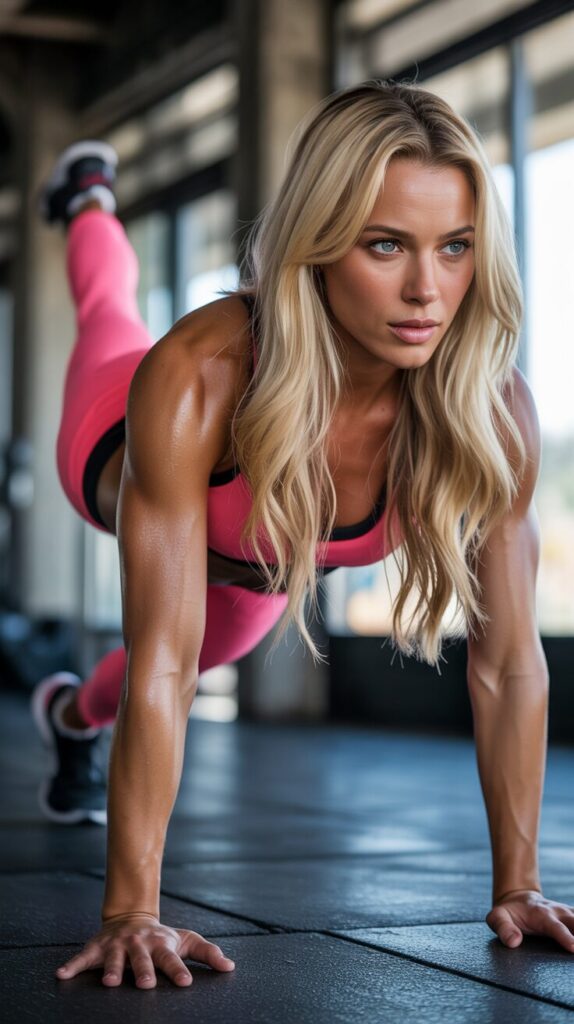
When you lift one leg off the ground during a push-up, you transform a fundamental chest exercise into a demanding stability challenge that engages your entire core and proprioceptive system. You’ll activate your pectoralis major while simultaneously recruiting your anterior deltoids, triceps, serratus anterior, and deep stabilizers like the transversus abdominis.
This balance training variation forces your body to resist rotation and pelvic drift, delivering superior core engagement compared to standard push-ups. Position your hands slightly wider than shoulder-width, maintain a rigid plank position, and elevate one leg in line with your torso throughout each repetition.
Progress methodically—master standard push-ups first, then practice single-leg holds before attempting full reps. This variation teaches full-body tension, which is essential for maximizing strength gains across all movement patterns. You’ll develop unilateral strength that transfers directly to athletic movements and overhead pressing patterns.
Conclusion
You’ve just opened the most powerful chest-building arsenal known to humanity—and you don’t need a single piece of equipment! These ten exercises will transform your chest from flat to phenomenal faster than you ever imagined possible. You’ll be ripping through shirts like the Hulk in no time. Don’t wait another second—your dream chest is literally at your fingertips. Start today, and you’ll never look back!