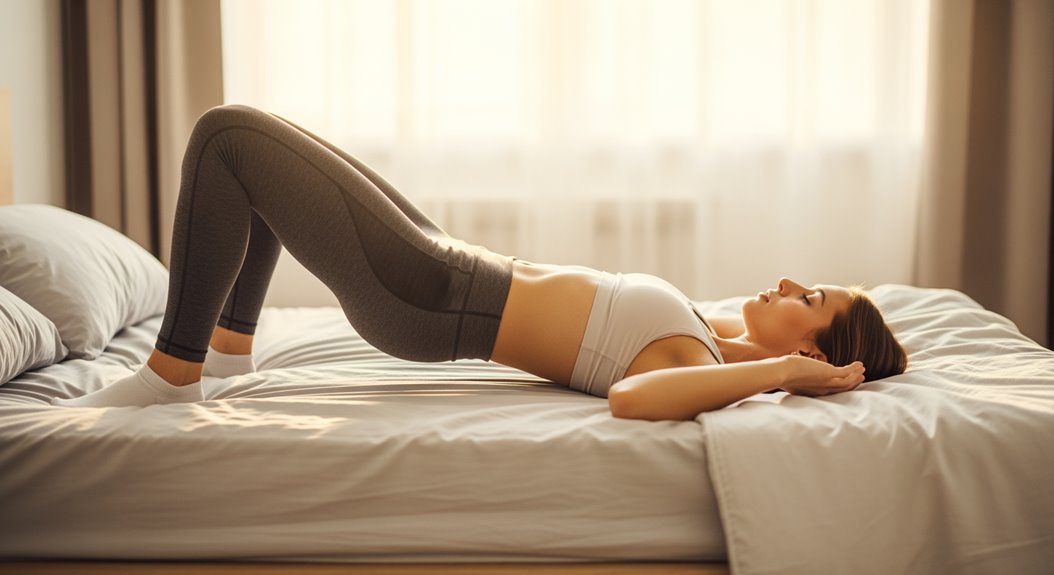
You can transform your bedroom into an effective workout space with ten bed-based exercises that require no equipment. Start with marching hip raises and side planks with twists to activate your core and lower body. Add diamond reverse crunches for defined abs, jack splits for explosive power, and arabesque leg lifts to sculpt your glutes. Include dolphin planks for upper body strength, toe tap leg lifts for hip flexibility, and bridges to strengthen your posterior chain. Morning stretching sequences will energize your entire day and enhance your overall mobility, helping you discover exactly which movements work best for your fitness goals.
Key Takeaways
- Marching hip raises activate glutes and core while lying down, preventing hip drops and lower back arching.
- Diamond reverse crunches target lower abs effectively by minimizing hip flexor involvement with splayed knees.
- Side planks with twists engage obliques through controlled rotation while building lateral stability and core strength.
- Bridge exercises strengthen the posterior chain, reduce back pain, and improve posture through glute activation.
- Morning stretching sequences increase flexibility and circulation, incorporating poses like Cobra and Seated Forward Bend.
Marching Hip Raises for Total Lower Body Activation
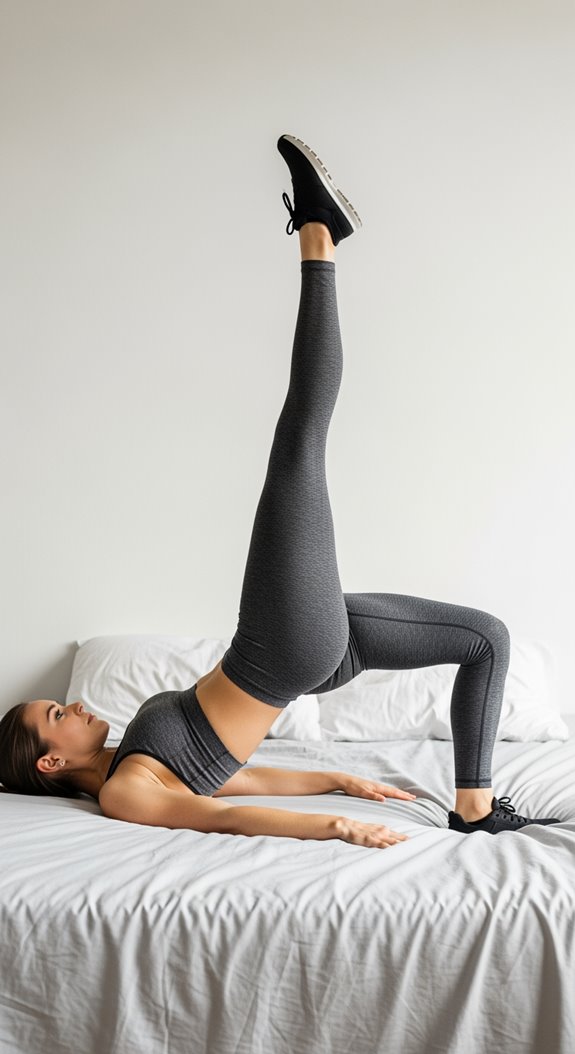
Marching hip raises transform your bed into a lower body training station by combining the foundational glute bridge with alternating knee drives. You’ll simultaneously activate hip extensors and flexors while demanding continuous core engagement to prevent lumbar compensation. This efficiency makes marching variations invaluable for athletes and rehabilitation clients alike. They also complement a range of glutes workouts to build balanced lower-body strength.
Execute the movement by establishing a stable bridge position, then drive one knee toward your chest while maintaining hip height and spinal alignment. Common errors include dropping hips during the march phase or over-arching your lower back—both signal inadequate glute activation or core bracing. Focus on maintaining your shin angle parallel to your torso during each knee drive to ensure proper hip flexion mechanics.
The exercise’s scalability allows progressive overload through resistance bands, elevated foot positions, or tempo manipulation. You’re building functional strength that directly transfers to sprinting mechanics, agility tasks, and daily movement patterns requiring dynamic hip stability.
Side Plank With Twist to Sculpt Your Waistline
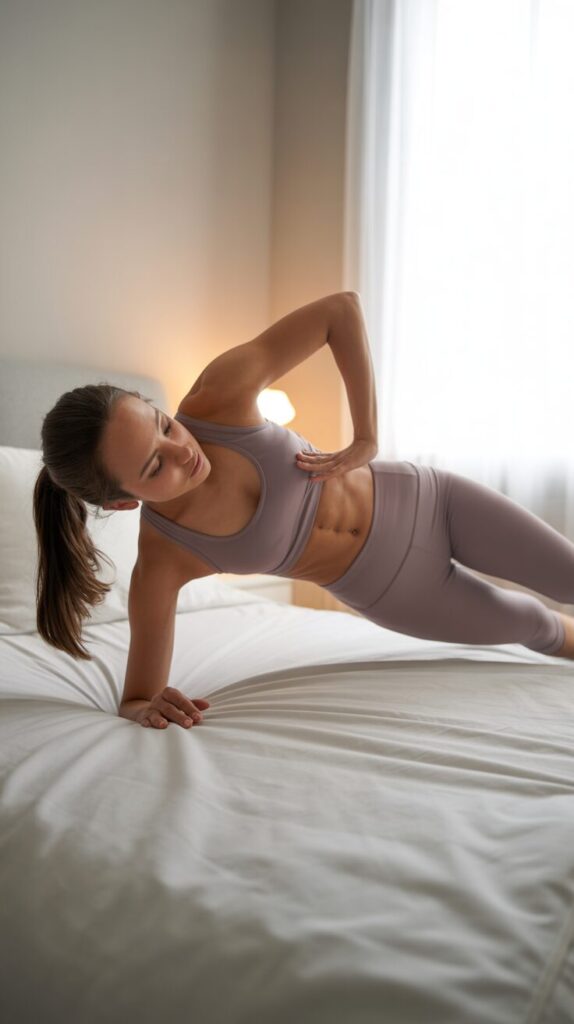
Rotational power defines athletic performance and real-world movement competence, yet most training programs neglect this critical dimension. The side plank with twist addresses this gap directly, targeting your obliques through controlled rotation while maintaining lateral stability. You’ll activate rectus abdominis, transverse abdominis, and deep spinal stabilizers simultaneously—essential for waistline sculpting and injury prevention. Many effective core moves can be done without equipment and fit easily into home workouts. Position your elbow beneath your shoulder, maintain full-body tension, and execute controlled twists toward the mat. This movement builds core stability through both isometric holds and dynamic rotation, strengthening muscles critical for single-leg activities and athletic performance. You’ll reduce lower back injury risk while developing the rotational strength that translates to sports and daily tasks. Maintain head alignment with spine throughout the movement, looking straight ahead rather than down at the mat.
Hold 30–40 seconds per side or perform 8–12 reps. Scale difficulty by adjusting leg position or adding resistance.
Diamond Reverse Crunches for Defined Lower Abs
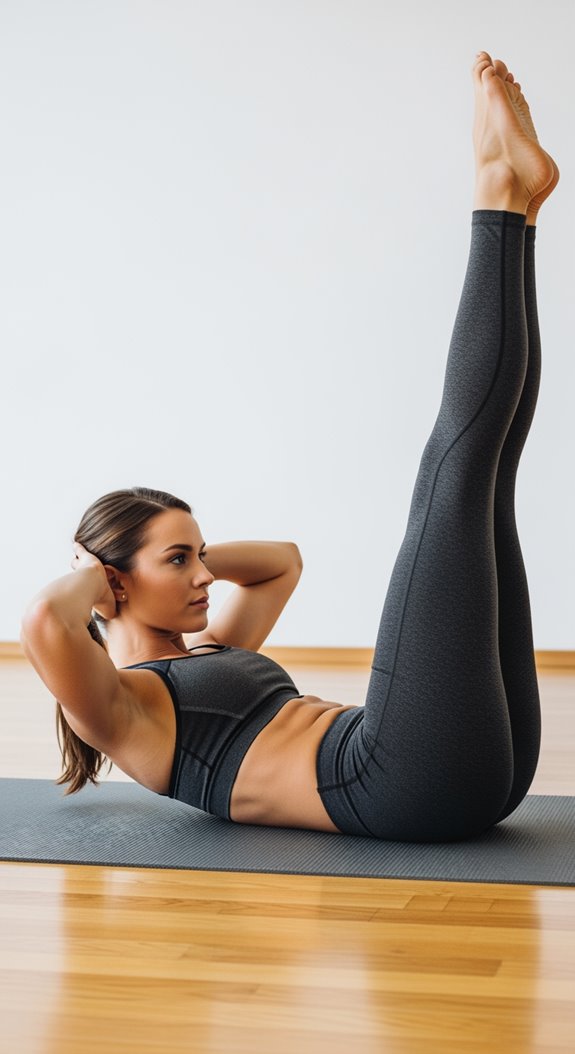
While rotational work strengthens your obliques and lateral stability, lower abdominal development demands a different approach. Diamond reverse crunches target the often-undertrained lower rectus abdominis by positioning your feet together with knees splayed outward. This configuration minimizes hip flexor dominance, redirecting tension to your lower abs.
Execute by lying flat, maintaining constant lower-back contact with your mattress. Curl your knees toward your chest, lifting your hips off the surface through pure core contraction—not momentum. Control each repetition through the full range, squeezing at peak contraction.
Perform 8–18 reps for 3–4 sets, emphasizing quality over speed. This exercise also engages your obliques and hip flexors as secondary muscles, contributing to overall core stability. Advanced practitioners can explore diamond crunch variations by adding resistance between the ankles or extending heels toward the ceiling. Master these lower ab techniques to build extensive core strength and enhanced abdominal definition. Incorporating a variety of core workouts helps ensure balanced development and keeps routines enjoyable.
Arabesque Leg Lifts to Shape Your Glutes
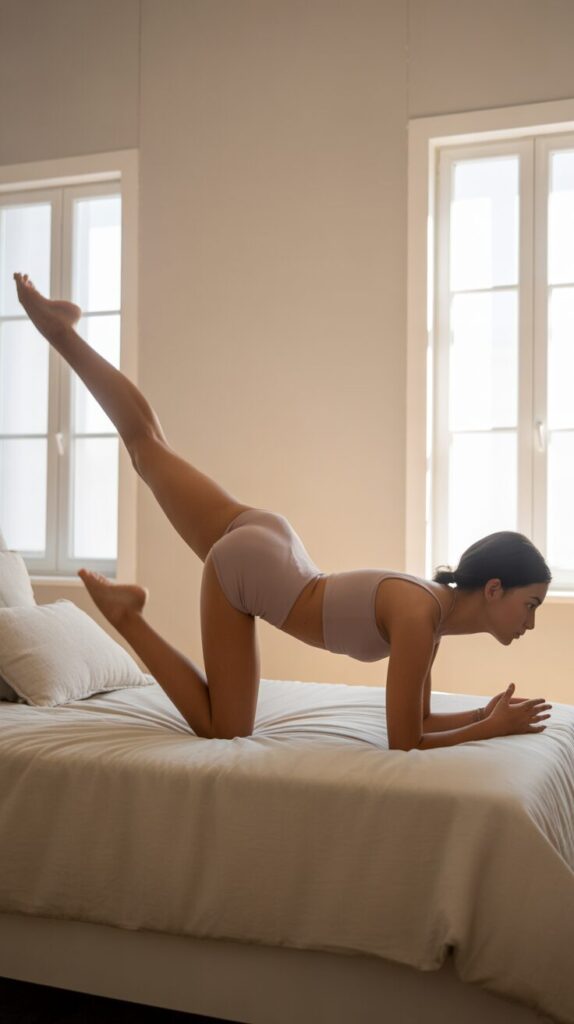
Your glutes deserve a workout that combines balletic grace with serious muscle-building intensity, and arabesque leg lifts deliver exactly that. By extending your leg behind you with hip external rotation, you’ll maximize glute activation—EMG studies confirm this position effectively fires your gluteus maximus. Execute each lift with a straight back and neutral spine, avoiding lower back arching. Control is paramount: lift slowly, squeeze hard at the top, and add 1-2 second holds to exhaust muscle fibers.
Progress through arabesque variations by incorporating resistance bands above your knees or ankles, boosting glute activation by up to 40%. Small pulses at peak extension increase metabolic stress for hypertrophy. For enhanced stability and trunk control, perform supported arabesques on a physio ball to create a long curve from head to toe while maintaining balance. Research shows consistent practice yields 20-30% strength gains within 6-8 weeks, sculpting firmer, rounder glutes while protecting your lumbar spine.
Flutter Kicks for Rapid Core Endurance
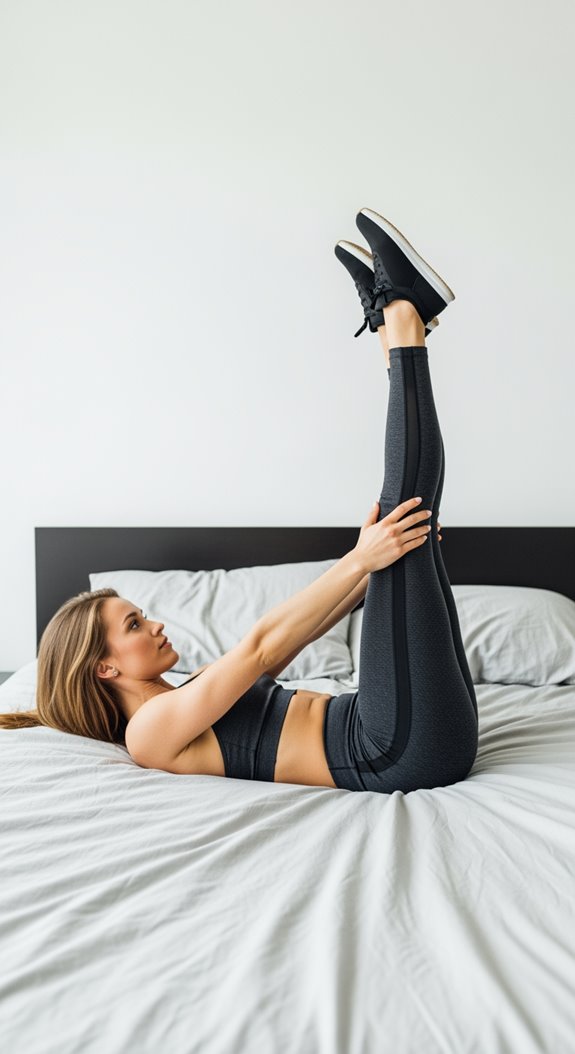
Flutter kicks transform your core into an endurance powerhouse by targeting your lower abs, hip flexors, and obliques through rapid, alternating leg movements. You’ll achieve peak muscle activation by maintaining straight legs elevated 12 inches while engaging your entire core to stabilize your spine. This exercise delivers dual benefits: muscular endurance and cardiovascular conditioning that amplify your fitness capacity.
Execution principles for ideal results:
- Maintain neutral spine positioning with your lower back pressed into the mattress, eliminating lumbar strain while maximizing core engagement
- Control tempo strategically by starting with slow, deliberate movements before progressing to explosive speeds that elevate heart rate
- Emphasize hollow body mechanics by keeping shoulders slightly lifted and core braced throughout the movement sequence
Your secondary muscles—quads, glutes, and hamstrings—coordinate to support leg elevation while building functional strength for athletic performance. Beyond building strength, flutter kicks contribute to weight loss by burning calories during the continuous leg movement patterns.
Dolphin Plank to Strengthen Your Upper Body
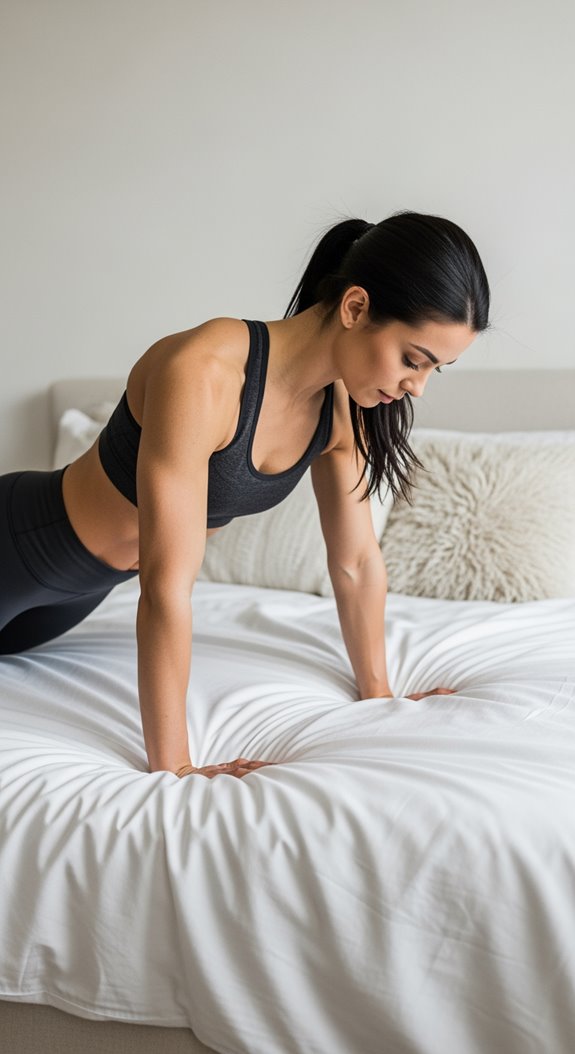
Dolphin plank demolishes the notion that effective upper body training requires equipment—this forearm-supported position transforms your shoulders, arms, and chest into pillars of functional strength. You’ll activate deltoids, rotator cuffs, and triceps while your core stabilizes relentlessly. The isometric hold builds exceptional muscle endurance throughout your arms and shoulders as scapular stabilizers fire continuously.
Position your elbows directly beneath your shoulders, elevate your hips, and maintain spinal extension. Your upper back engages to anchor shoulder blades while deep abdominals prevent sagging. The inverted angle delivers cerebral blood flow enhancement and proprioceptive refinement. This pose stimulates the nervous system while enhancing vestibular function for improved balance.
For progression, alternate between dolphin and forearm plank positions to introduce cardiovascular demand. Keep your neck neutral—never force your head downward. This foundational movement prepares you for advanced inversions while fortifying shoulder architecture against injury.
Toe Tap Leg Lifts for Hip Flexor Control
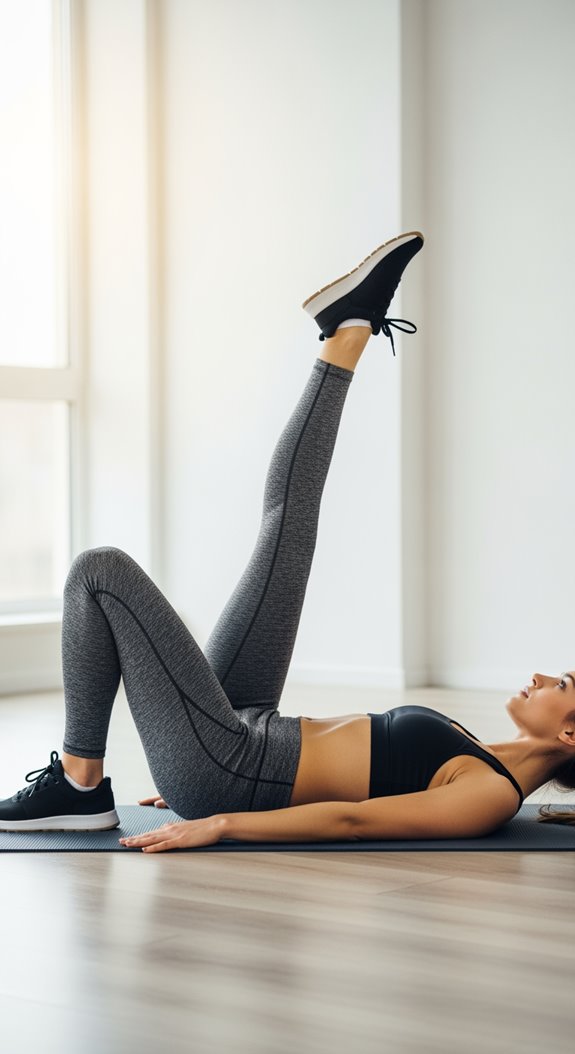
While dolphin plank fortifies your upper body architecture, toe tap leg lifts target the often-neglected hip flexors that govern lower body mobility and pelvic stability. Begin in tabletop position—hips and knees at 90 degrees, hands beneath your glutes to protect your lumbar spine. Lower one leg with deliberate eccentric control, tapping the floor as gently as creating a water ripple, then return. This controlled descent maximizes hip flexor benefits through neuromuscular precision rather than momentum. For enhanced stability throughout the movement, focus your gaze on a fixed point ahead to maintain proper alignment and balance.
Strategic progressions for advancing practitioners:
- Isometric holds at bottom or top positions intensify time-under-tension for the iliopsoas group
- Exercise variations include ankle weights, double-leg execution, or removing hand support to challenge core stabilization
- Tempo manipulation (4-second lowers, 2-second lifts) develops eccentric strength essential for advanced calisthenics
Alternate sides for 10-15 controlled repetitions, emphasizing quality over quantity.
Bridges: Build a Strong Foundation
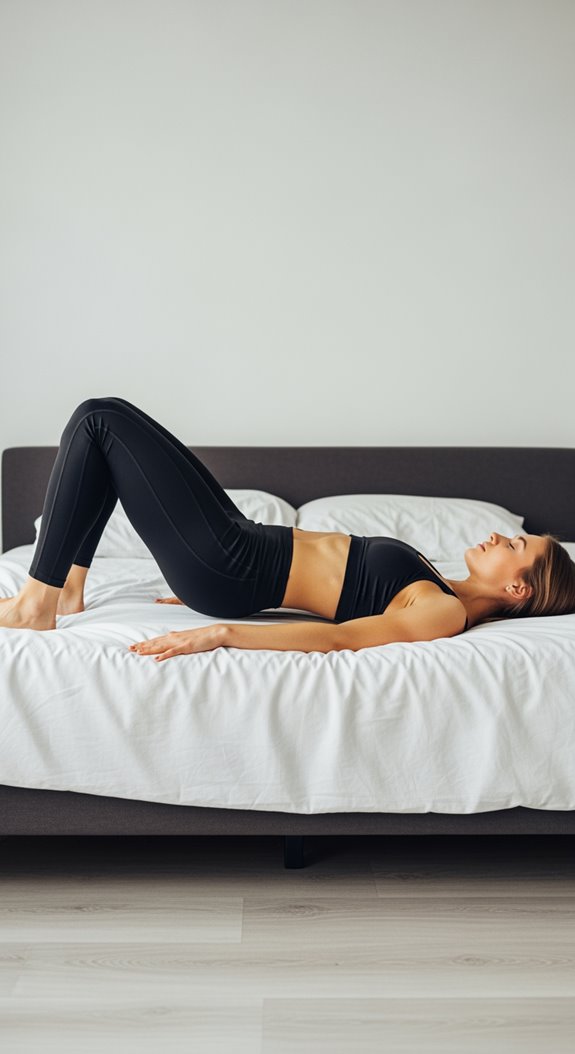
The bridge transforms your posterior chain into a resilient foundation that powers every movement from standing up to sprinting. You’ll activate your glutes, hamstrings, and deep abdominal muscles while strengthening spinal erectors that protect against injury. Studies show measurable gains in core stability—internal obliques thicken by 0.3 cm and transverse abdominis by 0.1 cm with consistent practice.
Start with double-leg bridges, then progress through bridge variations: single-leg lifts target core stability intensely, while straightening your knees emphasizes hamstrings. You’ll counter prolonged sitting’s damage by strengthening weak glutes and stretching tight hip flexors simultaneously. This equipment-free exercise reduces low back pain, corrects anterior pelvic tilt, and builds the hip extension strength essential for walking, running, and climbing stairs. The movement also stretches your chest and shoulders, promoting better posture throughout your upper body. Whether you’re rehabilitating or pursuing performance, bridges deliver functional power.
Morning Stretching Sequences to Energize Your Day
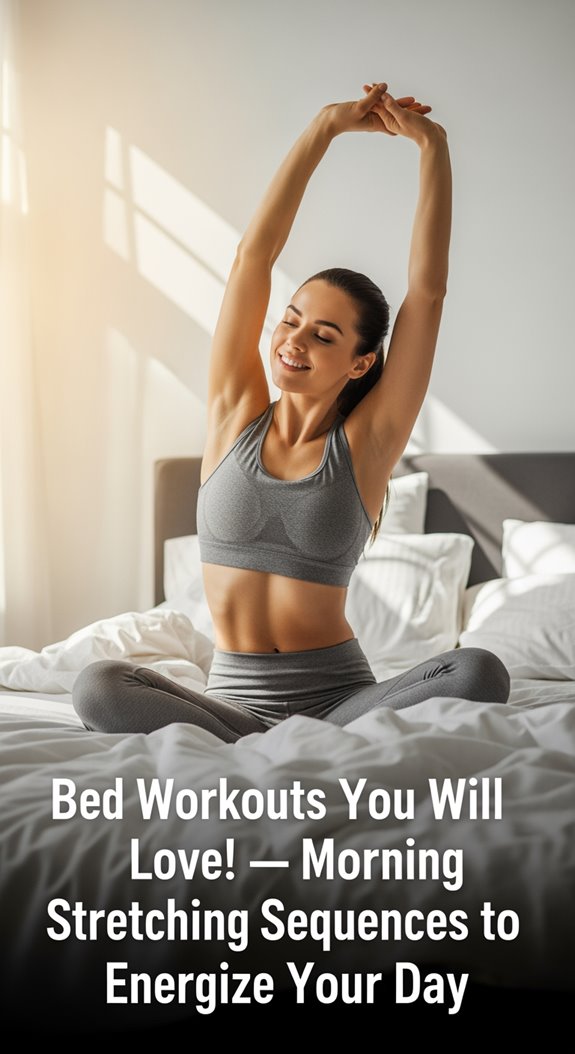
Your body craves movement after hours of stillness, and morning stretches deliver exactly what those stiff muscles need. Morning flexibility routines counter muscle tightness while enhancing circulation, preparing you for peak physical and mental performance. These energizing stretches increase range of motion and alleviate tension from sleep positions. Morning stretching reduces pain and boosts mood, setting a positive tone for your entire day.
Execute these proven sequences for best results:
- Cobra Pose: Position yourself prone, palms near shoulders, then press into gentle spinal extension to activate core and back muscles
- Extended Puppy Pose: From all fours, reach arms forward to open shoulders and chest, relieving upper body tension
- Seated Forward Bend: Sit with legs extended, fold forward to improve hamstring and lower back flexibility
Hold each stretch for 60 seconds total, emphasizing slow, deep breathing. Consistency and proper technique maximize benefits.
Conclusion
You’ve discovered nine incredible moves that’ll transform your mornings without leaving your mattress. But here’s what most people miss: consistency beats perfection every single time. Will you actually do them? That’s the real question. Start with just three exercises tomorrow—choose your favorites. Because the difference between dreaming about results and actually achieving them? It’s simpler than you think. Your move begins now.