
You’ll transform your physique with these barbell essentials: back squats for explosive lower body power, deadlifts for posterior chain strength, and bench press for upper body mass. Add overhead press for shoulder development, bent-over rows for back thickness, and rollouts for core stability. Don’t overlook landmine twists for rotational strength, standing curls for bicep growth, and reverse curls for forearm balance. Each movement builds functional strength while preventing injuries through proper technique and progressive overload. Discover how to program these exercises for maximum results in the thorough guide below.
Key Takeaways
- Barbell back squats and deadlifts build lower body power, enhance athletic performance, and increase bone density for functional strength.
- Bench press, overhead press, and bent-over rows maximize upper body muscle growth while engaging stabilizers for injury prevention.
- Barbell rollouts develop core stability by challenging torso control through anti-extension movements with progressive difficulty levels.
- Landmine twists create rotational strength for real-world movement patterns while engaging obliques and reducing joint stress.
- Barbell curls and reverse curls target arm hypertrophy and grip strength using tempo variations and strategic grip width adjustments.
Barbell Back Squat for Complete Lower Body Development

When you load a barbell across your shoulders and descend into a squat, you’re performing one of the most effective exercises for building complete lower body strength and muscle mass. This compound movement simultaneously targets your quadriceps, hamstrings, glutes, and core while demanding proper stabilization from your upper back and calves. Beyond hypertrophy, you’ll increase bone mineral density in your femur and hips, reducing osteoporosis risk as you age. The barbell back squat enhances athletic performance by improving explosive power, sprint speed, and vertical jump height. Mastering proper technique—bar positioned on your upper trapezius, maintaining spinal neutrality, and achieving parallel depth—protects against injury while maximizing results. The exercise also strengthens joint structures, which supports injury prevention throughout your training career. Incorporate squat variations and prioritize mobility enhancement to develop functional strength that translates directly to daily activities and competitive performance. Many lifters enjoy combining squats with complementary leg workouts to create balanced routines that suit all fitness levels.
Barbell Bench Press to Build Upper Body Power

As you position yourself beneath a loaded barbell and drive it upward from your chest, you’re executing the benchmark exercise for upper body power and strength. The bench press maximally loads your pectoralis major, anterior deltoids, and triceps while demanding total-body tension from feet to shoulders. Retract your scapulae, maintain a slight lower-back arch, and grip the bar with wrists stacked over elbows at approximately 45–70 degrees. Lower the bar to your mid-chest, then press upward in a controlled arc. Safety techniques require a full thumb-wrapped grip, spotter assistance, and controlled tempo—never bounce the bar. Progressive overload through varied bench press variations and periodized programming guarantees continuous strength gains. Plant your feet, brace your core, and systematically increase loading to develop exceptional pressing power. Wrist wraps provide essential support to keep your wrists vertical and aligned during heavy pressing, maximizing force transfer while reducing injury risk. Many gym-goers pair barbell lifts with weight machine workouts to target specific muscle groups and round out their strength programs.
Barbell Deadlift for Posterior Chain Dominance
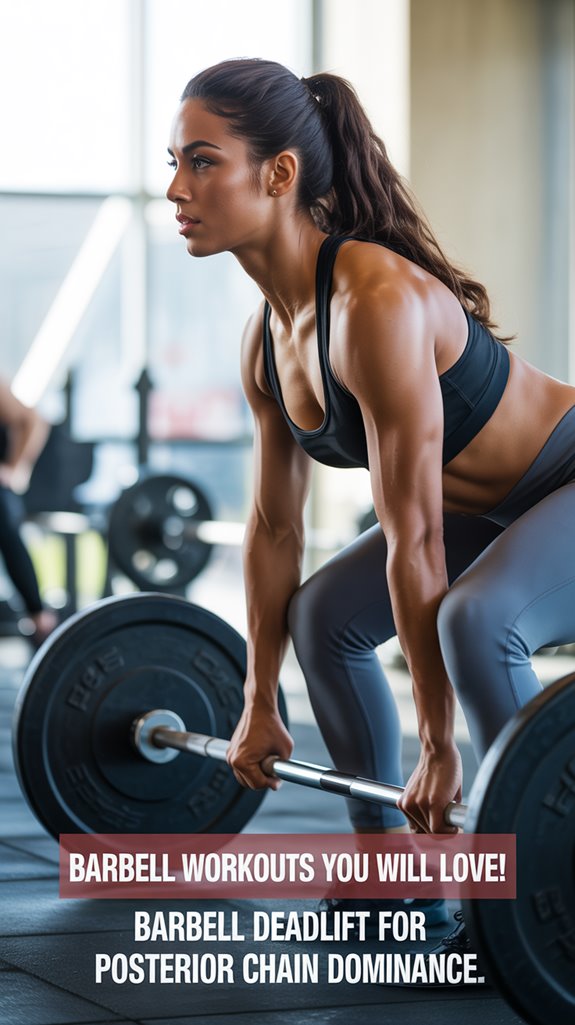
Gripping a loaded barbell from the floor and driving it upward through pure posterior power, you’re performing the king of strength movements—the deadlift. This compound lift dominates your glutes, hamstrings, lower back, and traps while building functional strength that transfers directly to athletic performance. Your posterior chain becomes resilient through progressive loading, enhancing sprint speed, vertical jump, and injury prevention.
Master the fundamentals through deliberate technique:
- Position feet shoulder-width with toes under the bar, maintaining hips lower than shoulders
- Engage lats by pulling slack from the bar while bracing your core for spinal protection
- Progress from overhand to mixed grip as loads increase
Explore deadlift variations—conventional, sumo, Romanian—to target specific posterior chain segments. The deadlift functions as a full-body movement that simultaneously activates multiple muscles and bones throughout your entire kinetic chain. Program 2-3 weekly sessions with proper recovery for peak strength development and cross-transfer gains to other lifts. Additionally, pair deadlifts with complementary glute and hamstring exercises to maximize posterior chain development.
Barbell Overhead Press for Shoulder Strength

While the deadlift builds posterior dominance, the barbell overhead press establishes vertical pushing strength through your shoulders, triceps, and upper back. The overhead press benefits extend beyond isolated deltoid work—you’ll engage stabilizers throughout your core and trunk while building injury-resistant shoulders. Master proper form by positioning the bar high on your front delts with a shoulder-width grip. Press the bar vertically—not forward or back—keeping your chest elevated and elbows tracking forward. Lock out completely at the top while shrugging your shoulders upward to protect your rotator cuff. Avoid common errors like excessive backward lean, partial reps, or wide grips that compromise joint integrity. Maintain almost straight wrists with knuckles angled about 75° back to keep the bar properly aligned over your forearm bones. Start light, prioritize full range of motion, and progress systematically. This compound movement delivers unmatched shoulder strength when executed with technical precision.
Barbell Bent-Over Row for a Thick Upper Back

The barbell bent-over row stands as the cornerstone movement for building a thick, powerful upper back. You’ll maximize recruitment of your lats, rhomboids, and trapezius while driving substantial muscle hypertrophy through heavier loads than alternatives allow. Execute with a 30–45° torso angle, pulling the bar toward your sternum with elbows driving backward—not lifting with your arms.
Critical execution points for ideal upper back development:
- Maintain scapular retraction at the top position, squeezing shoulder blades together to fully engage target musculature
- Program 3–5 sets of 6–12 reps, balancing mechanical tension with metabolic stress for hypertrophy
- Vary grip width and stance regularly—close grip emphasizes mid-back thickness, while wider grips shift emphasis to rear deltoids
Avoid rounding your spine or using momentum, as these undermine muscle engagement and invite injury. This exercise also strengthens your hamstrings and spinal erectors, contributing essential posterior chain stability that translates to improved performance in compound lifts and athletic movements.
Barbell Hip Thrust for Maximum Glute Activation
No other exercise delivers superior glute activation quite like the barbell hip thrust, where EMG studies consistently show higher glute recruitment than squats, deadlifts, or lunges. Position your upper back against a bench with feet shoulder-width apart, maintaining a 90-degree knee angle at full extension. Drive through your heels while bracing your core, achieving complete hip lockout at the top. Master glute activation techniques by performing posterior pelvic rotation and squeezing maximally at peak contraction—visualize preventing a coin from falling between your glutes. Hold this position for one to three seconds before lowering over a two-second count. Address tight hip flexors through foam rolling beforehand to prevent compensation patterns. The barbell hip thrust primarily targets gluteus maximus while engaging hamstrings and lower back muscles for stabilization throughout the movement. Explore hip thrust variations by adjusting foot positioning and implementing different pause durations for enhanced hypertrophy stimulus.
Barbell Rollouts for Core Stability and Control

Mastery of anti-extension movements separates functional core strength from superficial aesthetics, and barbell rollouts stand as one of the most challenging tests of true torso stability. You’ll engage your rectus abdominis, transverse abdominis, and erector spinae simultaneously while demanding shoulder and lat stabilization. This exercise builds the kind of core engagement that translates directly to heavy compounds and athletic performance.
Essential execution principles:
- Maintain a straight line from knees to head—any lumbar sagging compromises injury prevention
- Roll forward only as far as you can control the return without compensation patterns
- Progress gradually through planks and ball rollouts before attempting the full movement
Your hip flexors, rotator cuffs, and deep stabilizers must coordinate perfectly. This integration creates authentic core strength that protects your spine under load. Start with 3-4 sessions per week to allow adequate recovery time between workouts, as muscles require rest to adapt and grow stronger.
Landmine Twists for Rotational Strength

While most core training confines you to sagittal plane movements, landmine twists release true rotational power by engaging your obliques, rectus abdominis, and transverse abdominis through functional arcing patterns that mirror real-world demands. You’ll develop explosive strength transferable to athletic tasks like throwing and lifting while building superior balance and coordination through multi-planar stabilization.
The standing position optimizes spinal alignment and reduces joint stress compared to traditional lifts, making it accessible for those with shoulder or back concerns. Start with lighter loads to master the controlled arc, gripping the barbell with both hands and rotating fully to each hip. Progressive overload remains achievable whether you’re pursuing hypertrophy, rehabilitative stability, or sport-specific power. This versatile movement addresses muscular imbalances while delivering exceptional muscle engagement and rotational strength development. The exercise activates scapular stabilizers and deltoids, creating a full-body movement that strengthens multiple muscle groups simultaneously.
Standing Barbell Curl for Bicep Hypertrophy

- Straight bar vs. E-Z bar: Straight bars maximize supination and bicep recruitment, while E-Z bars reduce wrist strain
- Grip width manipulation: Wider grips emphasize the short head; narrower grips target the long head
- Tempo adjustments: Slow eccentrics (3-4 seconds) dramatically increase hypertrophy stimulus
Program 8–12 reps with progressive overload, training twice weekly for peak mass-building.
Reverse Barbell Curl for Forearm and Arm Balance
Execute with a pronated grip, elbows pinned to your torso, maintaining neutral wrists throughout. Expect to handle 30-40% less weight than standard curls—this isn’t weakness, it’s biomechanics. Control the eccentric phase for maximum motor unit recruitment. Include reverse curls after primary pressing movements or pair them with hammer curls for thorough arm development. This strategic variation addresses muscular weak points that limit your overall lifting capacity. The movement primarily targets the brachioradialis, a key forearm muscle that enhances your ability to grip heavier loads across all pulling exercises.
Conclusion
You’ve been handed the keys to your own iron kingdom. Each barbell movement is a brick in the fortress you’re building—squat by squat, press by press. Like a blacksmith forging armor, you’ll hammer away at these nine exercises, tempering your body into something unbreakable. The barbell’s your anvil, your sweat’s the fire, and your dedication’s the steel. Now go—your castle won’t build itself.