
This post contains affiliate links. As an Amazon Associate I earn from qualifying purchases.
You’ll transform your fitness routine with these ten research-backed workouts: moderate-intensity cardio (150–300 minutes weekly) reduces heart disease risk by up to 31%, while sprint intervals slash body fat 39% more effectively than traditional HIIT. Add dumbbell overhead presses, bent-over rows, and cable face pulls for upper body strength, then incorporate pushups, planks, and dead bug exercises for core stability. Complete your regimen with pistol squats for leg strength and bodyweight circuits that deliver 4.3% fat reduction. Discover below how each exercise optimizes your specific fitness goals.
Key Takeaways
- Sprint interval training delivers superior fat loss results—39% more effective than HIIT—while requiring 61% less exercise time.
- Bodyweight circuits at home increase muscle mass by 1.9% and upper body strength by 20% without equipment.
- Moderate-intensity cardio for 150–300 minutes weekly reduces heart disease risk by 22–31% and lowers blood pressure.
- Pushup and plank variations build total-body core stability while targeting obliques, hip flexors, and deep stabilizers.
- Pistol squats develop single-leg strength, balance, and joint control anywhere without specialized equipment or gym access.
Moderate-Intensity Cardio Sessions for Heart Health

When you engage in moderate-intensity cardio sessions, you’re taking one of the most effective steps toward protecting your heart and extending your life. Target 150–300 minutes weekly of aerobic activity like brisk walking, cycling, or swimming at 50%–70% of your maximum heart rate. This commitment reduces coronary disease risk by 22%–31% and lowers systolic blood pressure by 5–8 mm Hg. You’ll improve your cholesterol profile, enhance insulin sensitivity, and boost cardiorespiratory fitness. Break sessions into 10-minute bouts if needed—consistency matters more than duration. The greatest heart health gains occur when you shift from sedentary to moderately active. After each workout, you can experience lower blood pressure for up to 13 hours, providing extended cardiovascular protection throughout your day. Exceed 300 minutes weekly for additional mortality reductions up to 38%, and combine moderate with vigorous efforts for ideal cardiovascular protection. Many people enjoy incorporating dance cardio or outdoor activities into their routines to keep workouts engaging and sustainable.
Sprint Interval Training for Speed and Metabolism
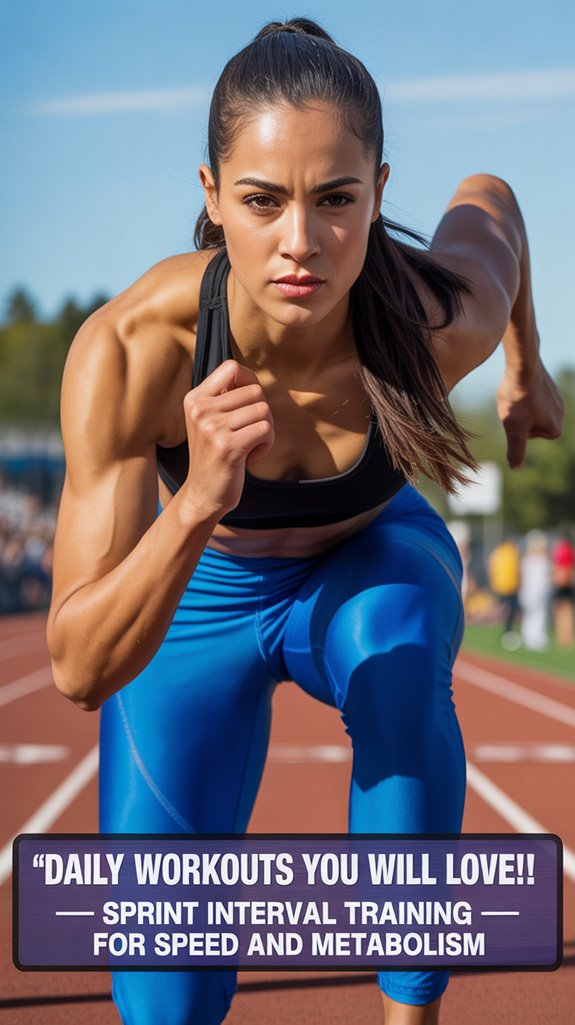
Sprint interval training takes your fitness to the next level by combining maximum-effort bursts with strategic recovery periods that reshape your metabolism and body composition. You’ll develop powerful sprint adaptations that enhance VO2max, increase lactate threshold, and boost power output by up to 2.8% in just six sessions. These physiological changes enable you to sustain high-intensity efforts 42% longer than traditional endurance training allows.
The metabolic efficiency gains are remarkable—you’ll slash body fat 39% more effectively than HIIT while spending 61% less time exercising. Your insulin sensitivity improves by 53%, naturally elevating growth hormone and testosterone levels. Fast-twitch muscle fibers activate, neuromuscular recruitment accelerates, and your body switches from carbohydrate to fat burning—all through strategic maximum-effort intervals. Research with well-trained distance runners demonstrated that sprint interval training produced significant improvements across multiple distances, from 100 meters to 3000 meters, outperforming traditional endurance methods. These results align with findings that short, intense intervals are a cornerstone of effective high-intensity interval training.
Dumbbell Overhead Press for Upper Body Strength
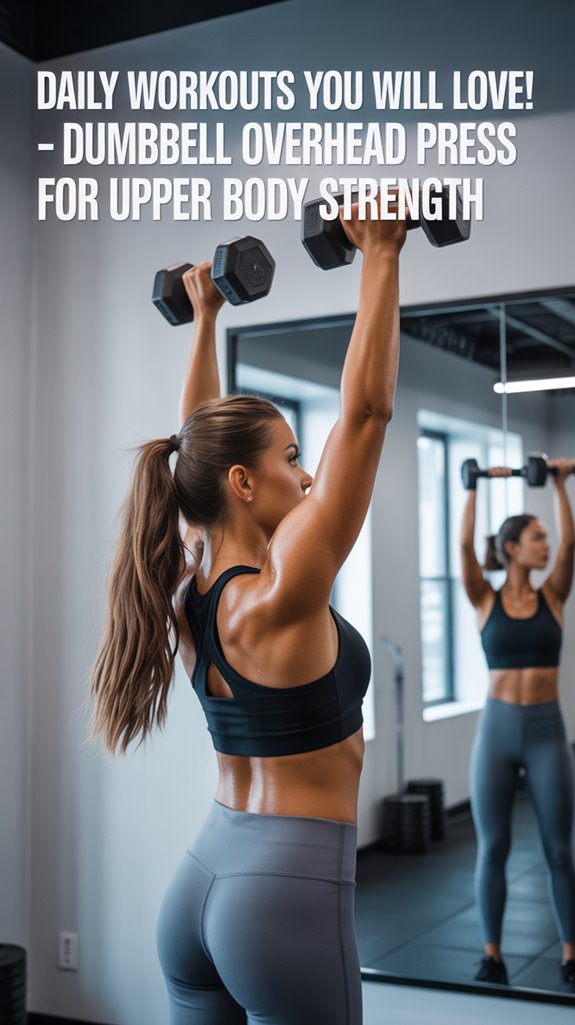
The dumbbell overhead press delivers targeted upper body development by emphasizing your anterior and medial deltoids while simultaneously engaging your triceps brachii as primary movers. You’ll also recruit your upper pectorals as stabilizers and activate your core throughout the movement. Including a mix of complementary arm workouts can keep training varied and effective for consistent progress arm workouts you will love.
Optimal execution requires three technical fundamentals:
- Positioning: Sit with neutral spine, dumbbells at shoulder height, elbows positioned at 45 degrees from your torso
- Pressing mechanics: Drive weights overhead with controlled tempo, maintaining shoulder stability by avoiding full elbow lockout. Shrug shoulders towards the ceiling at the top of the movement to maximize deltoid engagement and complete the range of motion.
- Eccentric control: Lower dumbbells slowly to 90-degree elbow angle, preventing shoulder impingement
For arm hypertrophy and strength gains, you’ll progress from 8–12 reps with moderate loads to 4–6 reps with heavier dumbbells. Train this movement 2–3 times weekly for measurable development.
Bent-Over Barbell Rows for Back Development
Bent-over barbell rows target your entire posterior chain with a compound pulling movement that builds both back thickness and width. You’ll achieve ideal muscle activation by maintaining a 30-45 degree torso angle, which balances recruitment between your lats, traps, and rhomboids while minimizing lower back strain.
Master these form techniques: hinge at your hips with a neutral spine, brace your core throughout, and pull the barbell toward your lower abdomen with elbows tracking close to your body. Control the eccentric phase to maximize time under tension. Experiment with grip variations—overhand emphasizes your upper back and rear delts, while underhand increases biceps and lat engagement. This compound exercise promotes increased bone density through consistent resistance training, delivering superior skeletal benefits compared to aerobic activities. For unilateral development, incorporate single-arm rows to address imbalances and achieve greater range of motion without compromising spinal position.
Pushups and Plank Variations for Core Stability
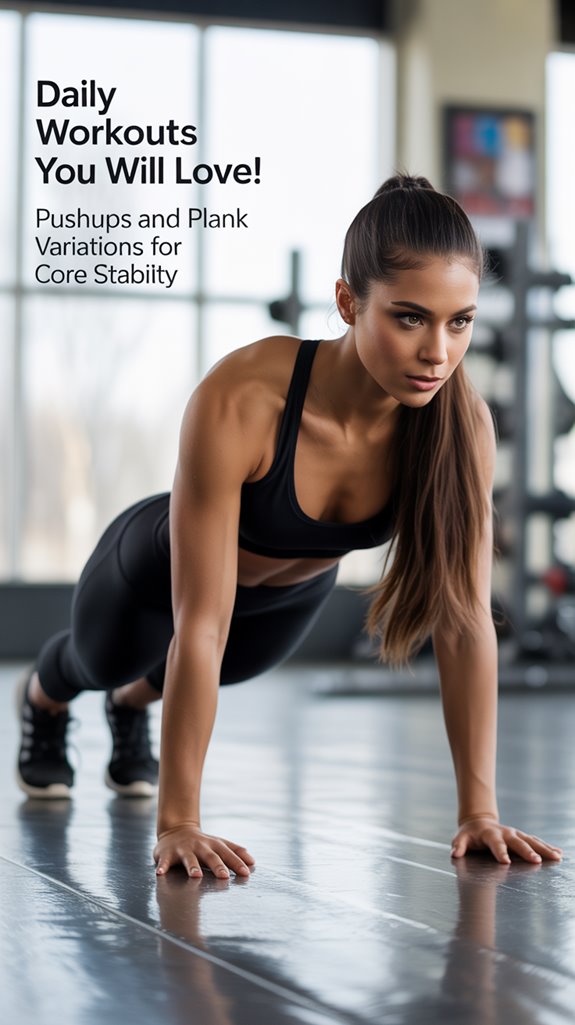
Core stability forms the foundation of every compound movement in your training arsenal, and pushups combined with plank variations deliver unmatched efficiency for building that foundation. These pushup variations and plank dynamics transform static holds into powerful stability training tools that demand total muscle engagement.
Essential Variations for Maximum Core Activation:
- Spiderman Pushups – Drive your knee to elbow, targeting obliques and hip flexors with deliberate oblique focus
- RKC Planks – Generate maximal tension throughout your entire body for rapid core strength gains
- Two-Point Pushup Planks – Lift opposing limbs simultaneously, challenging deep stabilizers and upper body stability
Progress through forearm-to-high plank shifts for endurance building, then integrate shoulder taps for anti-rotation work. These functional movement patterns enhance athletic performance while strengthening shoulder stabilizers, reducing injury risk during compound lifts. The forearm plank serves as your foundational exercise, engaging abs, obliques, and lower back while you maintain proper alignment from ankles to shoulders.
Walking Lunges for Lower Body Power
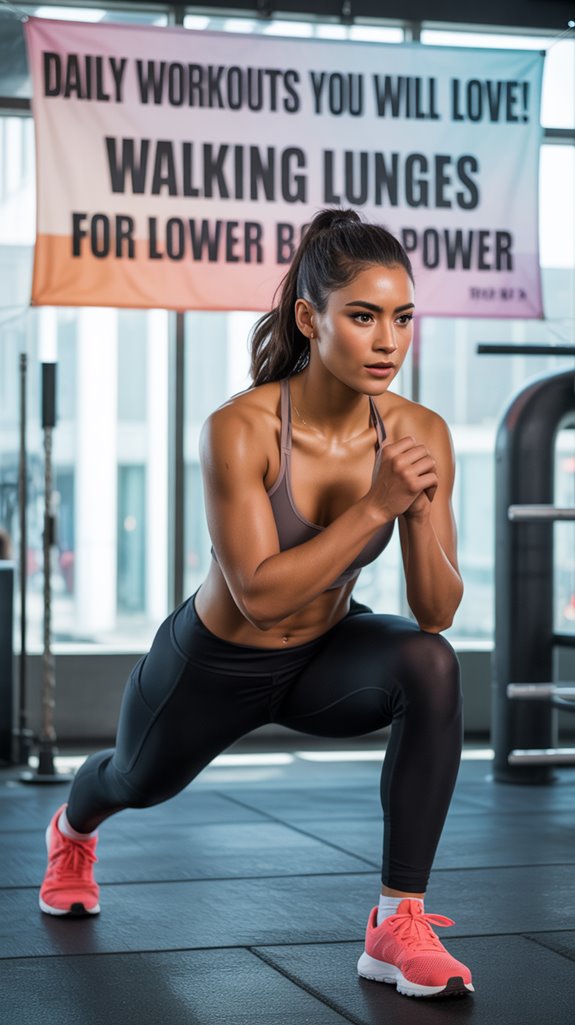
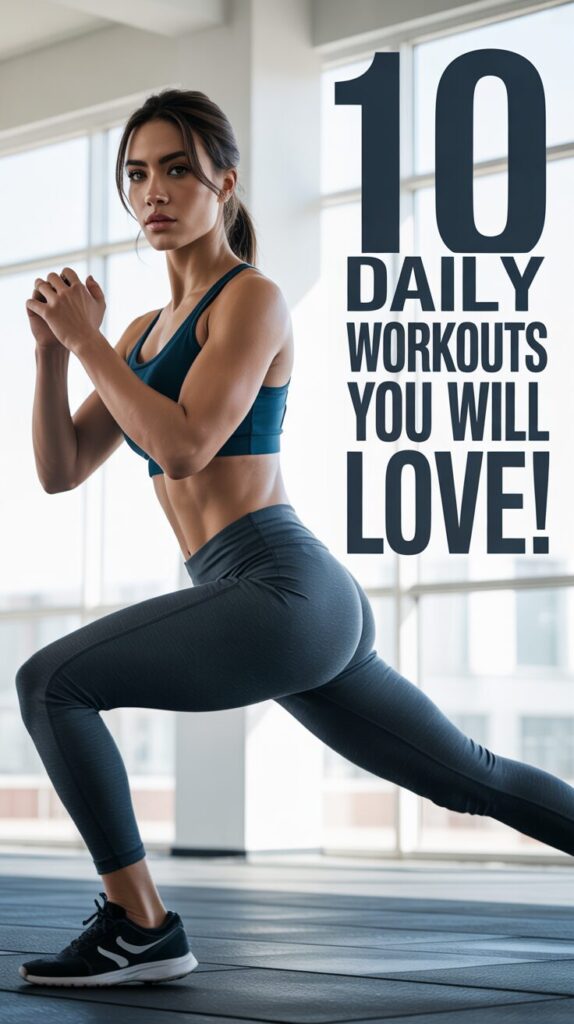
While upper body stability creates your training foundation, lower body power propels you through every athletic endeavor and daily activity. Walking lunges deliver unmatched muscle recruitment across your quadriceps, hamstrings, glutes, and calves while simultaneously engaging stabilizers around your knees and ankles. You’ll challenge your balance and proprioception with each unilateral step, forcing enhanced neuromuscular coordination that translates directly to real-world movements like climbing stairs and sprinting.
The continuous core engagement required maintains proper posture throughout the movement pattern, while the dynamic hip flexor stretch counteracts sitting-induced tightness. You can explore lunges variations by adding dumbbells to amplify resistance, elevating your heart rate and metabolic burn. Walking lunges promote muscle hypertrophy through progressive overload when you consistently increase resistance and volume over time. This compound exercise strengthens connective tissues, reduces muscle imbalances, and builds joint resilience—protecting your lower body while developing explosive power for peak performance.
Dead Bug Exercise for Deep Core Activation
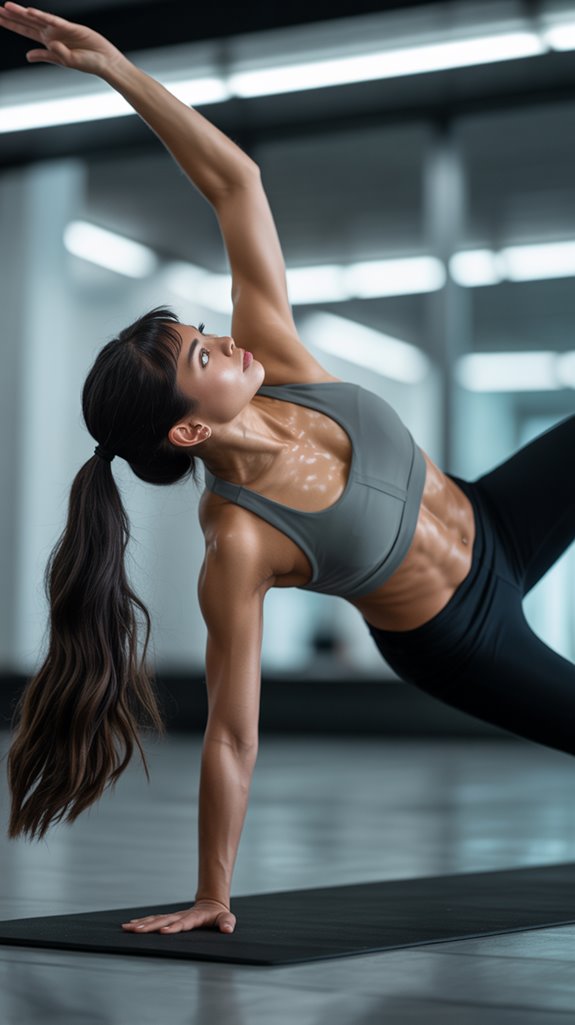
Your body’s deepest core muscles—the transverse abdominis, multifidus, and pelvic floor—don’t respond well to traditional crunches and sit-ups that primarily target superficial layers. The dead bug exercise provides superior core stability through anti-extension and anti-rotation work while maintaining lumbar-floor contact.
Execution Protocol:
- Lie supine with arms extended toward ceiling, knees and hips flexed to 90°
- Press lower back into floor, then extend opposite arm overhead while straightening opposite leg
- Return to start position and alternate sides with controlled tempo
This movement pattern forms the foundation of rehabilitation strategies for low back pain, systematically strengthening stabilizers without excessive spinal loading. You’ll enhance neuromuscular coordination, postural alignment, and functional movement performance—making it indispensable for both therapeutic recovery and athletic development. The exercise proves particularly beneficial for swimmers and athletes requiring rotational control and spinal stabilization during dynamic movements.
Pistol Squats for Advanced Leg Strength
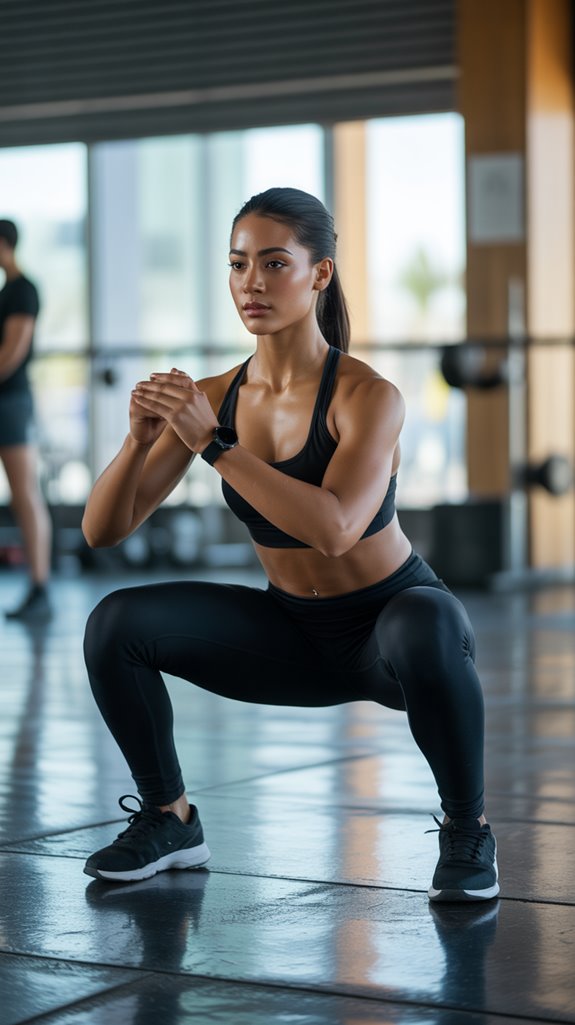
Because bilateral exercises allow your stronger leg to compensate for the weaker one, they often mask significant strength imbalances that compromise athletic performance and increase injury risk. Pistol squats eliminate this compensation by forcing each leg to develop strength independently while simultaneously challenging your balance and proprioception throughout the movement.
You’ll build exceptional hip and knee joint control as you descend below parallel, requiring deep hip flexion and ankle dorsiflexion that most bilateral movements don’t demand. These unilateral leg workouts strengthen stabilizing muscles around your knees and ankles without the spinal compression of loaded back squats. The movement engages multiple muscle groups including your quadriceps, gluteus maximus, hamstrings, adductors, and calves as primary movers.
The equipment-free nature means you can execute pistol squat variations anywhere. You’ll restore functional range of motion through your posterior chain while developing the coordination and core stability necessary for advanced athletic performance.
Cable Crunches and Face Pulls for Balanced Training
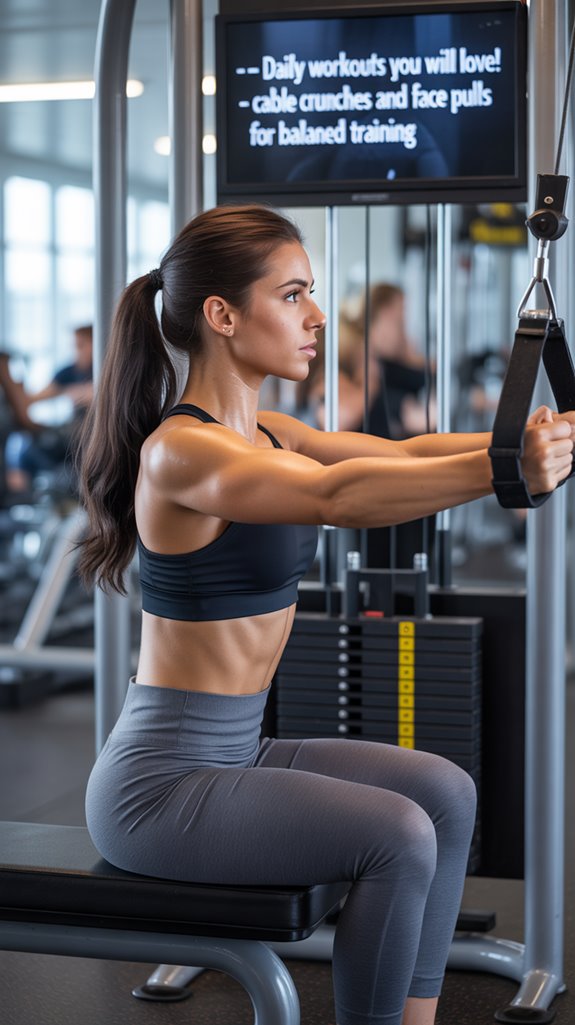
Most training programs inadvertently create muscle imbalances through excessive pushing movements—bench presses, overhead presses, and push-ups dominate typical workout routines while pulling exercises receive inadequate attention. You’ll correct this imbalance through strategic cable work targeting your posterior chain and core.
Cable crunches benefits include progressive overload capability for your abdominals, while face pulls technique strengthens your rear deltoids and rotator cuff muscles. Position the rope at eye-level, maintain a neutral grip with palms inward, and drive your elbows high and backward. Face pulls uniquely develop upper back strength without fatiguing other muscle groups, allowing you to maintain training intensity across your session.
Execute face pulls with these parameters:
- Three sets of 12-15 repetitions with 2:1 eccentric-concentric ratio
- Maximize scapular retraction by bringing hands toward temples
- Hold peak contraction for 1-2 seconds while separating rope around your face
This combination reduces shoulder injury risk by 69% while building foundational strength for compound lifts.
At-Home Bodyweight Circuit Training
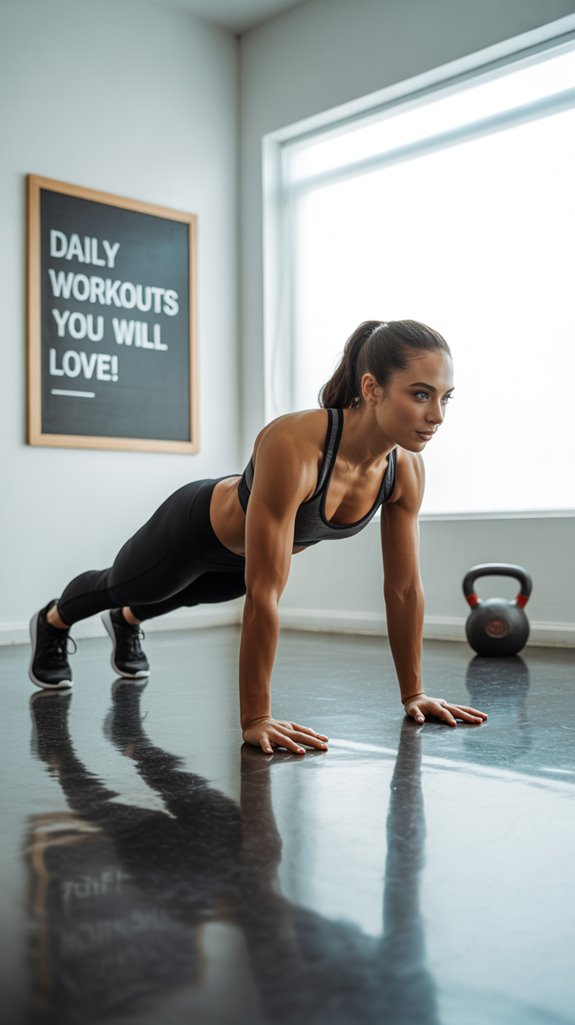
When equipment access becomes limited or gym memberships aren’t feasible, bodyweight circuit training delivers extensive fitness improvements without requiring specialized tools or dedicated workout spaces. You’ll achieve a 4.3% reduction in fat mass and 1.9% increase in muscle mass through structured protocols, while VO2max improves by 6.3%. Upper body strength increases 20%, lower body 23%, even without external resistance. Circuit variations combining push-ups, squats, planks, and jumping movements provide full-body engagement with maximal muscle fiber recruitment during short rest intervals. Sessions as brief as 11 minutes produce measurable adaptations when performed three times weekly at moderate-to-high intensity. This time-efficient approach maintains workout motivation through exercise diversity while adapting seamlessly to any fitness level, making progressive overload achievable through tempo adjustments and movement complexity rather than equipment dependency. Training programs typically incorporate 6 to 14 exercises per session, allowing you to customize workout complexity based on your current capabilities and available time while ensuring comprehensive muscle group activation.
Conclusion
You’ve got nine proven workouts that’ll transform your fitness—no excuses about needing fancy equipment or hours of free time. Yes, some exercises like pistol squats seem intimidating at first, but that’s exactly why we’ve included progressions for every fitness level. You can start where you are and build up gradually. Pick three workouts from this list, commit to them this week, and you’ll notice real changes in your strength, endurance, and confidence.