
This post contains affiliate links. As an Amazon Associate I earn from qualifying purchases.
Cable machines offer you constant tension throughout every rep, making them ideal for building muscle while protecting your joints. You’ll love exercises like cable chest flys for sculpted pecs, face pulls for rear delts and rotator cuff health, woodchoppers for rotational power, and pull-throughs for posterior chain strength. Add lat pulldowns for back width, Pallof presses for core stability, and lateral raises for broader shoulders. These movements translate directly to real-world functionality and athletic performance, and there’s much more to discover about perfecting your technique.
Key Takeaways
- Cable chest flys isolate pectoral muscles through constant tension and allow independent side work for improved symmetry and reduced joint strain.
- Cable face pulls target rear deltoids and rotator cuff muscles, addressing posterior shoulder weakness with controlled 12-20 rep sets.
- Cable woodchoppers develop rotational power through torso rotation and hip pivoting, translating strength to sports like golf and tennis.
- Cable pull-throughs strengthen glutes, hamstrings, and erector spinae safely using hip-hinge patterns without heavy barbell loading.
- Cable Pallof presses build core stability by resisting rotational forces, activating deep stabilizers while maintaining strict spinal alignment.
Cable Chest Fly for Sculpted Pecs and Strong Shoulders
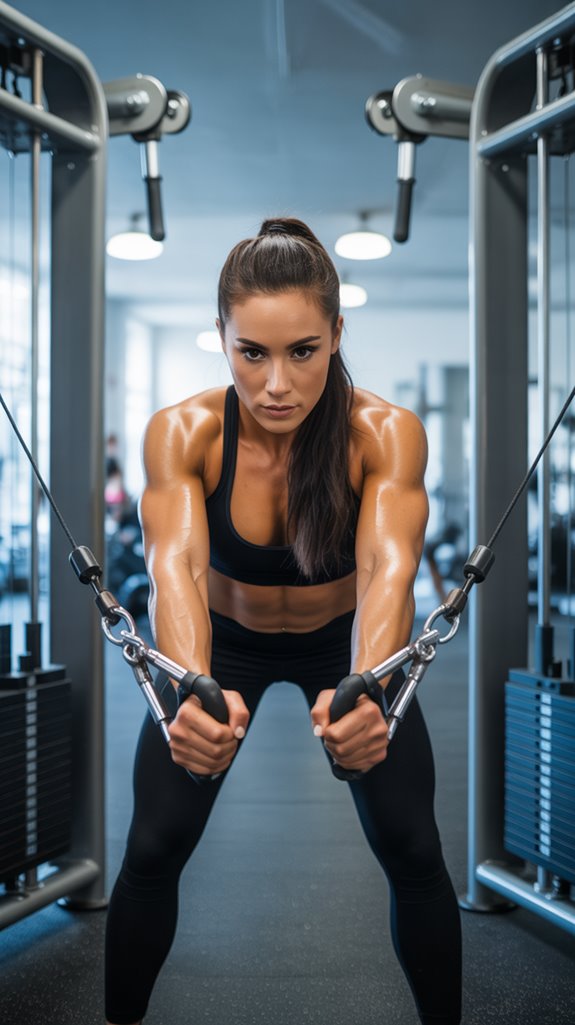
The cable chest fly stands apart from traditional pressing movements by isolating your pectoral muscles through a sweeping arc motion that maintains constant tension from start to finish. This exceptional muscle isolation recruits more fibers while reducing joint strain compared to heavy presses, making it ideal for joint safety without sacrificing results. You’ll develop superior chest symmetry since each side works independently, correcting imbalances that compound pressing can’t address.
Master the technique by setting cable angles at chest height, maintaining slightly bent elbows, and retracting your scapulae throughout. Your deltoids and rotator cuff stabilize the movement while your core engages for control. The stretched position of your chest muscles during the fly enhances muscle engagement more effectively than standard bench pressing movements. Explore workout variations through incline, flat, and decline positions to target every pec region. Whether standing or seated, this versatile exercise delivers thorough chest development. Many fitness enthusiasts also include multiple cable exercises in their routines to ensure comprehensive strength and stability benefits.
Cable Face Pull to Build Rear Delts and Protect Your Rotator Cuff
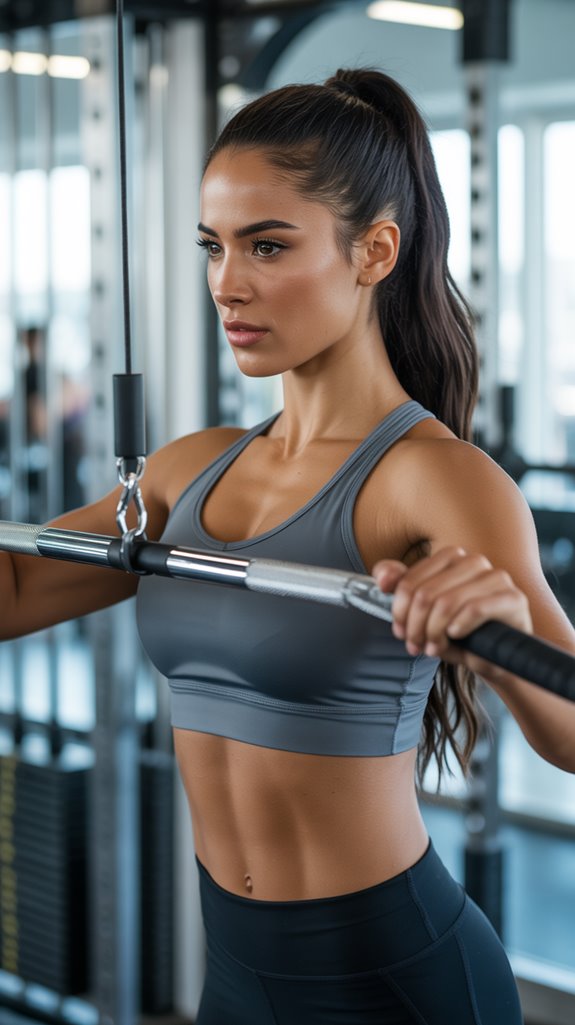
Set the rope attachment at head height and pull toward your forehead with elbows flared high. You’ll maximize muscle recruitment by externally rotating at the finish, pointing your thumbs behind you while squeezing your shoulder blades together. Control trumps load here—lighter weight with pristine form produces superior results. These exercises fit well into full body workouts you can do at home, providing balanced strength and convenience.
Program 3-4 sets of 12-20 reps after your pressing work. This strategic placement prevents fatigue from compromising compound lifts while addressing the posterior shoulder weakness that plagues desk workers and athletes alike. Face pulls enhance shoulder health and stability, making them an essential complement to heavy pressing movements.
Cable Woodchopper for Explosive Rotational Power
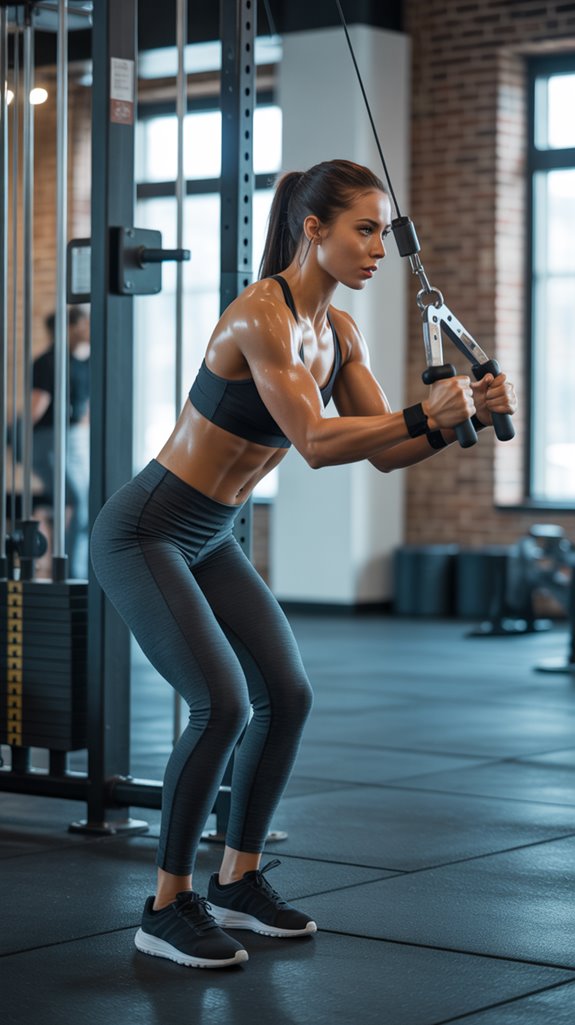
Execute 8–12 reps per side for 2–4 sets. Keep arms extended but not locked, pivot your rear foot, and rotate hips with torso. Control the cable’s resistance back to starting position. Exhale while pulling downward to maximize core engagement and power generation throughout the diagonal movement. This movement translates directly to golf swings, tennis serves, baseball throws, and martial arts strikes. Incorporate this exercise into your routine for balanced upper body development and improved functional strength.
Cable Pull-Through to Strengthen Your Posterior Chain
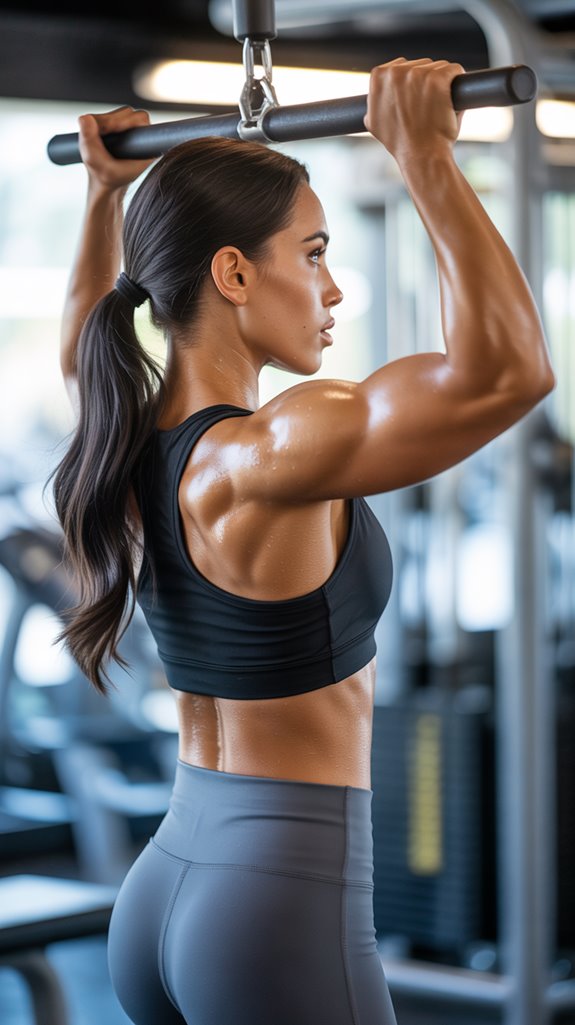
When you’re looking to build explosive strength without overtaxing your spine, cable pull-throughs deliver targeted posterior chain development that’s safer than heavy barbell movements. You’ll activate your glutes, hamstrings, and erector spinae through a hip-hinge pattern that translates directly to deadlifts and athletic performance.
Set up with the rope at knee height, facing away from the machine. Hinge at your hips while maintaining straight arms and a neutral spine, letting the rope pass between your legs. Drive forward explosively with your glutes—not your arms—ensuring continuous cable tension throughout each rep. The movement maintains constant muscle tension throughout, which enhances your time under tension for superior muscle development.
Maximize muscle activation by performing 8-15 controlled repetitions, pausing briefly at full hip extension. You’ll strengthen your posterior chain while minimizing lower back strain, making this movement essential for both performance gains and injury prevention.
Cable Lat Pulldown for a Wider, Stronger Back
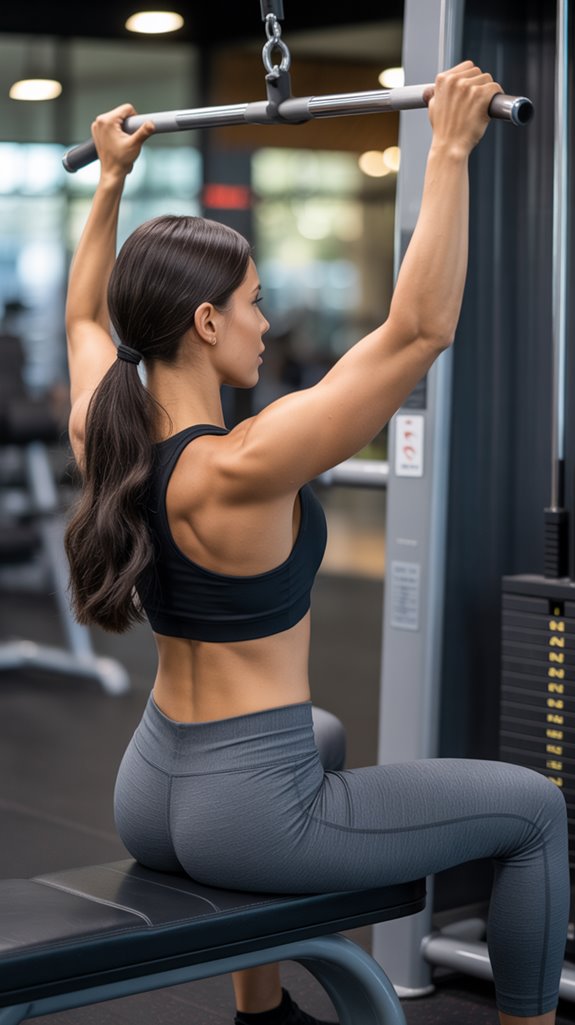
If you’re serious about building an impressive V-taper and raw pulling strength, the cable lat pulldown stands as one of the most effective exercises in your arsenal. This movement primarily targets your latissimus dorsi while recruiting biceps, teres major, and rhomboids for thorough upper body development.
Execute each rep with deliberate control—pull the bar to your upper chest only, extend fully at the top, and lead with your elbows to maximize lat activation. Avoid momentum and excessive backward lean, which compromise muscle engagement and shift tension away from target areas. Keep your core engaged throughout the movement to prevent excessive spine arching and maintain proper form.
The adjustable resistance enables systematic strength progression, making it ideal whether you’re building toward pull-ups or refining advanced pulling patterns. Vary your grip width and angles to stimulate complete back development and enhance functional performance across athletic disciplines.
Cable Biceps Curl for Constant Tension Arm Growth
Cable biceps curls deliver unrelenting tension that standard dumbbell variations simply can’t match, making them exceptionally effective for building thick, peaked arms. Position yourself with a shoulder-width grip, maintaining an athletic stance with your core locked tight. Keep your elbows pinned to your sides, arms slightly forward—critical bicep isolation techniques that prevent momentum stealing your gains. Squeeze the handle hard throughout each rep, flexing your triceps at full extension to pre-stretch the biceps. Hold the peak contraction for one second before controlling the descent. Explore cable curl variations like rope attachments for neutral grips or turn-away curls for enhanced time under tension. Avoid positioning too far from the machine, which forces elbows high and diminishes contraction quality. The constant resistance eliminates cheating, demanding pure muscular work. Unlike free weights, cables maintain consistent resistance throughout the entire range of motion, unaffected by gravity’s changing leverage points.
Cable Triceps Pushdown for Defined Arms
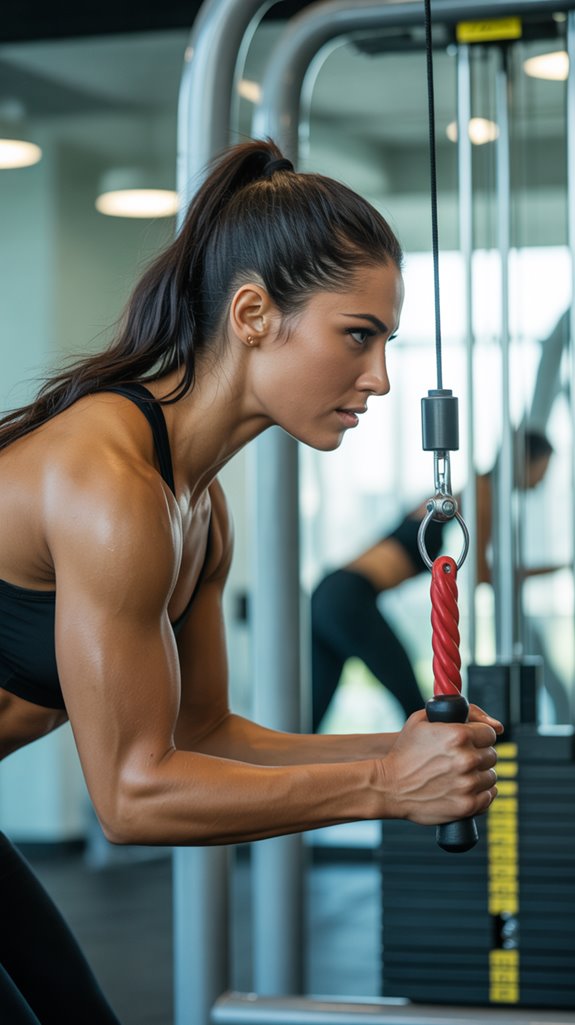
Lock your elbows to your sides and press down with controlled force—cable triceps pushdowns transform the back of your arms through constant tension that dumbbells can’t replicate. This isolation movement targets all three triceps heads, which comprise two-thirds of your upper arm mass, making it essential for complete arm development.
Master the setup: position elbows stationary by your torso, maintaining a slight forward lean. Execute full range of motion from complete stretch to locked-out contraction—partial reps waste your potential. Understanding triceps anatomy reveals why only your forearms should move; any shoulder involvement diminishes muscle engagement. Keep your chest stuck out while retracting your shoulder blades to press down maximum weight without feeling the cable pull your body upward.
Prioritize squeeze-and-stretch technique over heavy loads. Pause deliberately at both contraction and stretch phases, controlling eccentric and concentric movements. Program 10-15 reps across 2-3 sets, progressively overloading for measurable definition gains.
Cable Squat to Press for Full-Body Functional Strength
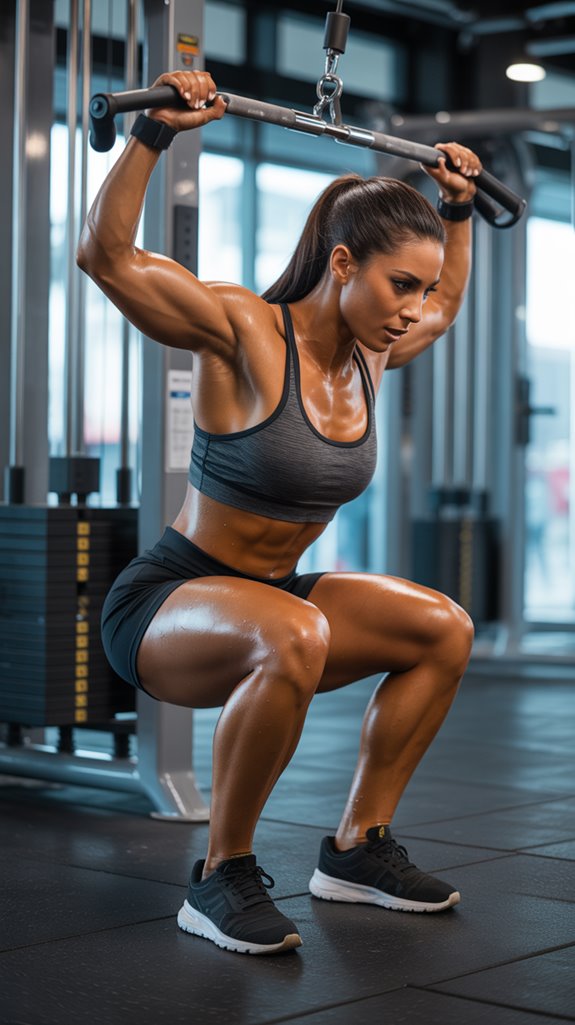
Combine explosive lower-body power with overhead pressing strength—the cable squat to press delivers thorough functional development that translates directly to real-world movements like lifting groceries or hoisting luggage overhead.
This functional fitness exercise simultaneously activates your quads, glutes, hamstrings, core, and shoulders while maintaining constant cable tension throughout the movement. You’ll develop balance, coordination, and hip stability that enhances daily functionality.
Key execution points for ideal strength training results:
- Maintain neutral spine positioning and flat foot contact throughout the squat descent
- Align knees with your second and third toes to prevent joint strain
- Drive explosively through your heels while pressing cables overhead in one fluid motion
The adjustable cable system lets you scale resistance progressively, targeting specific deltoid regions while building extensive muscle activation patterns that maximize caloric expenditure and lean mass development. This exercise enhances core and knee stability through the dynamic pressing motion combined with the squatting pattern.
Cable Pallof Press for Unshakeable Core Stability
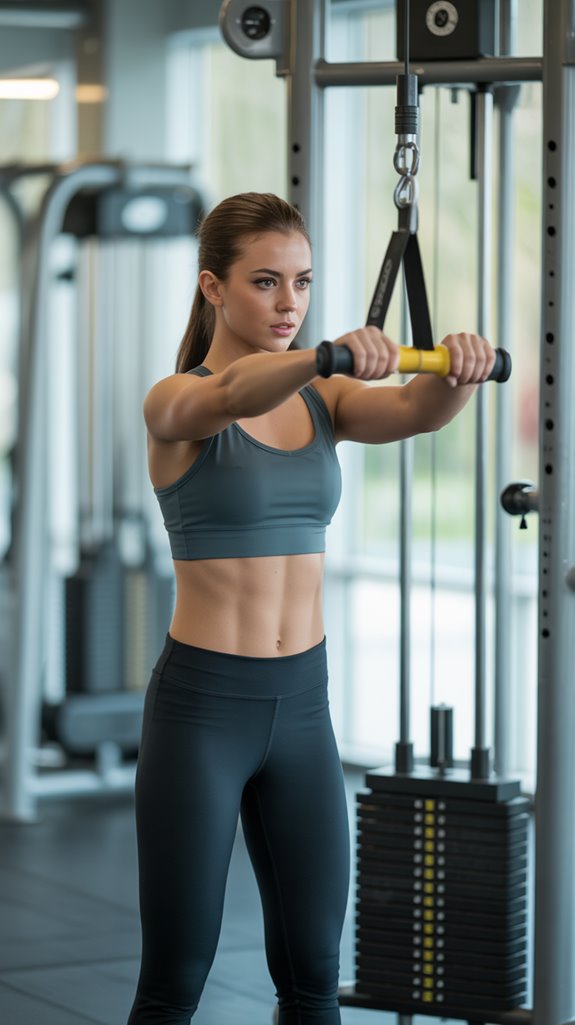
The Pallof Press transforms your core into an unyielding pillar of stability by forcing your midsection to resist rotational forces that constantly attempt to pull your torso sideways. You’ll activate deep stabilizers like your transverse abdominis and obliques while maintaining strict spinal alignment under load. This anti-rotation stimulus differs entirely from traditional flexion-based movements, building functional strength that transfers directly to compound lifts and athletic performance.
Set the cable at chest height and focus on controlled pressing while resisting external rotation. Your core engagement intensifies as you extend the handle away from your body, challenging reflexive bracing patterns essential for explosive movements. Proper movement mechanics require a neutral spine and stacked shoulders throughout each repetition. You’ll strengthen the musculature supporting your spine, reducing lower back injury risk while enhancing total-body coordination and posture resilience. The exercise mimics real-life movements that require resistance to various forces, making it exceptionally effective for functional training applications.
Cable Lateral Raise for Broader, Rounder Shoulders
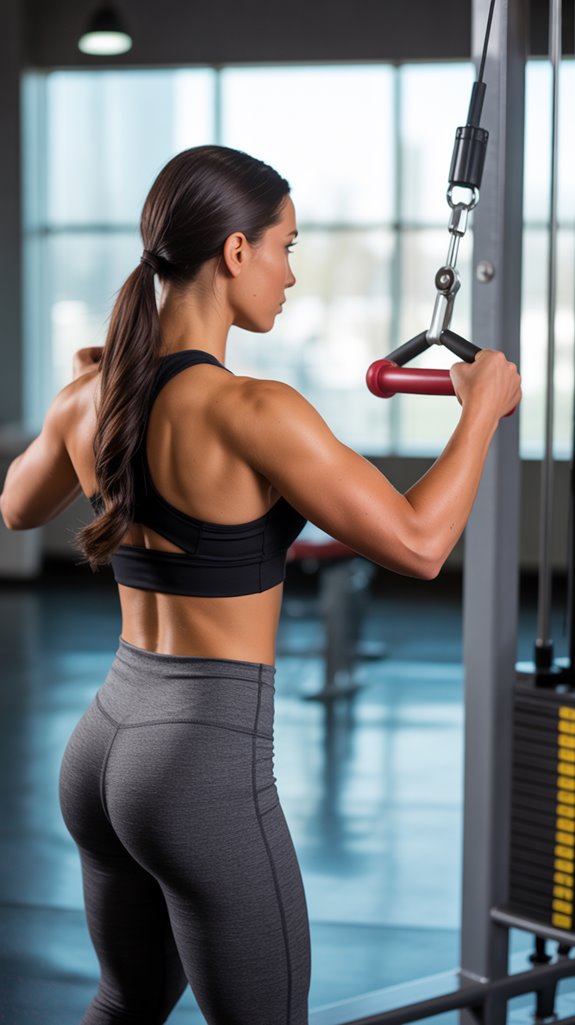
When you’re chasing that coveted V-taper physique, cable lateral raises deliver precisely targeted resistance that transforms ordinary shoulders into sculpted, three-dimensional deltoids. This movement excels at shoulder isolation through constant tension mechanics that dumbbells simply can’t match, particularly at the bottom and midpoint ranges where muscle activation peaks.
Critical execution fundamentals:
- Position your cable pulley at the lowest setting, stand side-on with feet shoulder-width apart, maintaining slight forward torso lean
- Cross your working arm in front of your body with 10–30-degree elbow bend, raising smoothly to shoulder height while keeping your little finger slightly elevated
- Control the eccentric phase deliberately, implementing 1–5 second pauses at peak contraction to maximize time under tension
Select lighter loads that preserve strict form—momentum sabotages lateral deltoid recruitment and compromises joint integrity. This exercise specifically targets the middle deltoid head, which is essential for creating that wider, more pronounced shoulder appearance that enhances your overall upper body aesthetics.
Conclusion
You’ve got your blueprint—now it’s time to build your temple. Like Michelangelo chipping away at marble, you’ll sculpt your physique one rep at a time with these cable exercises. Don’t let these movements gather dust in your mental gym bag. The cable machine isn’t just equipment; it’s your chisel, your paintbrush, your instrument. Pick it up, get to work, and transform that block of potential into your masterpiece. Your David awaits.