This post contains affiliate links. As an Amazon Associate I earn from qualifying purchases.
You’ll love these 10 bodyweight workouts that deliver results without equipment: Full-Body Burner Circuit links 4–8 exercises for maximum calorie burn, while Core Crusher Challenge strengthens your midsection in just 10–15 minutes. Lower Body Power Builder develops explosive leg strength, and Upper Body Push Protocol perfects your push-up variations. Explosive Cardio Blast torches fat through high-intensity intervals, and Glute Activation Sequence awakens your body’s largest muscle group. Dynamic Stability Workout enhances balance, Unilateral Strength Session corrects imbalances, and Total Body HIIT Finisher elevates your metabolism for up to 38 hours. Discover how each workout transforms your fitness journey.
Key Takeaways
- Full-Body Burner Circuit links 4–8 exercises with minimal rest, building muscular endurance and cardiovascular fitness in 2–3 weekly sessions.
- Explosive Cardio Blast uses high-intensity intervals like burpees and jump squats, burning calories and elevating metabolism for hours post-workout.
- Core Crusher Challenge offers 10–15-minute bodyweight circuits accessible for all fitness levels, requiring no equipment for consistent training.
- Lower Body Power Builder develops explosive strength through squat and lunge variations, targeting posterior chain with plyometric exercises.
- Dynamic Stability Workout reduces fall risk by 46–48% while strengthening stabilizer muscles through single-leg and balance-focused movements.
Full-Body Burner Circuit
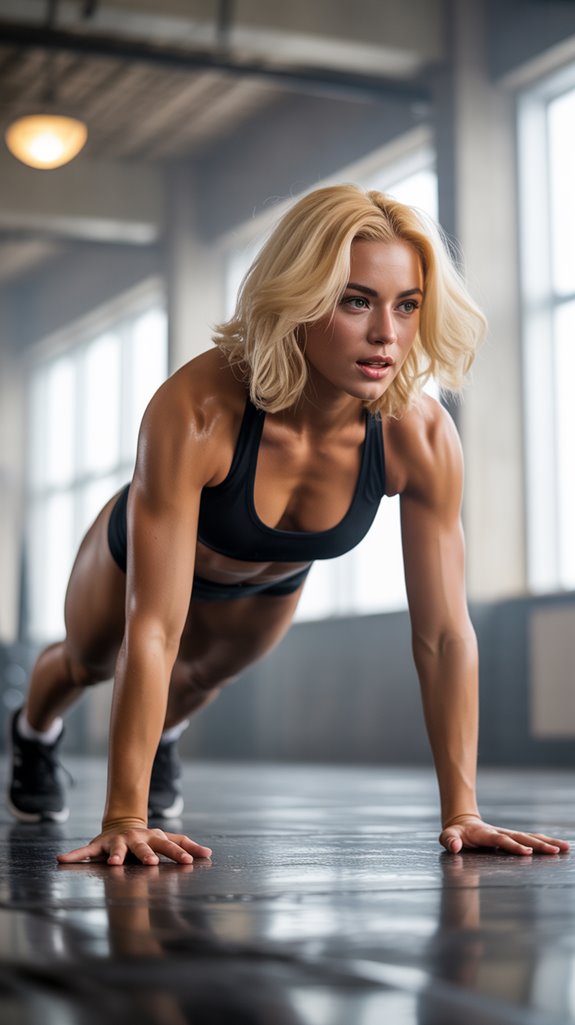
A full-body burner circuit delivers maximum results in minimum time by linking 4–8 exercises together with little to no rest between moves. You’ll perform each exercise for 30–45 seconds or a specific rep count before shifting immediately to the next. After completing all movements, you’ll rest 1–2 minutes, then repeat for 3–5 rounds total.
The circuit benefits extend beyond time efficiency. You’ll build muscular endurance, enhance cardiovascular fitness, and maximize calorie burn through strategic exercise variations. Structure your circuit with push-ups for upper body strength, squats and lunges for lower body power, and planks for core stability. Add burpees or mountain climbers to elevate intensity and engage multiple muscle groups simultaneously. You can progress by reducing rest periods, increasing rounds, or incorporating plyometric movements like jump squats and lunge jumps. For optimal results, schedule 2 to 3 sessions per week to allow adequate muscle recovery between workouts. This approachable format makes it easy to customize routines for all levels and enjoy consistent full-body gains with minimal equipment.
Core Crusher Challenge
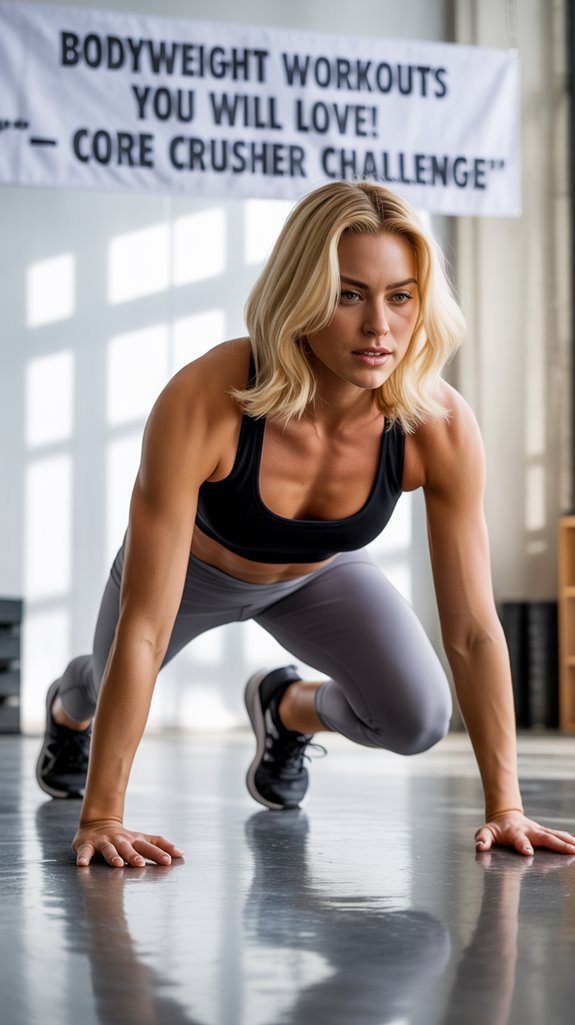
While full-body circuits build overall fitness, your core demands dedicated attention to develop the strength and stability that anchors every movement. The Core Crusher Challenge delivers targeted abdominal training through 10–15-minute circuits that maximize time under tension and muscle endurance. These short, focused sessions are accessible for every fitness level and encourage consistent practice.
You’ll cycle through bodyweight movements designed for complete core engagement:
- Hand-release push-ups with full chest-to-floor contact
- Butterfly sit-ups to minimize hip flexor dominance
- Penguins for oblique activation through alternating heel touches
- Russian twists targeting rotational strength
- Plank variations building anti-extension stability
Structure these as AMRAP formats or timed intervals—45 seconds work, 15 seconds rest. The equipment-free design removes barriers to consistency while the circuit structure burns calories and builds trunk rigidity essential for athletic performance and injury prevention. By lifting your hands off the ground at the bottom of each push-up, you eliminate momentum and force your muscles to generate maximum power on every repetition.
Lower Body Power Builder
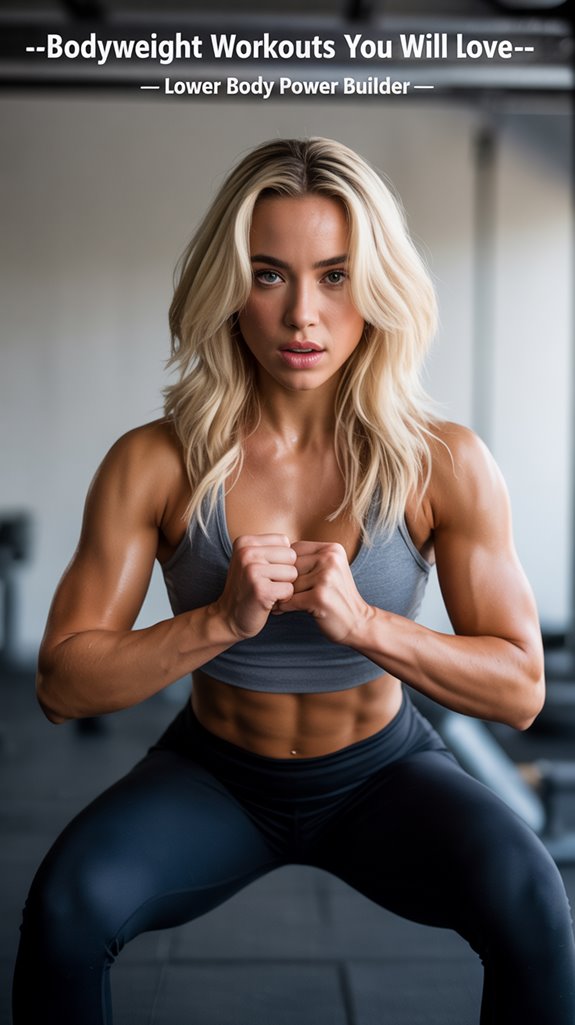
Strong legs generate the power that propels you through sprints, vertical jumps, and explosive changes of direction. Master squat variations like jump squaps and pistol squats to build explosive strength and unilateral control. Progress through lunge progressions from reverse lunges to Bulgarian split squats, developing functional athletic power. Perfect hinge mechanics with hip thrusts and Romanian deadlifts to dominate posterior chain development—your glutes and hamstrings drive hip extension power. Consistently practicing these movements with proper form builds toning and slimming effects alongside strength gains.
Integrate plyometric exercises including broad jumps, tuck jumps, and lateral bounds to maximize explosiveness and fast-twitch fiber recruitment. These movements translate directly to athletic performance. Lower body exercises like lunge jumps safeguard your joints while building strength and power through dynamic movement patterns. Layer in stability challenges like single-leg Romanian deadlifts and balance holds to strengthen stabilizing muscles and prevent injury.
Combine these elements strategically: squat patterns, hinge movements, plyometrics, and stability work create thorough lower body power development without equipment.
Upper Body Push Protocol

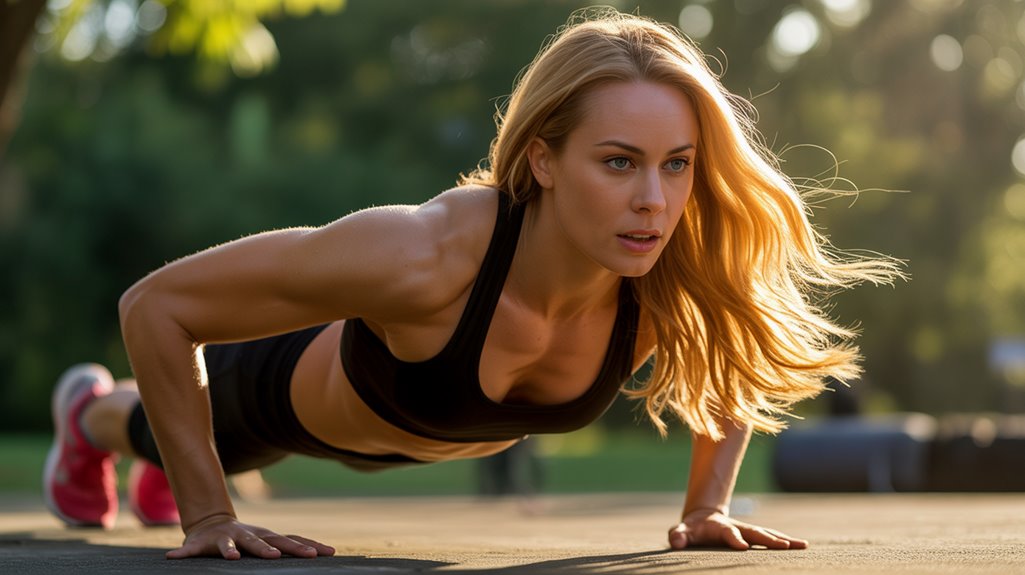
Push-ups and their variations form the foundation of your upper body pushing strength, targeting your chest, shoulders, and triceps through compound movements that require zero equipment. Master these progressions to release continuous adaptation and hypertrophy.
Essential push up variations for complete development:
- Standard push-up – Your baseline movement for chest and shoulder activation
- Diamond push-up – Maximizes triceps engagement through narrow hand positioning
- Pike push-up – Shifts load to shoulders, preparing you for handstand progressions
- Decline push-up – Intensifies upper chest recruitment and difficulty
- Incline push-up – Reduces load for volume accumulation and skill acquisition
Program 3–4 sets of 8–15 reps across 2–3 weekly sessions. Progress by advancing through variations rather than endlessly increasing reps. This approach builds functional strength while maintaining joint integrity and shoulder stability. Incorporating variety between unilateral and bilateral exercises prevents boredom and stimulates muscles differently.
Explosive Cardio Blast
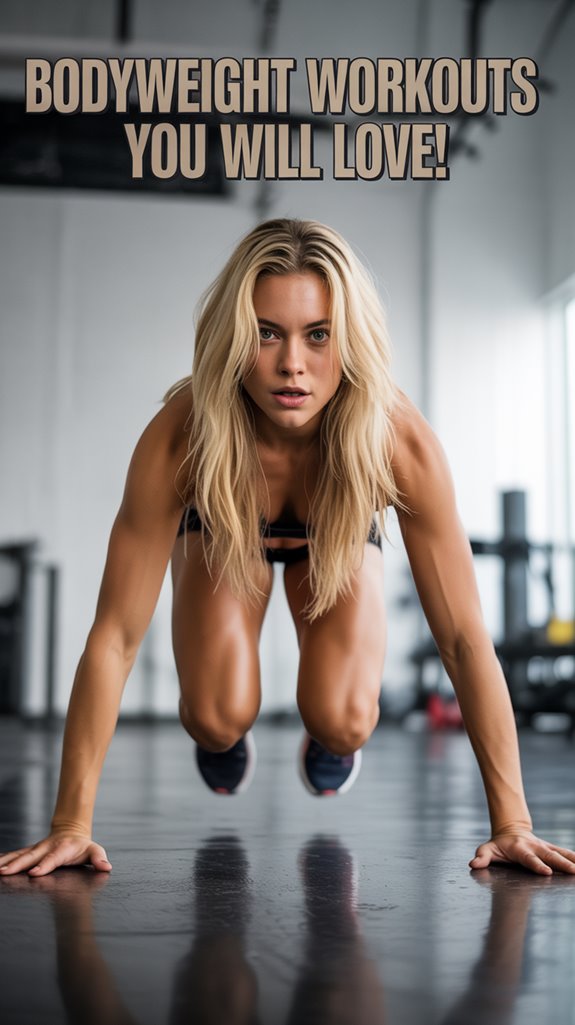
When your heart rate spikes above 85% of maximum and your muscles fire in rapid succession, you’re experiencing the metabolic demands that define explosive cardio training. You’ll execute high intensity intervals alternating 20–60 seconds of work with 10–30 seconds of rest, targeting both aerobic and anaerobic systems simultaneously.
Your protocol incorporates explosive movements like burpees, jump squats, and mountain climbers—exercises that recruit fast-twitch muscle fibers while maximizing calorie expenditure. The plyometric nature of these movements develops power, speed, and coordination beyond traditional steady-state cardio.
You’ll capitalize on EPOC, sustaining elevated metabolism post-workout for continued fat oxidation. Jump squats alone burn approximately 14 calories per minute, making them one of the most efficient movements for energy expenditure. This 15–30 minute format requires no equipment yet delivers superior cardiovascular adaptations, strength gains, and functional performance improvements. Progress by increasing movement velocity, interval duration, or exercise complexity.
Functional Mobility Flow
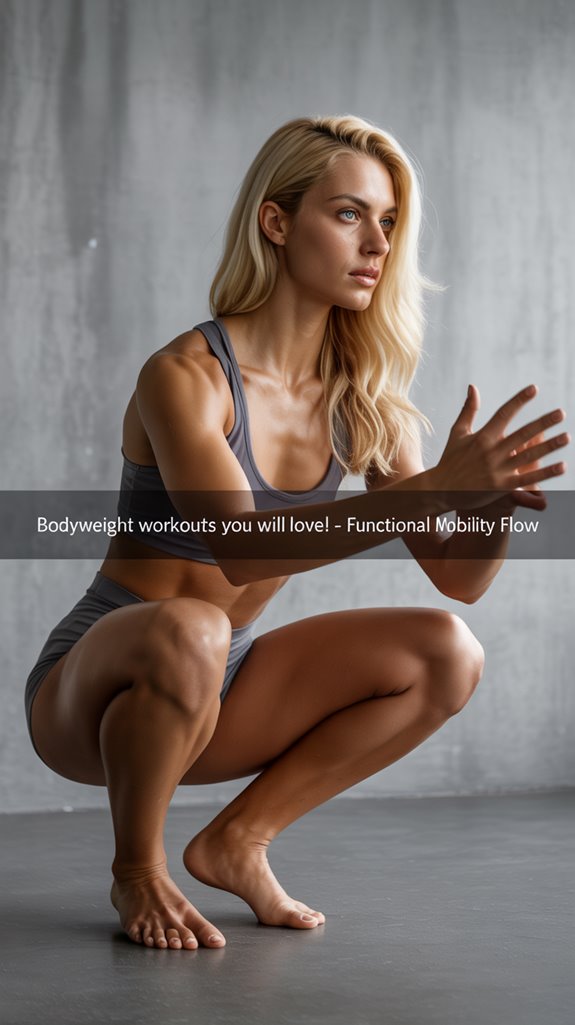
Through deliberate, controlled movements that challenge your joints across their full available range, functional mobility flow bridges the gap between static stretching and dynamic performance training. You’ll discover mobility benefits that extend beyond simple flexibility techniques, targeting the intricate relationship between strength, stability, and movement quality.
This approach delivers measurable advantages:
- Enhanced joint lubrication through synovial fluid production, protecting against degenerative conditions
- Improved neuromuscular coordination that translates directly to athletic power and agility
- Reduced compensatory movement patterns by addressing muscle imbalances and asymmetries
- Greater proprioceptive awareness for precise body control during complex movements
- Long-term independence through maintained functional capacity across your lifespan
You’re building a resilient movement foundation that supports both performance goals and daily living with exceptional efficiency. The practice requires minimal equipment, making it accessible whether you’re training at home, outdoors, or in a traditional gym setting.
Glute Activation Sequence
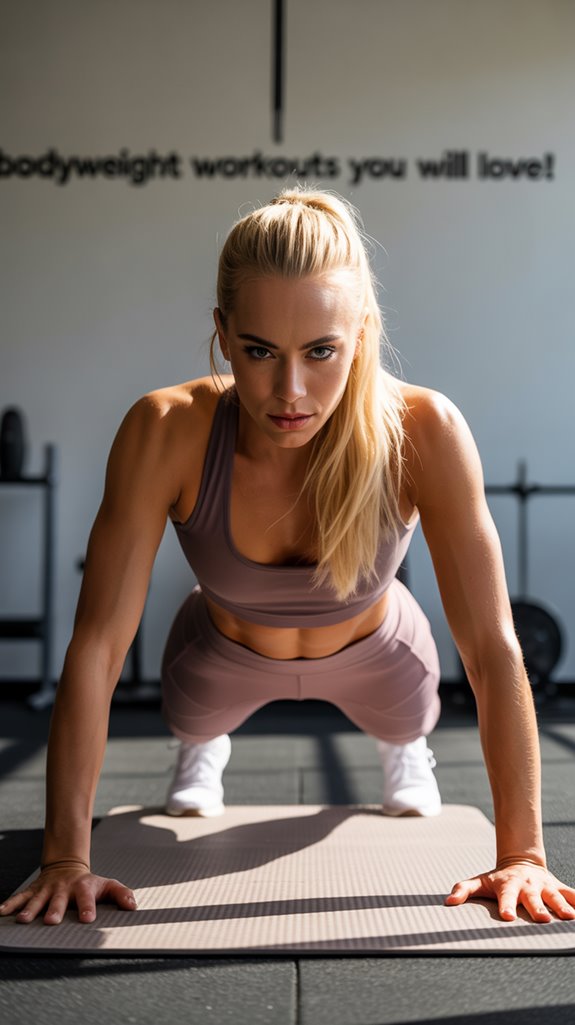
Your glutes—the body’s largest and most powerful muscle group—frequently remain dormant during everyday activities, creating a cascade of biomechanical dysfunction that undermines both athletic performance and injury prevention. Implementing targeted glute engagement techniques awakens these critical stabilizers before main training sessions.
Your activation sequence should incorporate glute bridges with isometric holds, clamshells for medius recruitment, and step-ups for dynamic integration. These muscle recruitment strategies enhance neural pathways, establishing mind-muscle connection that transfers directly to compound movements.
Execute 10-15 controlled repetitions per exercise, pausing at peak contraction to maximize motor unit activation. EMG studies confirm hip thrusts and step-ups generate superior glute engagement compared to traditional squats. This 5-10 minute protocol reduces compensatory patterns, fortifies hip stability, and greatly decreases lower back strain—particularly beneficial if you’re desk-bound. To achieve optimal growth, ensure you implement progressive overload by increasing resistance or repetitions weekly.
Dynamic Stability Workout

Balance challenges expose weaknesses that static exercises can’t address. Dynamic balance training targets your stabilizer muscles and proprioceptive systems through controlled, purposeful movement patterns. You’ll develop the reflexive strength needed for real-world demands—from preventing falls to enhancing athletic performance. Research demonstrates that fall risk reduces by 46-48% with consistent dynamic balance training.
Execute these stability exercises with precision:
- Single-Leg RDL: Hinge forward on one leg, emphasizing posterior chain control and hip stability
- Plank-to-Reach: Extend one arm forward while maintaining rigid core bracing and spinal alignment
- Lateral Bounds with Stick: Jump laterally, stabilizing the landing position for 3-5 seconds
- Walking Lunge with Overhead Arms: Step forward while holding arms overhead to challenge coordination
- Rotational Holds: Assume athletic stance, rotate torso against resistance while maintaining lower body position
Perform 2-3 sets of 8-10 controlled repetitions per side.
Unilateral Strength Session
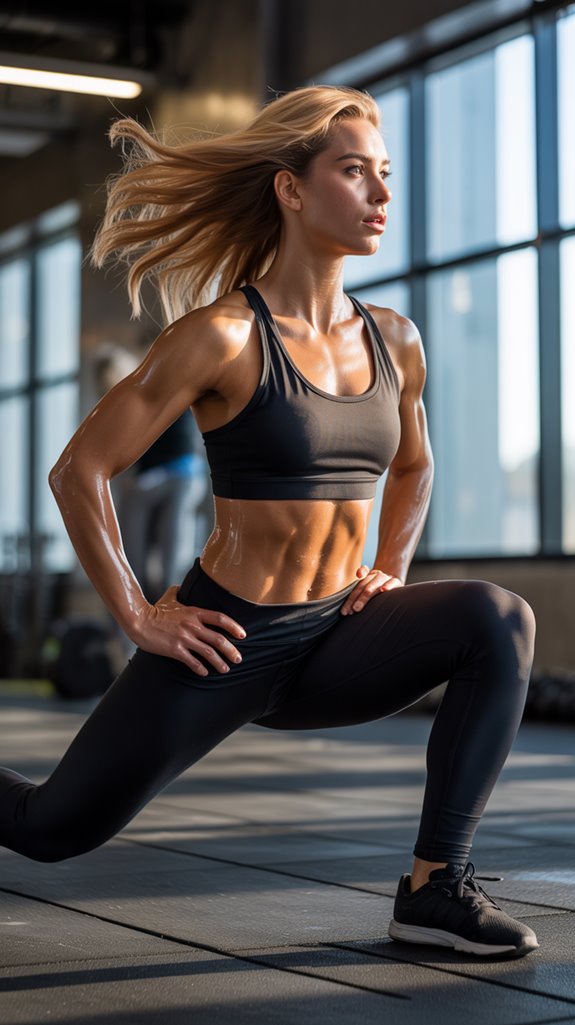
While bilateral exercises form the foundation of most strength programs, unilateral training reveals a different dimension of functional power by forcing each limb to carry the full load independently. You’ll immediately identify weaknesses that bilateral movements mask, as your dominant side can no longer compensate for imbalances. This exposure is vital—muscle symmetry directly reduces injury risk and enhances performance across all athletic endeavors.
Single-leg deadlifts, pistol squats, and one-arm push-ups demand exceptional core activation to counteract rotational forces. Your stabilizers work overtime, sharpening proprioception and balance while building functional strength that translates to real-world movements like sprinting and jumping. Unilateral loading places less spinal stress compared to bilateral exercises, allowing you to train heavy on one leg without the vertical compression that challenges your back. By addressing each limb separately, you’re not just building strength—you’re correcting asymmetries, fortifying joints, and developing the neuromuscular control that separates competent movers from elite performers.
Total Body HIIT Finisher
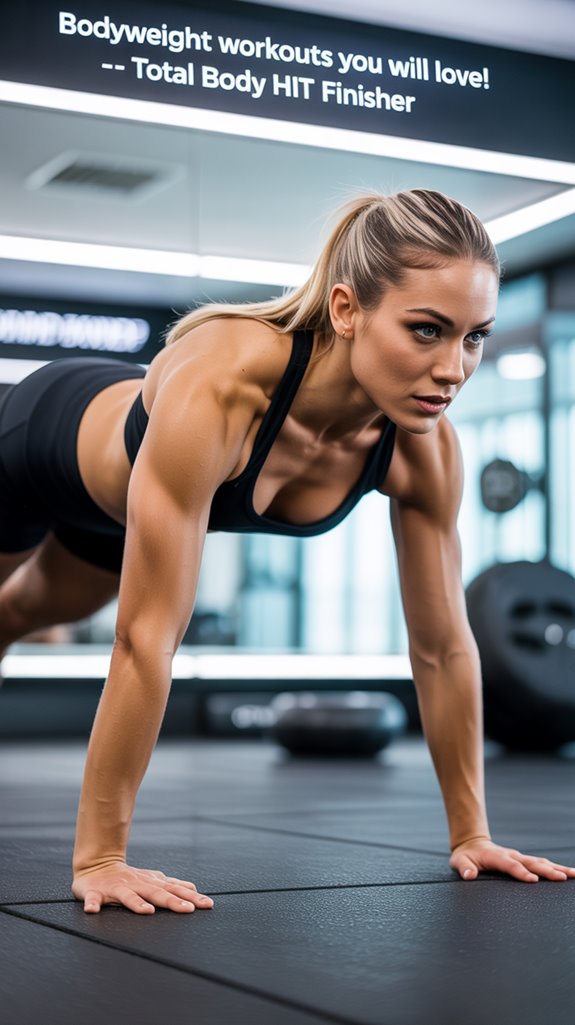
After you’ve completed your primary strength work and feel the satisfying burn of progressive overload, there’s one final opportunity to extract maximum adaptation from your training session. Total body HIIT finishers—those brutal 2-10 minute protocols—amplify HIIT benefits by triggering excess post-exercise oxygen consumption that burns calories for up to 38 hours post-workout while elevating metabolic rate by 30% beyond traditional cardio.
Strategic finisher selections for maximum effect:
- Burpee complexes performed at maximum repetitions within timed intervals
- Kettlebell swings executed with nearly all-out workout intensity
- Battle rope intervals challenging cardiovascular capacity and mental resilience
- Sprint protocols elevating heart rate through varied cardio-based work
- Circuit sequences utilizing bodyweight movements with minimal rest periods
You’ll build mental fortitude alongside physical conditioning, transforming workout capacity while processing increasingly demanding stimuli. These intense anaerobic protocols increase fast-twitch muscle fibers for enhanced strength and power development.
Conclusion
You’ve now got ten bodyweight workouts that’ll transform you into a Greek god—or at least someone who doesn’t wheeze climbing stairs. Your living room will become a torture chamber where you’ll question every life choice while planking. You’ll discover muscles you didn’t know existed, mostly through their screaming protests. But hey, at least you’re saving that gym membership money for the heating pads and ibuprofen you’ll desperately need tomorrow morning.